FINANCIAL GURKHA BLOGS
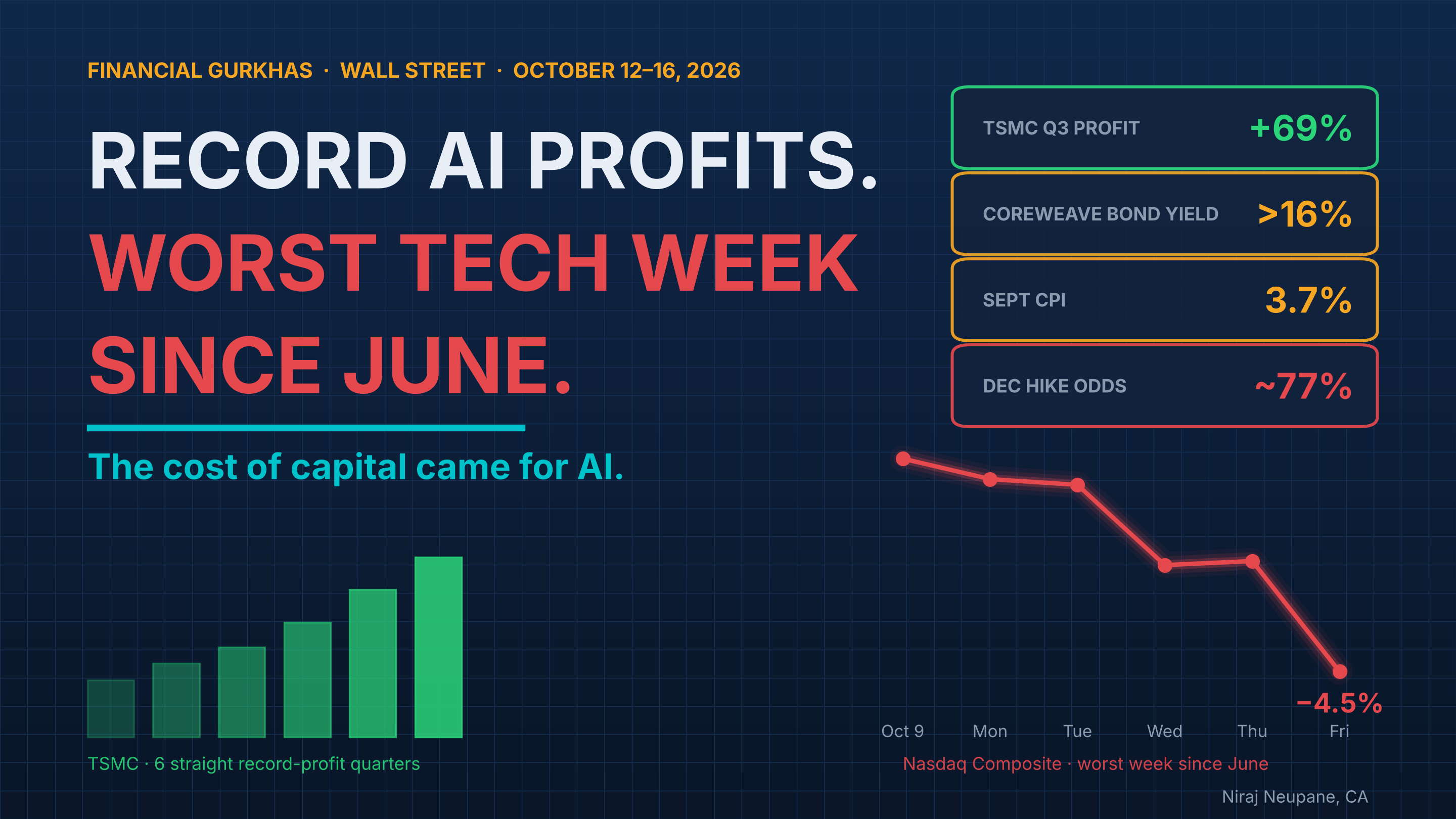
Record AI Profits, Worst Tech Week Since June: The Cost of Capital Came for AI
TSMC posted the biggest profit in its history on AI demand. In the same week, the Nasdaq fell 4.5% and an AI-infrastructure bond traded above 16%. Wall Street stopped asking whether AI demand is real, and started asking what it costs to finance it.
An Intrinsic Valuation of Rent the Runway (NASDAQ:RENT)
Revenue is growing, the debt got cut in half, losses are shrinking — and the stock sits near all-time lows at $1.72. Let's run the numbers honestly: what the filings say, what the debt deal cost shareholders, and what the arithmetic implies.

Trump Accounts Explained: The $1,000 Child Investment Accounts — SWOT and Cost-Benefit Analysis
Washington created 70 million investment accounts for American children this month. Here is a neutral, numbers-first breakdown: how they work, what they cost, what they can earn, and where the scheme is strong — and where it is not.

Britain's Welfare Bill Is Breaking the Budget — and the Bond Market Has Noticed
The OBR has welfare spending rising from £245 billion to £328 billion in six years. Borrowing is overshooting, the 10-year gilt yields 5.5%, and the IFS says the Chancellor needs £36 billion of tax rises or welfare cuts by October 28. How Britain compares to France — the welfare state that outspends everyone — and the rest of the G7.
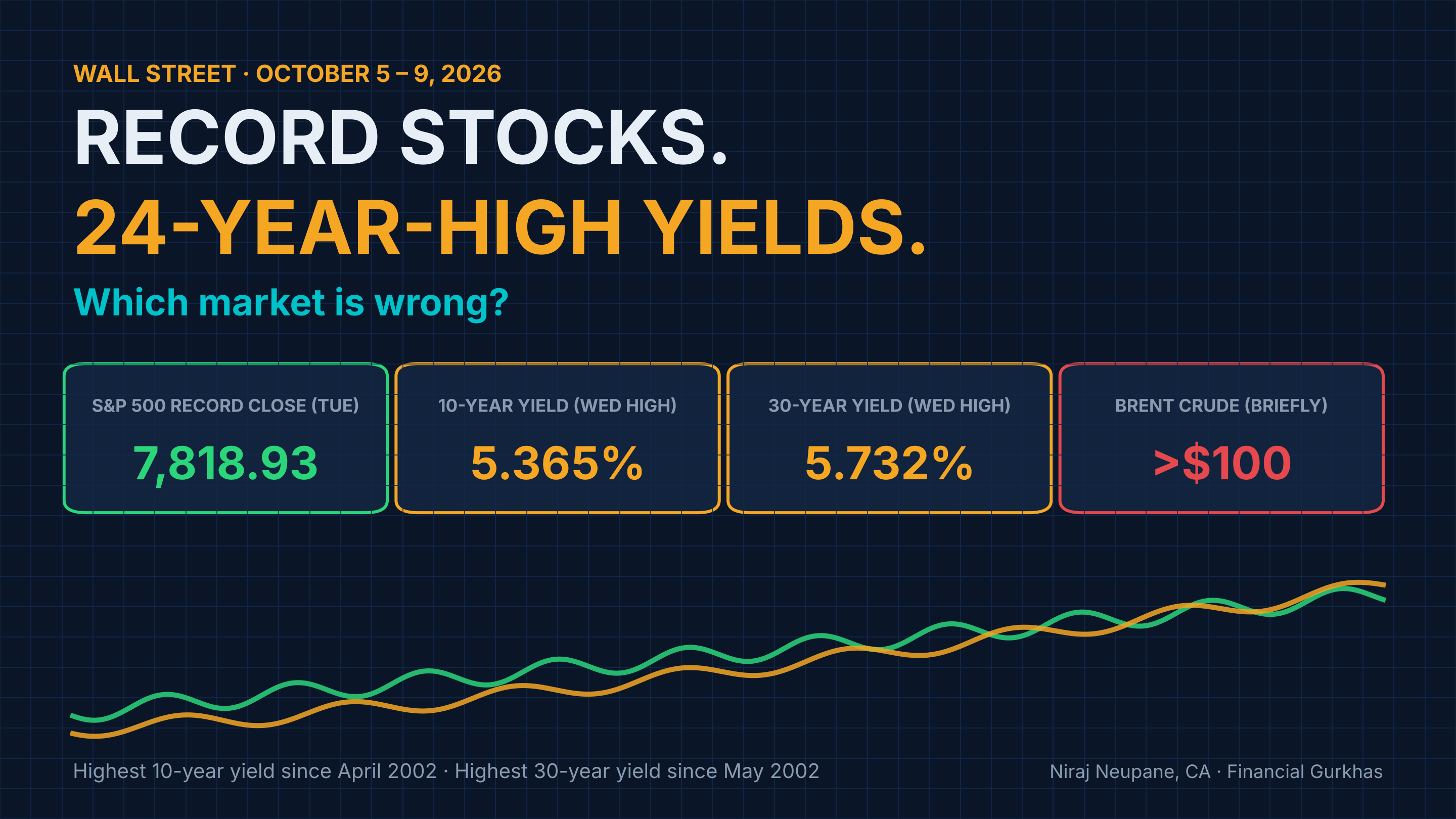
Record Stocks, 24-Year-High Yields: Which Market Is Wrong?
The S&P 500 closed at a record the same week the 10-year Treasury yield hit its highest level since 2002. Both markets cannot be right for long, and how this standoff resolves matters for investors, banks and households alike.

Physical AI: The Brain and the Body Have Become Their Own Markets
Humanoid robot brains may get their GPT-3 moment by mid-2027. The money is already moving: Physical Intelligence is raising at $11 billion, Skild AI sits above $14 billion, and Spirit AI has robots working on CATL production lines today. Meanwhile the unglamorous bottlenecks — power, thermal, electrical infrastructure — are where deployment scale will be won or lost. This is the first installment of our Physical AI research section.
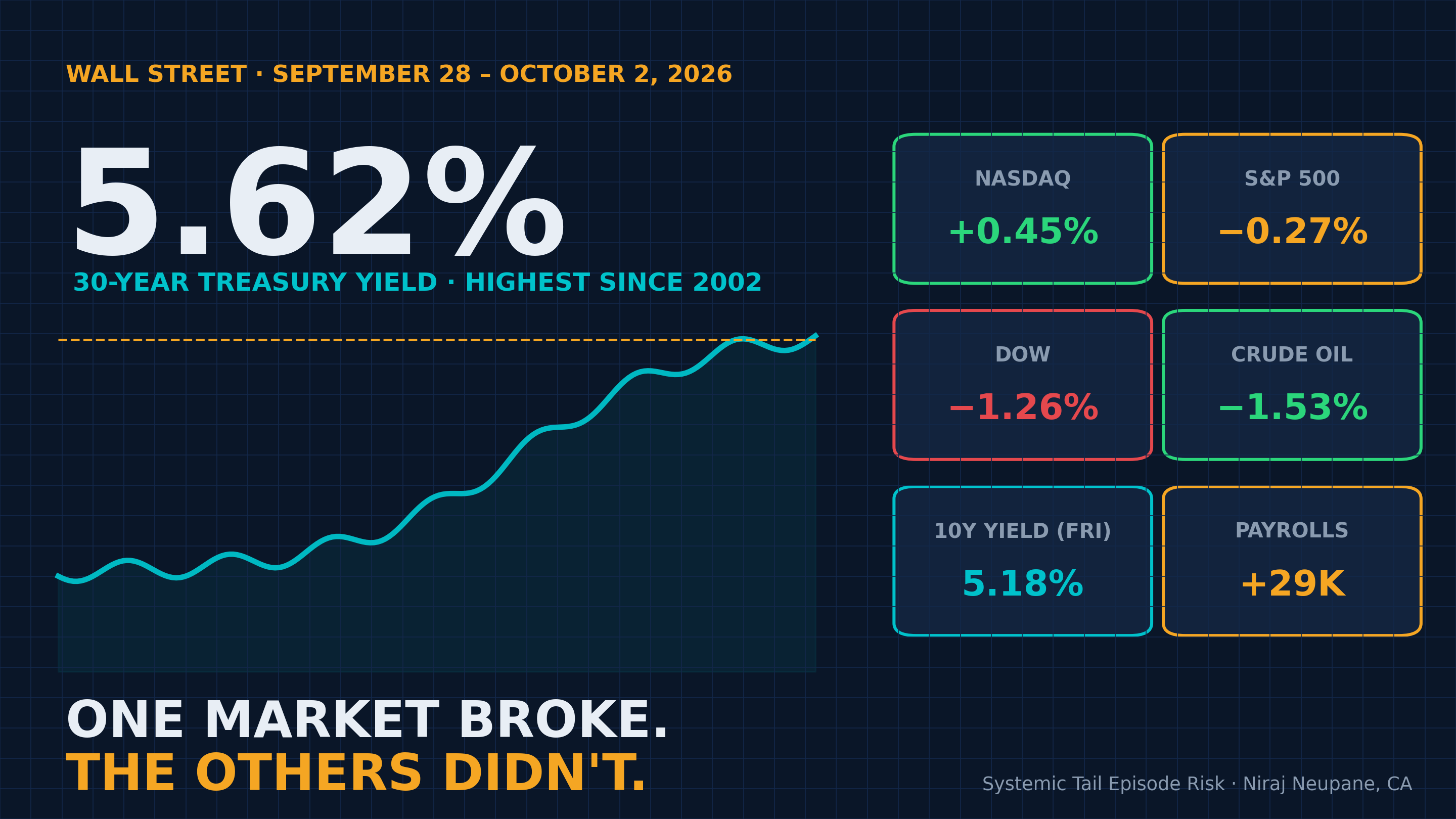
The 30-Year Hit a 2002 High. Why Didn't Wall Street Panic?
A new systemic-risk measure, Systemic Tail Episode Risk (STER), explains the difference between a bond-market shock and a financial crisis, and identifies what U.S. regulators and risk managers should watch next.

600 Years of Capitalism: Reading the Review of Sven Beckert’s Global History
Financial Gurkha Spotlight Book of October is Harvard historian Sven Beckert’s Capitalism: A Global History (Penguin Press, 2025, 1,087 pages), through Bennett Baumer’s review in The Indypendent #306. Beckert dates capitalism’s birth to a “great connecting” between roughly 1450 and 1640, and argues it was global before it had a name. We read The Indypendent review, test its argument, and add a question: what happened to the dollar and the pound during the panic of 1873?
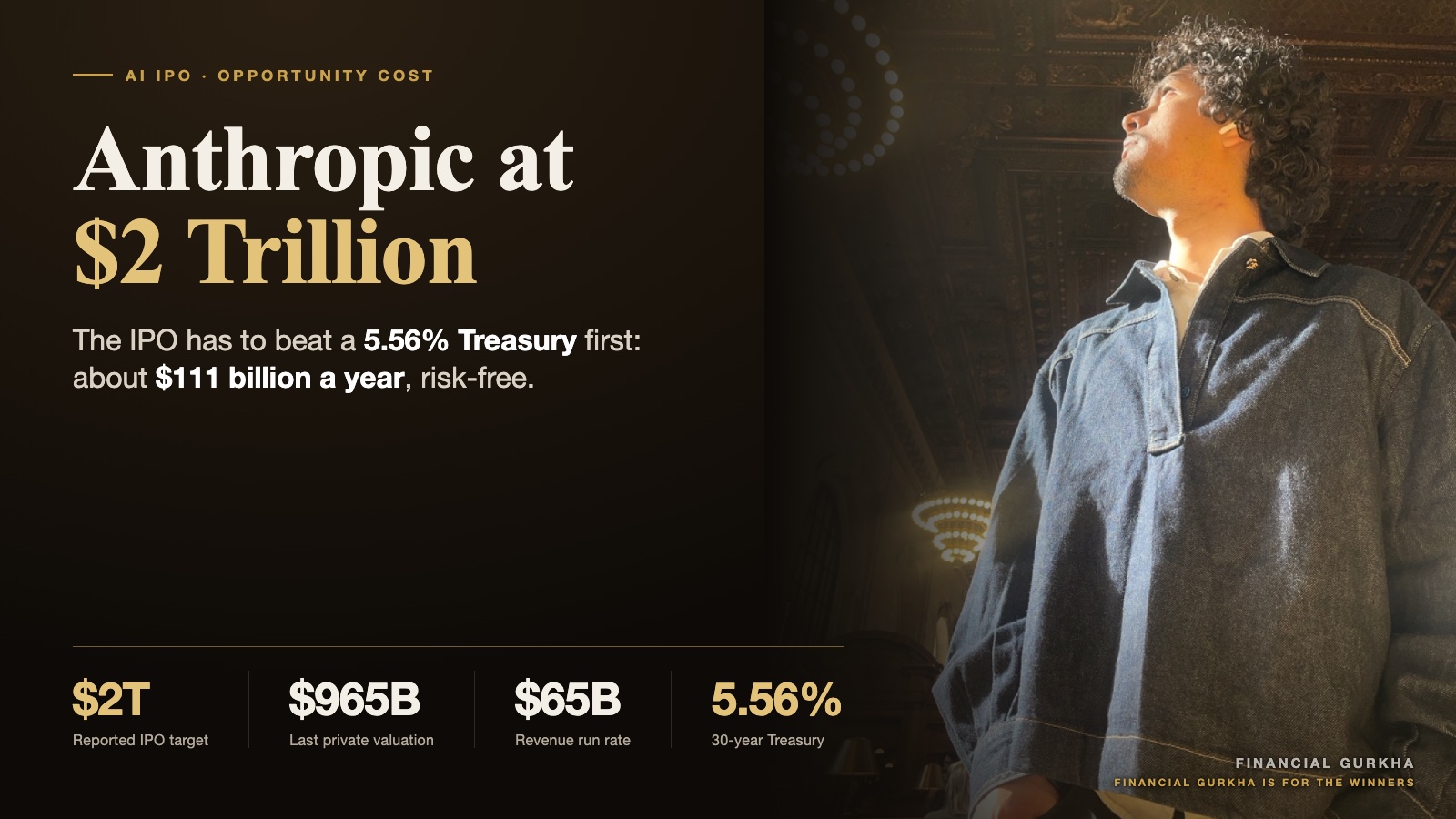
Anthropic at $2 Trillion: The IPO Has to Beat a 5.56% Treasury First
Anthropic, the maker of Claude, is preparing a Nasdaq IPO that could value it at more than $2 trillion, twice its $965 billion private valuation from May. Its revenue run rate has passed $65 billion, and it projects $190 billion to $200 billion of revenue in 2028. But with the 30-year Treasury yielding 5.56% and 13-week bills at 4.21%, a $2 trillion price has to eventually earn about $111 billion a year just to match a risk-free bond. Here is what the prospectus shows, what the company is worth privately, and where NVIDIA and its record $150 billion buyback fit in.

The Bond Market's Bad Week Was an Episode, Not a Day: Why VaR Can't See It
The 10-year Treasury yield reached 5.23% this week, its highest since 2007, through a connected run of bad days rather than one shock. Value-at-Risk and Expected Shortfall cannot tell that run apart from the same losses scattered across a quarter. A new working paper proposes Tail Episode Risk (TER) and Conditional TER (CTER) to measure the worst connected run of extreme losses. Tested on 26 years of data across six markets, it finds that Treasury episodes are the most predictable, and that a richer forecasting model still did not beat a simple EWMA volatility baseline.
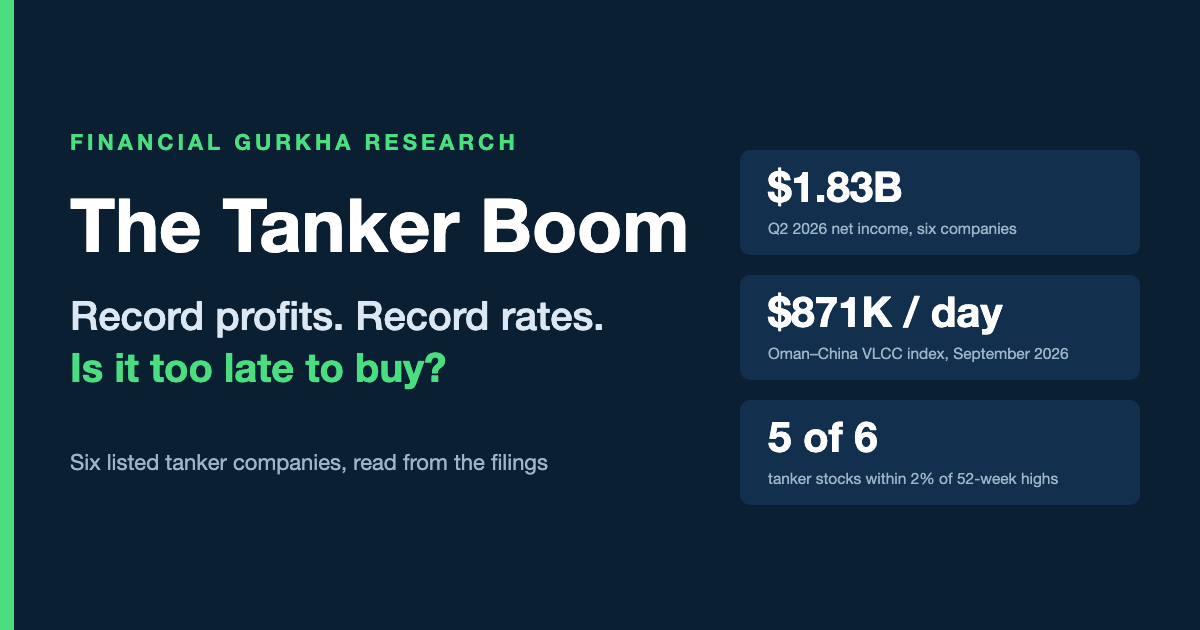
Tanker Stocks in 2026: Record Profits, Near-$1 Million-a-Day Rates, and Whether It Is Too Late to Buy
Six listed tanker companies earned $1.83 billion in Q2 2026, 5.6 times a year earlier, as the Strait of Hormuz crisis pushed VLCC rates to records. Five of the six stocks now sit within 2% of their 52-week highs. We read the filings and ask whether the boom is already priced in.

Reading BRICS Like a Risk Manager: Why Dollar Diversification Is a Model-Risk Problem for U.S. Financial Markets
BRICS is not replacing the dollar. The more consequential question is whether a more diversified global financial system could make yesterday's risk assumptions less reliable.
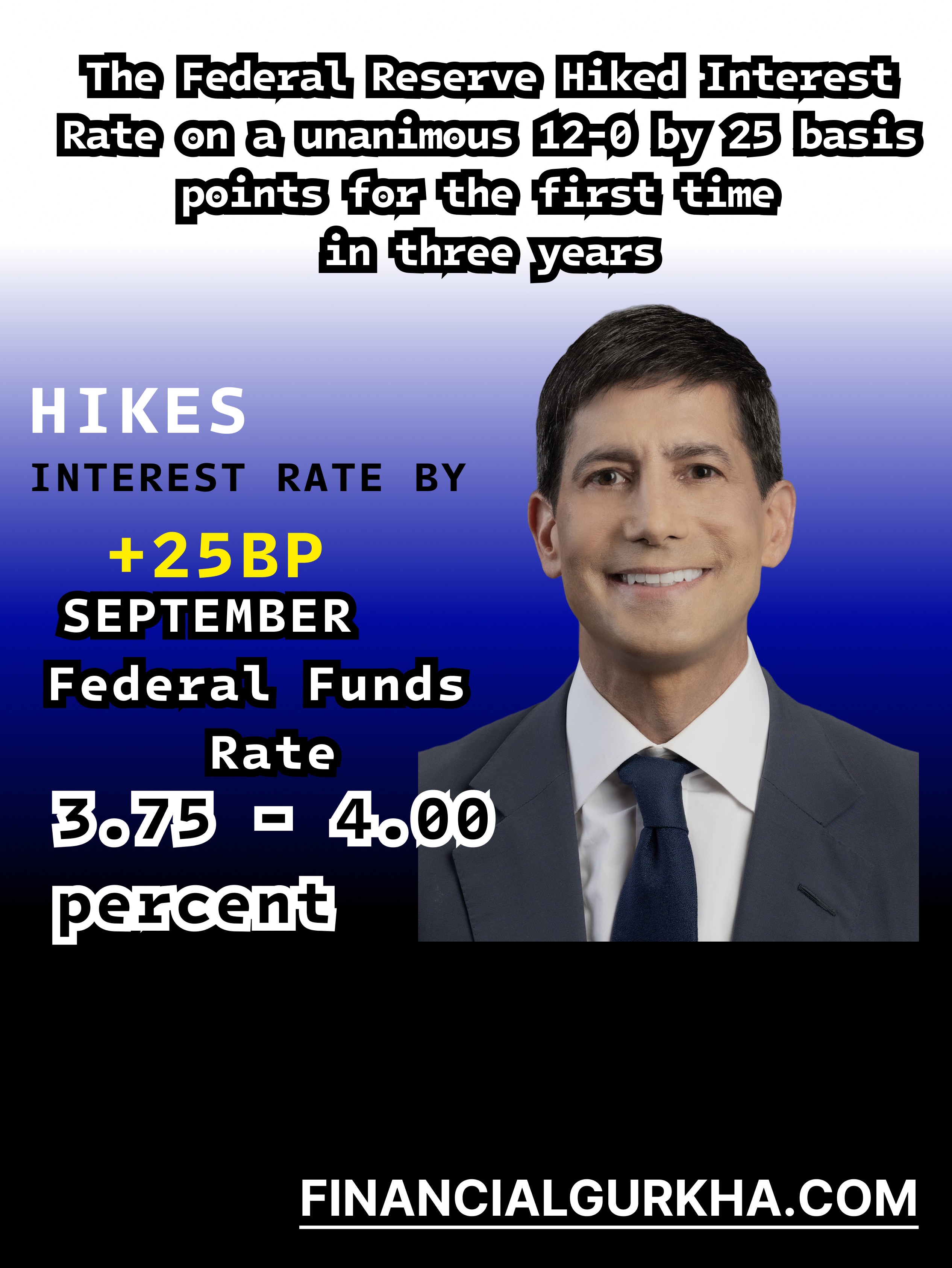
Federal Reserve Raises Interest Rates to 3.75%–4%. Twelve Votes, Zero Dissents.
The Federal Open Market Committee raised the target range for the federal funds rate by a quarter point to 3.75 percent to 4 percent — unanimously. In July, three voters dissented to hike and were outvoted. Seven weeks later, nobody dissented. We go through the 12–0 vote, what "expanding at a solid pace" actually commits the Fed to, every line of the Implementation Note, and what changed word by word from the July statement.

When Markets Turn Volatile, Can Machine Learning See the Risk Coming?
ML-LiqVaR combines GARCH volatility modelling, Extreme Value Theory and gradient-boosted quantile regression to forecast one-day-ahead Value-at-Risk on US equities. Across 8,072 out-of-sample observations from eight S&P 500 constituents between 2018 and 2024, it delivered the closest 99% calibration and the lowest average pinball loss of five models tested — but its improvement over GARCH-EVT was not statistically significant at the 5% level. This is what the paper found, what it did not find, and why the second half matters as much as the first.

The State of US Energy: Crude Production, Petroleum refining, the Strategic Petroleum Reserves, and Why Nobody Will Build a Refinery
A full read of the US crude complex as of the week ending August 28, 2026. Domestic production is at 13.86 million b/d, refiners are running at 98% of a capacity base that shrank again last year, Cushing is scraping tank bottoms, the Strategic Petroleum Reserve has fallen to its lowest level since 1983, and the diesel crack just printed above $100 a barrel. Compiled from EIA weekly data, Bloomberg terminal research, and reporting on why the record margins are not buying a single new refinery.

US National Accounts, Gross Domestic Income Components, Fiscal Deficits, and Housing: Insights from Bloomberg Terminal Research
A comprehensive macroeconomic study of US Gross Domestic Income breakdown, 70-year wage share trends, housing inventory anomalies, mortgage rates, budget balances, and global superpower comparisons.
July 2026 CPI: Headline Inflation Says 3.4%. The Last Three Months Say 0.8%.
Consumer prices rose 0.1% in July and 3.4% over the year, with core at 2.5%. But annualise the last three months and headline inflation is running at 0.8% and core at 1.6% — below target. The 3.4% is a March energy shock that has not yet rolled out of the base. We go through the energy component in detail, show why the shelter number is quieter than it looks, and cross-reference the EIA outlook to ask whether record US oil and gas output is producing healthy or unhealthy emissions growth.

Sandisk reports $9.8 billion in Q426 revenue
Sandisk (NASDAQ:SNDK) reported fiscal 2026 revenue of $20.2 billion, up 175%, and swung from a $1.6 billion loss to $11.4 billion of net income. Datacenter revenue grew 437%. Cost of revenue actually fell year over year while sales rose 372%. Eighteen months after being spun out of Western Digital and written down for impairment, the company that invented flash storage is printing a 77% net margin. Here is what the filing says — and why memory investors should read the cycle warning carefully.

Caterpillar's First $20 Billion Quarter: A Record $72 Billion Backlog, Raised Guidance, and the AI Boom in Yellow Iron
CAT posted $20.5 billion in sales and revenues in Q2 2026 — the first $20 billion quarter in company history — raised full-year guidance to mid-to-high teens growth, and disclosed a record $72 billion backlog with Power & Energy customers ordering as far out as 2030. Power generation sales grew 29% on data center demand. Here is the full breakdown, from the release and the call.

Microsoft FY26 Earnings: $331 Billion in Revenue, $133 Billion in Profit, and the $115 Billion AI Bet That Just Paid Off
MSFT is up 25% in two trading days after a blowout fiscal 2026: revenue grew 18% to $331.8 billion, net income jumped 31% to $133.7 billion, and Azure is guided to grow ~45% into FY27. We went through the 10-K line by line — the income statement, the balance sheet, the cash flows, and the tax table — to show you exactly where the money is coming from and where it is going.

Federal Reserve Keeps Interest Rates Steady
The Federal Open Market Committee left the target range for the federal funds rate at 3.5 percent to 3.75 percent. The headline says "Fed holds." The headline is the least interesting sentence in the document.

All About Monad (MON): Generate Value From Monad Blockchain
MON is the native-token of Monad Blockchain, an EVM comatible L1,the all-new superfast 10,000 TPS blockchain making waves. Learn all about Monad Blockchain, MON tokens, and how to gain value and make money from the Monad blockchain and its native MON tokens.

An Intrinsic Valuation of FIGMA (NYSE:FIG)
Figma just crossed the $1bn annual revenue mark and maintains a 40% growth rate. Let's dive deep into Figma's filings and estimate an intrinstic value of the leading collaborative design platform for building meaningful products
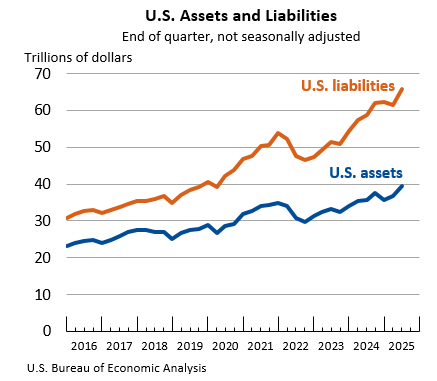
America's Net Investment Position with the World
How much of American assets does the world own? How much global stocks does America own? We expand the scope of Bureau of Economic Analysis to understand America's net investment position with the world.
Dollar Gold Crude Relations
Making sense of the relationship between the US Dollar, Gold, and Crude Petroleum.

Gold: A Primer on Commodities and Trading
Commodity traders believe we are in the midst of a commodities market supercycle - a period of more 6 years where commodities priced in USD are going to see significant rise in their prices. Gold and Silver are amongst the most traded precious metal commodities. In this article, we explore Gold, the most widely coveted precious metal.

Novo Nordisk DCF Valuation: Should you invest in the Ozempic and Wegovy Maker for exeptional returns?
Novo Nordisk briefly became Europe’s most valuable company by market cap before experiencing a sharp 60% pullback within six months. Despite the volatility, this century-old pharmaceutical leader continues to innovate across its core specialties in diabetes and blood-related disorders. The company is aggressively scaling its production capacity for high-demand treatments while investing heavily in research aimed at curing emerging diseases. Novo Nordisk’s international revenue segments and its growing online prescription platform are also delivering strong year-over-year growth. In this analysis, we break down Novo Nordisk’s fundamentals and present a full intrinsic valuation using DCF.

MP Materials Valuation: A Discounted Cash Flow Approach
MP Materials (NYSE:MP), a leading rare earth materials producer in the Western Hemisphere, has impressively grown their revenue since going public in 2020. The company recently began producing NdPr - core ingredients for manufacturing permanent magnets. In this article we approach MP Materials valuation through a discounted cash flow approach.