Financial Gurkha | New York City | September 16, 2026
Twelve to Zero: The Fed Hikes, and the Argument Is Over#
💡 TL;DR
- The Fed raised rates by 25 basis points What a basis point isA basis point is one hundredth of a percentage point. 25 basis points is 0.25 percentage points, which is the standard size of a single Fed rate move. to a target range of 3.75%–4.00%. It is the first hike in three years and the first under Chair Kevin Warsh.
- The vote was 12–0. In July, Hammack, Kashkari and Logan dissented because they wanted a hike and lost. Seven weeks later nobody dissented. They are now simply the majority.
- The Fed describes the economy as strong across the board: solid growth, resilient spending, strong productivity, robust investment and a balanced labor market. That leaves it no reason to wait.
- The statement no longer mentions energy or the Middle East. It now says only "geopolitical developments." The Fed has dropped its excuse to look past high inflation.
- The Implementation Note moves every administered rate up by the same 25 basis points: 3.90% on reserves, 4.00% for standing repo and the discount window, 3.75% for reverse repo. The $160 billion reverse repo cap stays, and the Fed keeps buying Treasury bills to hold reserves ample. The Fed is raising the price of money, not shrinking the supply of reserves.
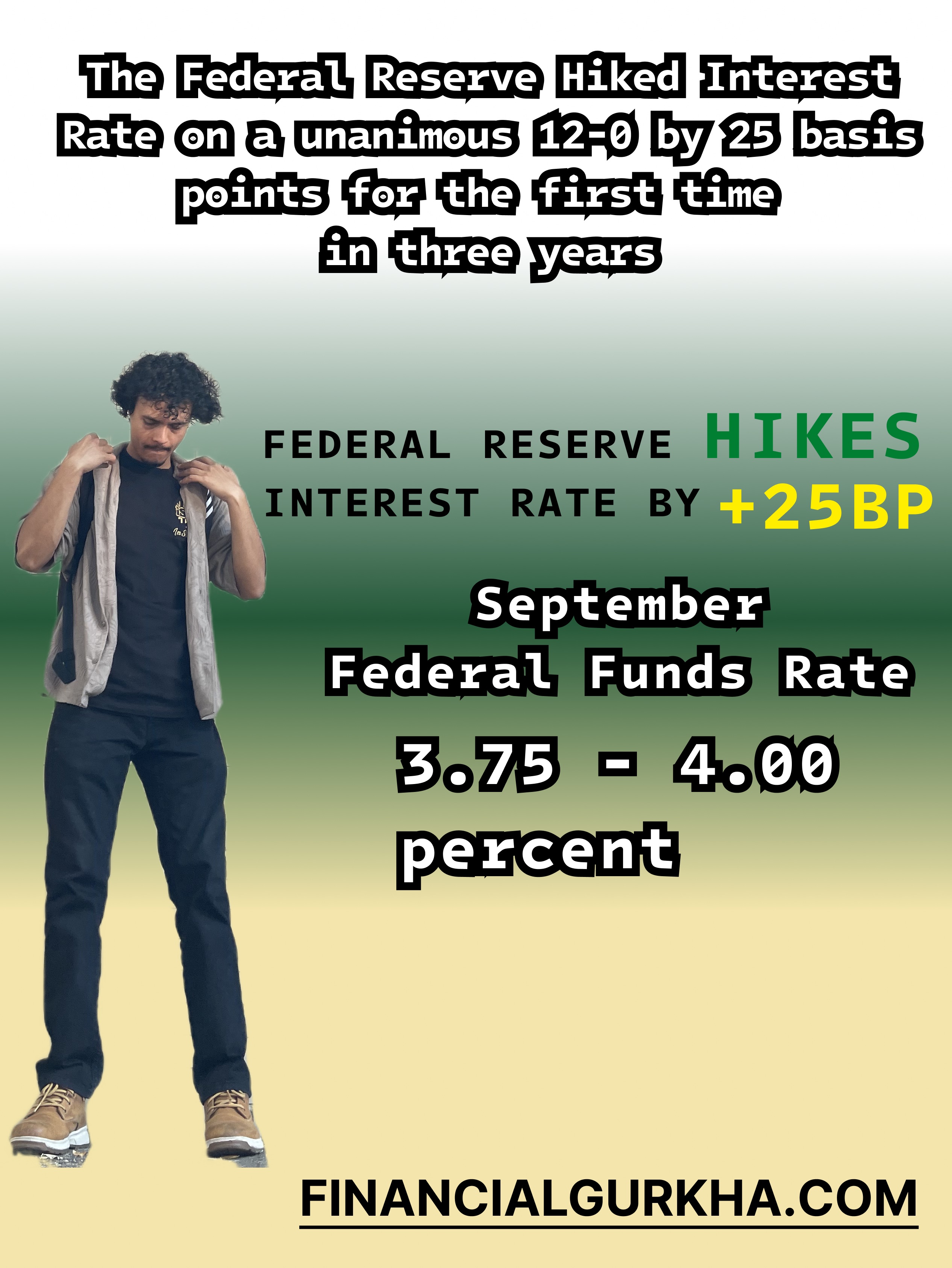
The Federal Reserve hiked by 25 basis points on a unanimous 12–0 vote, the first increase in three years. The September federal funds rate is now 3.75 to 4.00 percent.
What's in this report#
- Twelve to Zero: The Fed Hikes, and the Argument Is Over
- What's in this report
- The Numbers at a Glance
- The Statement, in Full
- Part One: The Unanimous Vote
- Part Two: "Economic Activity Is Expanding at a Solid Pace"
- Part Three: What Changed From July, Word by Word
- Part Four: The Implementation Note, Line by Line
- Part Five: Where This Leaves Real Rates
- What This Means for Markets
- What We're Watching Next
Disclaimer: This article is for educational purposes only and is not investment advice. Trading and investing are subject to volatility and market risk, including partial or entire loss of capital. Please consult your financial advisor before making investment decisions. Financial Gurkha and its writers are not liable for your losses, nor do we take credit for your gains. Policy text is quoted from the Federal Open Market Committee statement and the Federal Reserve Implementation Note, both issued September 16, 2026.
In July we wrote that three dissents in one direction were a faction, not a personality, and that September was live. September was live. The more important number is not the quarter point. It is the zero.
The Numbers at a Glance#↑ Contents
| September 16, 2026 FOMC | Before (July 29) | After (effective Sept 17) |
|---|---|---|
| Federal funds target range | 3.50% – 3.75% | 3.75% – 4.00% |
| Interest on reserve balances (IORB) | 3.65% | 3.90% |
| Standing repo facility (SRF) rate | 3.75% | 4.00% |
| Overnight reverse repo (ON RRP) rate | 3.50% | 3.75% |
| Primary credit (discount window) rate | 3.75% | 4.00% |
| Vote | 9–3 (hold) | 12–0 (hike) |
"Before" figures for the administered rates are the post-July settings implied by a uniform 25 basis point move; each rate kept its position inside the range.
The Statement, in Full#↑ Contents
The Committee decided to raise the target range for the federal funds rate by 1/4 percentage point to 3-3/4 to 4 percent, in support of the Federal Reserve's dual mandate. The Committee is continuing its policy of maintaining ample reserves in the banking system.
Economic activity is expanding at a solid pace. While uncertainty remains elevated owing, in part, to geopolitical developments, domestic spending has been resilient. Productivity growth is strong, and capital investment is robust. Job gains have kept pace with the workforce, and the unemployment rate has changed little.
Inflation remains elevated. Today's policy action will support a timelier return to the Committee's 2 percent goal. The Committee will deliver price stability.
It is short. Every sentence in it is doing work.
Part One: The Unanimous Vote#↑ Contents
Who votes, and why 12–0 is a real number#
The FOMC has twelve voting members Who sits on the FOMCThe Federal Open Market Committee has 12 voting seats: the seven members of the Board of Governors in Washington, the president of the Federal Reserve Bank of New York (a permanent voter), and four of the remaining eleven regional Reserve Bank presidents, who rotate in one-year terms. All nineteen participants — governors plus all twelve Reserve Bank presidents — sit at the table and argue, but only twelve vote.: the seven governors, the New York Fed president, and four rotating Reserve Bank presidents. In 2026 the rotating voters are Cleveland (Beth Hammack), Philadelphia (Anna Paulson), Dallas (Lorie Logan), and Minneapolis (Neel Kashkari).
A unanimous vote is not the default outcome of a Fed meeting. It is the outcome the chair manufactures when the committee's disagreement is small enough to fit inside the statement language. When the disagreement is too large, you get what we got in July: a 9–3 tally with every dissent pointing the same way.
From 9–3 to 12–0 in seven weeks#
Put the two meetings side by side.
| July 29, 2026 | September 16, 2026 | |
|---|---|---|
| Decision | Hold at 3.50%–3.75% | Hike to 3.75%–4.00% |
| Vote | 9–3 | 12–0 |
| Dissents | Hammack, Kashkari, Logan — all for a hike | None |
| Dissents for a cut | None | None |
Two things stand out.
First, nobody moved toward the doves, because there were no doves to move toward. In July there was not a single vote to cut. The debate was never whether policy should tighten — it was when. A committee arguing only about timing is a committee that will eventually converge, and the only question is on which side. It converged on the hawks' side.
Second, the nine who held in July voted to hike in September, and none of them felt the need to register discomfort. That matters. A member who thinks a hike is premature but goes along with it for the sake of consensus can still signal reluctance through a dissent, a speech, or a leak. A clean 12–0 tells you the July majority did not merely concede — they were persuaded, or the data did the persuading for them.
What unanimity buys the chair#
Warsh does not give forward guidance. He has said so repeatedly. That makes the vote tally itself the most important communication device he has, because it is the one piece of information the market cannot argue with.
- A 7–5 hike would say: this may be the only one.
- A 10–2 hike with dovish dissents would say: the next one is a fight.
- A 12–0 hike says: there is no internal constituency for reversing this.
The market can price the path however it likes. What it cannot do after today is price a Fed that is divided about direction. The first hike of a cycle, delivered unanimously, is the Fed telling you the floor has moved, not that a ceiling has been reached.
The lesson from July still holds: the tally was the tell. In July it told you a hike was coming. In September it tells you there is no one inside the building arguing to take it back.
Part Two: "Economic Activity Is Expanding at a Solid Pace"#↑ Contents
Every central bank that tightens needs to be able to answer one question: can the economy take it? The second paragraph of the statement is the Fed's answer, and it is an unusually complete one.
Reading the paragraph clause by clause#
| Clause | What it claims | Why it matters for the hike |
|---|---|---|
| "Economic activity is expanding at a solid pace." | Real growth is at or above trend. | Output is not the constraint. A hike does not risk tipping a weak economy into contraction. |
| "uncertainty remains elevated owing, in part, to geopolitical developments" | Risks exist and are acknowledged. | The Fed sees the risk and is hiking anyway — uncertainty is no longer an argument for waiting. |
| "domestic spending has been resilient" | Households and businesses keep spending despite uncertainty. | New language. Resilient demand is the channel through which inflation stays sticky. This is the hawks' core premise, now in the majority text. |
| "Productivity growth is strong" | Output per hour is rising fast. | Strong productivity lets wages rise without pushing unit labor costs up. It is the reason the Fed can tighten without fearing a wage-driven slump. |
| "capital investment is robust" | Firms are still spending on plant, equipment, and technology. | Investment that is robust at a 3.5%–3.75% policy rate is investment that is not very rate-sensitive at the margin. The Fed is signaling it has room. |
| "Job gains have kept pace with the workforce, and the unemployment rate has changed little." | The labor market is balanced. | The maximum-employment half of the dual mandate is not under stress. That frees the Fed to act on the price-stability half alone. |
The dual mandate, rebalanced#
The statement says the hike is "in support of the Federal Reserve's dual mandate." The dual mandateCongress directs the Federal Reserve to pursue two goals: maximum employment and stable prices. The Fed interprets stable prices as 2 percent inflation over time, measured by the personal consumption expenditures (PCE) price index. When the two goals conflict — say, inflation is too high but unemployment is rising — the Fed has to weigh them against each other. When they don't conflict, the decision becomes much simpler. That phrasing is not boilerplate. It is the Fed pre-empting the obvious criticism that a hike sacrifices jobs for prices.
The logic runs like this:
- Employment is at its goal. Job gains match workforce growth; unemployment is stable.
- Prices are not at their goal. Inflation "remains elevated."
- Therefore the two mandates do not conflict. Tightening costs the employment mandate little and advances the price mandate a lot.
When one half of the mandate is satisfied and the other is not, "support of the dual mandate" and "fighting inflation" become the same sentence. The Fed wrote the paragraph so that nobody — Congress included — can say the hike ignored workers.
Why "solid" is a commitment, not a description#
There is a subtle trap in a paragraph this upbeat. Once the Fed has told you the economy is solid, resilient, productive, investing, and fully employed, it has removed its own reasons to stop. A future pause now requires the data to visibly change — weaker spending, softer hiring, a rise in unemployment — and requires the statement language to change with it.
That is the tell to watch. The hiking cycle ends when this paragraph gets rewritten, not before.
Part Three: What Changed From July, Word by Word#↑ Contents
Fed statements are edited documents. The edits are the message.
| July 29, 2026 statement | September 16, 2026 statement | Our read |
|---|---|---|
| Activity expanding at a solid pace "despite elevated uncertainty that owes, in part, to the conflict in the Middle East" | "While uncertainty remains elevated owing, in part, to geopolitical developments, domestic spending has been resilient." | The Middle East is no longer named. The risk has been generalized, and the emphasis has shifted from the risk to the economy's resilience against it. |
| Inflation elevated "in part reflecting supply shocks that have driven price increases in certain sectors, including energy" | "Inflation remains elevated." | The energy explanation is gone. In July the Fed offered a supply-shock reason for high inflation. A supply shock is an argument to look through. Removing it removes the excuse. |
| — | "Today's policy action will support a timelier return to the Committee's 2 percent goal." | New. "Timelier" concedes that the prior path back to 2 percent was too slow. The hike is framed as accelerating, not starting, disinflation. |
| "The Committee will deliver price stability." | "The Committee will deliver price stability." | Unchanged — and now backed by action. In July we called this the most expensive verb tense in central banking. In September they paid for it. |
The most important edit is the removal of the energy language. Here is why.
When inflation is caused by a supply shock — an oil disruption, a war-driven price spike — the textbook response is to look through it: the shock raises prices once, it does not create persistent inflation, and hiking into it simply destroys demand without fixing supply. In July the Fed had written itself exactly that escape hatch.
In September it closed the hatch. By describing inflation as simply "elevated," with no attributed supply cause, and describing demand as "resilient," the Fed has reclassified the problem as demand-side and persistent — the kind of inflation that interest rates are designed to fix.
Part Four: The Implementation Note, Line by Line#↑ Contents
The statement tells you what the Fed wants. The Implementation Note tells you how the plumbing is set to get it. What the Implementation Note isThe FOMC sets a target range for the federal funds rate, but the Fed doesn't set that rate directly — it's a market rate at which banks lend reserves to each other overnight. The Implementation Note lists the administered rates and operating instructions the Fed uses to keep the market rate inside the target range. It's issued alongside every statement and is where the operational detail lives. Most coverage ignores it. It is where the Fed's balance-sheet intentions are actually written down.
1. Interest on reserve balances raised to 3.90%#
The Board of Governors of the Federal Reserve System voted unanimously to raise the interest rate paid on reserve balances to 3.90 percent, effective September 17, 2026.
IORB is the primary tool for steering the federal funds rate in an ample-reserves system. Banks will not lend reserves overnight for less than they can earn by leaving them at the Fed, so IORB acts as a strong magnet for the market rate.
- Set at 3.90%, it sits 10 basis points below the top of the 3.75%–4.00% range and 15 basis points above the bottom.
- That placement is unchanged from July. The Fed moved the whole structure up by 25 basis points without any technical adjustment inside the range.
- No technical adjustment is itself information: the Fed sees money markets trading where it wants them to within the range, and reserves are not so scarce that the effective funds rate is drifting toward the ceiling.
- Note it was a Board of Governors vote, not an FOMC vote. IORB is set by the Board under its own statutory authority, which is why the Implementation Note records it separately.
2. The domestic policy directive to the New York Fed Desk#
The FOMC then instructs the Open Market Desk at the Federal Reserve Bank of New York — the traders who actually run the System Open Market Account (SOMA) What SOMA isThe System Open Market Account is the Federal Reserve's portfolio of securities — mostly U.S. Treasuries and agency mortgage-backed securities. It's managed by the Open Market Desk at the New York Fed on the FOMC's instructions. When the Fed buys securities for SOMA, it pays with newly created reserves, which adds liquidity to the banking system. — with five operating instructions.
a) Keep the federal funds rate in 3-3/4 to 4 percent.
Undertake open market operations as necessary to maintain the federal funds rate in a target range of 3-3/4 to 4 percent.
The mandate for the Desk. Everything below is the toolkit for meeting it.
b) Standing repo at 4.0% — the ceiling.
Conduct standing overnight repurchase agreement operations at a rate of 4.0 percent.
The standing repo facility lets eligible counterparties borrow cash overnight from the Fed against Treasury and agency collateral. If private repo rates spike above 4.0%, firms can come to the Fed instead. Pricing it at the top of the range turns the top of the range into a hard ceiling on overnight funding costs. It is the Fed's insurance against a September 2019-style repo spike, and it rises one-for-one with the hike.
c) Overnight reverse repo at 3.75% with a $160 billion per-counterparty cap — the floor.
Conduct standing overnight reverse repurchase agreement operations at an offering rate of 3.75 percent and with a per-counterparty limit of $160 billion per day.
The ON RRP lets money market funds, government-sponsored enterprises, and other non-bank institutions that cannot earn IORB park cash at the Fed overnight. Nobody on that list will lend in the market below 3.75% when the Fed will pay them 3.75% risk-free, so this sets the floor.
- The rate is at the bottom of the range, unchanged in placement.
- The $160 billion per-counterparty limit is unchanged. The Fed is not trying to push cash out of the facility or pull more in. It is simply repricing it.
d) Keep buying Treasury bills to keep reserves ample.
When appropriate, increase the System Open Market Account holdings of securities through purchases of Treasury bills and, if needed, other Treasury securities with remaining maturities of 3 years or less to maintain an ample level of reserves.
This is the most important line in the entire document, and the one most likely to be misread.
The Fed is raising the price of money while explicitly instructing the Desk to keep growing its securities holdings when needed. That can look contradictory — isn't buying securities easing?
It is not, for two reasons:
- These are reserve management purchases, not quantitative easing. QE buys long-duration bonds specifically to push down long-term yields. Buying bills and short coupons of three years or less has almost no effect on term premia. The purpose is purely operational: as currency in circulation, the Treasury General Account, and bank demand for reserves grow, the Fed has to add reserves just to keep the system ample rather than drift toward scarce.
- The statement says so directly. "The Committee is continuing its policy of maintaining ample reserves in the banking system." The hike is being delivered through administered rates, not through a reserve squeeze.
Put simply: the Fed has decided it can fight inflation with the policy rate while keeping the money-market plumbing well-lubricated. It does not want funding stress to do the tightening for it, because funding stress is uncontrolled tightening.
e) Roll over Treasuries, and move agency MBS money into bills.
Roll over at auction all principal payments from the Federal Reserve's holdings of Treasury securities. Reinvest all principal payments from the Federal Reserve's holdings of agency securities into Treasury bills.
- Treasuries: full rollover. No runoff. Maturing Treasuries are replaced at auction, so the Treasury portfolio does not shrink passively.
- Agency MBS: paydowns go into bills. As homeowners pay down or refinance mortgages, the principal the Fed receives is not reinvested in more mortgage bonds. It goes into short-dated Treasury bills.
The effect is a slow, steady change in composition of the balance sheet: fewer mortgage-backed securities, more bills, shorter average maturity. That is a long-stated Fed goal — a balance sheet that is "primarily Treasury securities" — and it suits a sound-money chair who has long argued the Fed should not be a large, permanent holder of housing finance.
3. The discount rate: 4.0%, and the seven banks that asked#
the Board of Governors of the Federal Reserve System voted unanimously to approve a 1/4 percentage point increase in the primary credit rate to 4.0 percent, effective September 17, 2026. In taking this action, the Board approved requests to establish that rate submitted by the Board of Directors of the Federal Reserve Banks of Cleveland, Richmond, Atlanta, Chicago, Minneapolis, Kansas City, and Dallas.
The primary credit rate is the rate at which sound banks can borrow directly from their regional Reserve Bank at the discount window. How the discount rate is setLegally, each of the twelve regional Federal Reserve Banks proposes its own discount rate through its board of directors, and the Board of Governors in Washington approves it. In practice the rates are kept identical nationwide. Not every Reserve Bank files its request by the day of the FOMC meeting, so the initial announcement often lists only some banks; the rest typically follow with the same rate shortly after.
- 4.0% equals the top of the target range, the same placement as before. It sits at parity with the standing repo rate, so banks face a consistent backstop price whether they borrow through repo or the window.
- Seven of twelve Reserve Banks submitted requests in time for approval: Cleveland, Richmond, Atlanta, Chicago, Minneapolis, Kansas City, and Dallas. The remaining five — Boston, New York, Philadelphia, St. Louis, and San Francisco — were not listed.
- Do not over-read the missing five. Staggered filings are routine; the rest normally follow at the same rate. We will note it only if any of them do not follow.
The corridor, visualized#
 4.00%  ──────────  Top of target range
        │           Standing repo facility rate (ceiling)
        │           Primary credit / discount window rate
 3.90%  ─ ─ ─ ─ ─   Interest on reserve balances (main steering tool)
        │
        │           Effective fed funds expected to trade in here
        │
 3.75%  ──────────  Bottom of target range
                    Overnight reverse repo rate (floor)
Everything moved up 25 basis points. Nothing moved relative to anything else. This was a clean, conventional hike with no technical fine print — which is precisely what a chair wants when the message is supposed to be the vote, not the plumbing.
Part Five: Where This Leaves Real Rates#↑ Contents
In our July CPI report we showed headline CPI at 3.4% year over year and core at 2.5%, while the three-month annualized pace had fallen to 0.8% headline and 1.6% core.
Against the new 4.00% upper bound, that puts the policy rate:
| Inflation measure (July 2026) | Rate | Real policy rate at 4.00% |
|---|---|---|
| Headline CPI, 12-month | 3.4% | +0.6% |
| Core CPI, 12-month | 2.5% | +1.5% |
| Core CPI, 3-month annualized | 1.6% | +2.4% |
Real policy rate here is simply the top of the target range minus the inflation measure. The Fed's own inflation target is set on PCE, which typically runs below CPI.
This is the honest tension in today's decision. On backward-looking year-over-year inflation, policy is only modestly restrictive. On recent momentum, it is clearly restrictive. The Fed has chosen to act on the level, not the momentum — and "timelier return to the Committee's 2 percent goal" is how it justifies that choice. The bet is that a strong, resilient, fully employed economy will re-accelerate prices if given the chance, and that it is cheaper to lean against that now than to chase it later.
If momentum is right, the Fed will have tightened into disinflation that was already happening. If the level is right, this is the first of several. The unanimous vote says the committee believes the second.
What This Means for Markets#↑ Contents
Front-end yields. Bill and two-year yields reprice most directly off the funds rate. With reserve-management bill purchases continuing and agency paydowns flowing into bills, the Fed is itself a steady buyer at the very front of the curve, which marginally cushions bill yields relative to where the hike alone would put them.
Money market funds. The ON RRP rate rising to 3.75% passes through almost immediately to money fund yields. Cash earns more, again. That keeps the opportunity cost of holding risk assets rising.
Mortgages. The Fed continues to let its MBS holdings run off into bills, not back into mortgages. Combined with a higher policy rate, there is no Fed support coming for mortgage spreads.
The dollar and gold. In July we argued that a sound-money chair with a hawkish committee is a structurally strong-dollar, weak-gold setup. A unanimous hike is that thesis delivered in its purest form.
What We're Watching Next#↑ Contents
- Whether the second paragraph changes. The cycle ends when "solid," "resilient," "strong," and "robust" start getting edited out. Until then, assume the Fed does not believe it is done.
- Whether energy re-enters the statement. The Fed dropped the supply-shock explanation for inflation. If an energy shock returns and the Fed still does not name it, the committee has decided it will not look through supply shocks at all.
- The first dissent of the hiking cycle. A 12–0 committee has nowhere to go but split. The first dissent — and, critically, which direction it points — will tell you the cycle's shape before the dot plot does.
- ON RRP balances and the effective funds rate. If the effective rate starts drifting from its spot below IORB toward the ceiling, reserves are getting less ample than the Fed thinks, and a technical adjustment to IORB or a faster pace of bill purchases comes next.
- The remaining five discount-rate filings from Boston, New York, Philadelphia, St. Louis, and San Francisco. Routine — unless one of them isn't.
Financial Gurkha. Views are our own and are not investment advice. Please consult a financial advisor before making investment decisions.