Disclaimer: This article is for educational purposes only and is not investment advice. Historical patterns do not guarantee future market outcomes.
Financial Gurkha | Spotlight Books | New York City | October 2, 2026
Spotlight Books is presented by Spotlight Links. Discover how often your business appears in AI recommendations before you lose another customer. Probe Your Business Today.
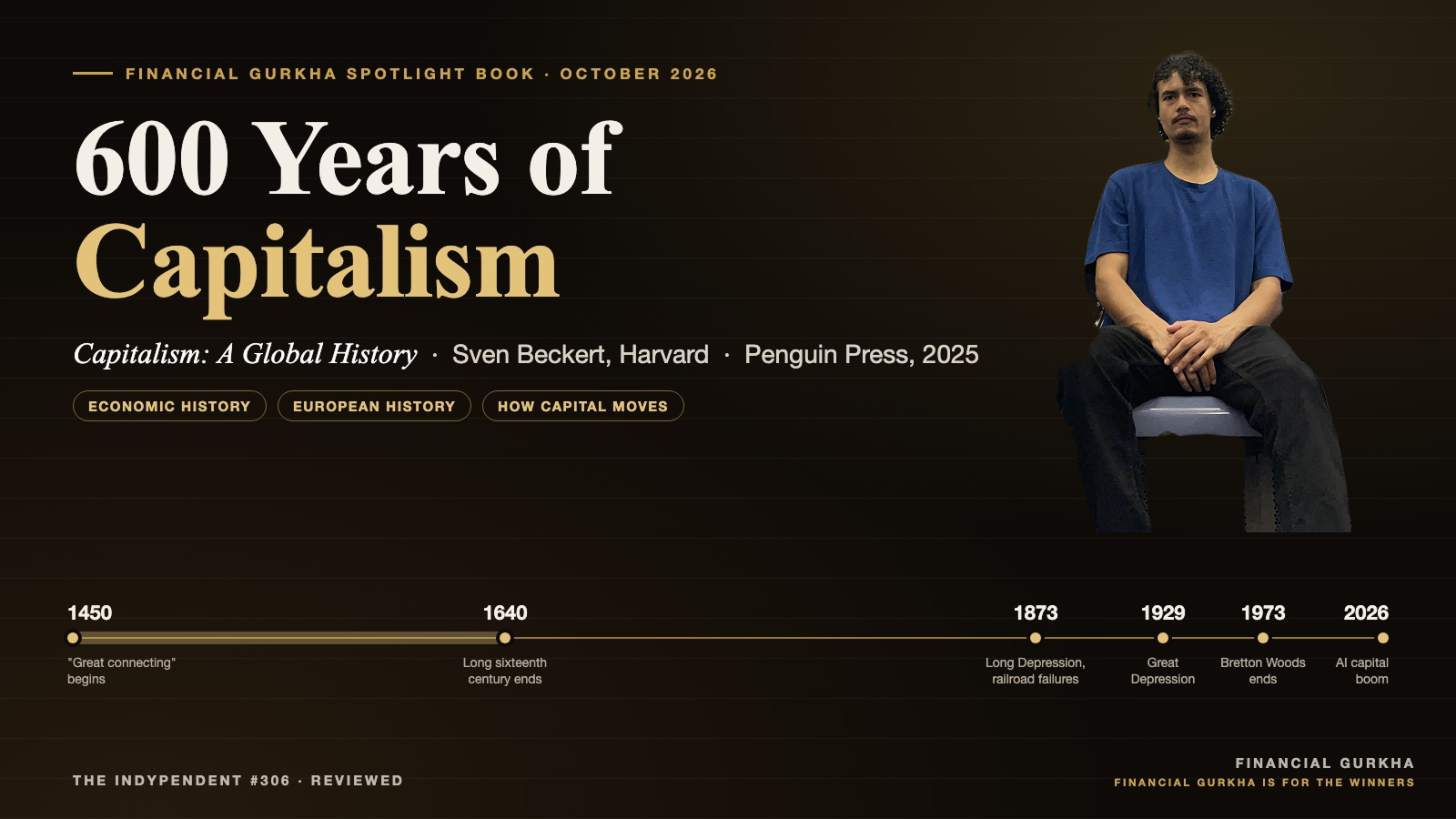
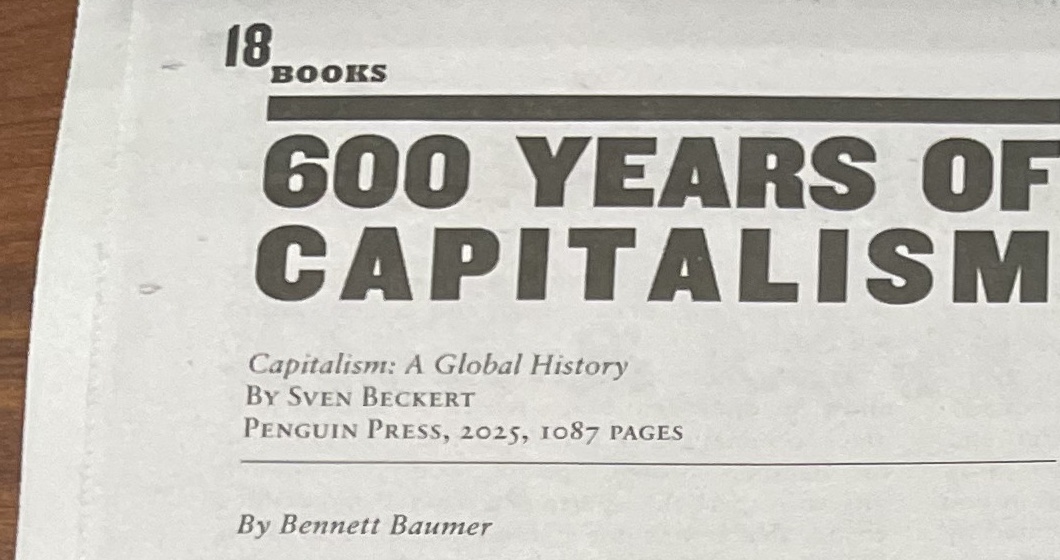
Our first pick is Harvard historian Sven Beckert's Capitalism: A Global History. We came across Bennett Baumer's Sept. 14 review titled "600 Years of Capitalism," in issue #306 of The Indypendent.
Advertisement
The 60-Second Version#↑ Contents
| Book | Capitalism: A Global History by Sven Beckert (Harvard). Penguin Press, 2025. 1,087 pages |
| Reviewed in | "600 Years of Capitalism" by Bennett Baumer, The Indypendent #306, Sept/Oct 2026, p. 18 |
| Subjects | Economic History · Economic History of Capitalism · European History · How Capital Moves |
| Core claim | Capitalism was born in a "great connecting" of the "long sixteenth century," roughly 1450 to 1640, and was global before it had a name |
| Reviewer's verdict | Sweeping and timely; early chapters "can be a slog"; just one chapter on 2008 |
| Our verdict | The review is strong on politics, and claim made on 'capital crosses border at will' is a strong argument repeatedly proved throughout history. As US 10 Treasury Yield cross 525 basis points, protests are unfolding in France. |
Key Takeaways from the Indypendent Review of Capitalism: A Global History:
- Capitalism is a process, not a moment. Beckert puts its birth in a 190-year window when trade networks connected the world, not in one British field or factory.
- Capital has no loyalty. Money that piled up in Florence and Genoa financed Spain and Portugal's push into Africa and the Americas. It went wherever the return was.
- States and merchants fused. Empires needed merchants' taxes to pay for armies and navies; merchants needed empires for trade routes, protection and markets. That bargain is where capitalism really takes off.
- Instability is built in. Baumer writes, "uncertainty about the future is the key driver of capitalism." From the Long Depression of 1873 to 1896, through 1929 and 2008, the system repeatedly breaks down and gets rebuilt in a new form.
- The review skips the money. It covers states, wars and ideologies, but not currencies, gold or exchange rates. That is the gap our margin note fills: what happened to the dollar and the pound when the railroads failed.
What's in this report#
- The 60-Second Version
- 1. The Book and the Review
- 2. Where the Review Starts: Uncertainty and the AI Boom
- 3. Beckert's Big Claim: Capitalism Was Global Before It Had a Name
- 4. How Capital Moves: Merchants, Empires and Fungible Money
- 5. Instability: From the Long Depression to 1929
- 6. Question: What Happened to the Dollar When the Railroads Failed?
- 7. The Twentieth Century: Nationalism, Bretton Woods and Neoliberalism
- 8. What the Review Gets Right, and What It Leaves Out
- 9. Why This Book Matters for Investors in 2026
- Frequently Asked Questions
- Conclusion and Key Takeaways
- References and How to Cite
1. The Book and the Review#↑ Contents
Capitalism: A Global History is Sven Beckert's account of how capitalism emerged and spread across six centuries and every continent. Beckert is a professor of history at Harvard, and his previous book, Empire of Cotton: A Global History (2014), won the Bancroft Prize by tracing a single commodity across the world economy.
| Details | |
|---|---|
| Title | Capitalism: A Global History |
| Author | Sven Beckert, Harvard University |
| Publisher | Penguin Press, 2025 |
| Length | 1,087 pages |
| Period covered | Roughly 1450 to the present |
| Field | Economic History; Economic History of Capitalism; European and global history |
| Previous book | Empire of Cotton: A Global History (2014), Bancroft Prize |
The review we are responding to is Bennett Baumer's "600 Years of Capitalism," published on page 18 of The Indypendent #306 (September/October 2026). The Indypendent is a New York City newspaper with a left-of-center editorial line, and the review reads that way: it is most interested in labor, empire and the politics of the present. It is illustrated with a period cartoon titled Arbeid ("work" in Dutch), showing a laborer pushing a wheelbarrow while a top-hatted man in polished boots looks on, under the caption "Someone's getting rich."
2. Where the Review Starts: Uncertainty and the AI Boom#↑ Contents
Baumer opens in the present, not the past. Capitalism, he notes, looks as dominant as ever: massive investment is flowing into Big Tech, and the largest U.S. banks are reporting record revenues. Yet JPMorgan Chase CEO Jamie Dimon, he points out, has said publicly that nobody knows how long the good times will last.
The review's opening argument is that uncertainty, not confidence, is the engine of capitalism. It cites Big Tech's private AI investment of more than $285 billion in 2025, against $12 billion in China, and notes that Chinese state-backed research is closing the capability gap anyway.
Baumer then reaches for John Maynard Keynes John Maynard KeynesBritish economist (1883–1946) whose General Theory (1936) argued that investment depends on expectations about an unknowable future, and that confidence, which he called "animal spirits," can collapse independently of the fundamentals., who argued that the future cannot be reduced to a mathematical formula. Past performance does not predict future results, but expectations about the future decide where capital goes today.
Financial Gurkha views "uncertainty of the future is the biggest driver of capitalism" as a strong thesis driving investments into the future. This is the review's best idea, and it is a useful frame for the whole book. Every era Beckert describes is, in effect, a different answer to the same problem: how do you commit capital today against a future nobody can see? Florentine bankers lending to Iberian explorers, British investors buying American railroad bonds, and Big Tech spending $285 billion a year on AI are the same bet in different clothing.
3. Beckert's Big Claim: Capitalism Was Global Before It Had a Name#↑ Contents
Beckert dates capitalism's birth to a "great connecting" during the "long sixteenth century," roughly 1450 to 1640, when ocean voyages, merchant networks and empires linked Europe, Africa, Asia and the Americas into one trading system. The point of a 190-year birth, the review notes, is that capitalism is a process. By the nineteenth century it had changed the world drastically, but it took centuries to assemble.
According to the review, Sven writes a detailed history, spanning at least a hundred pages, on early traders and merchants, to make his central claim: capitalism was a global phenomenon before anyone had a word for it. The review is candid that these chapters are interesting but can be a slog.
Advertisement
4. How Capital Moves: Merchants, Empires and Fungible Money#↑ Contents
This is the heart of the book- both as the review presents it, and how we read it.
The system really gets going, Beckert argues, when European states and empires fuse with merchant economic power. The bargain ran both ways:
| What empires needed from merchants | What merchants needed from empires |
|---|---|
| Tax revenue to pay for armies and fleets | Access to new markets |
| Loans to fund wars and expeditions | Protection of trade routes |
| Loyalty | Profits |
Empires expected loyalty in return, and they did not always get it. Beckert writes that capital was fungible FungibleInterchangeable. A dollar is a dollar wherever it came from, or wherever you found it, so capital can move to any use or any place without carrying its history with it. and its loyalty to particular states was weak. His example: capital accumulated in Italian city-states such as Florence and Genoa was crucial to Iberian voyages along the coast of West Africa, the early slave trade, and the Spanish and Portuguese push into the Americas.
Read that as a description of capital flows and it could be written about any century since:
| Era | Where capital accumulated | Where it went | What moved it |
|---|---|---|---|
| 1400s–1500s | Florence, Genoa | Iberian exploration, the Atlantic slave trade, the Americas | Higher returns than at home; empires that needed financing |
| 1800s | London | American railroads, Argentine and other foreign bonds | Higher yields abroad, under a gold standard that fixed exchange rates |
| 1944–1973 | Mostly stayed home | Domestic industry, postwar reconstruction | Bretton Woods capital controls kept money inside borders |
| 1973–2008 | New York, London, Tokyo | Factories in Asia and Latin America | Liberalized markets; in the review's words, capital crossing borders at will in search of the highest returns |
| 2020s | U.S. Big Tech balance sheets | AI chips, data centers and the energy to run them | Expected returns on AI; $285 billion of private investment in 2025 |
The Industrial Revolution, as the review describes Beckert's treatment, was different in kind: machinery, fossil fuels and "global commodity" production, driven by both wage labor and slavery. The second half of that sentence is a theme of Beckert's work going back to Empire of Cotton: industrial capitalism in Europe and America was built in part on coerced labor elsewhere.
5. Instability: From the Long Depression to 1929#↑ Contents
Instability, the review notes, is a subtle but persistent theme in the book: capitalism is prone to downturns and uncertainty.
The review singles out two crises:
- The Long Depression (1873 to 1896) Long DepressionA two-decade stretch of falling prices, bank and railroad failures and recurring panics across Europe and the United States, beginning with the Panic of 1873. Historians debate whether it was one depression or several recessions in a deflationary era., marked by mass unemployment, railroad failures, debt crises and social turmoil.
- The Great Depression of 1929 and the 1930s, which shook the orthodox belief that the market, left to work by itself, would cure an economic crisis.
The review moves quickly here, and it is where we wanted more. "Railroad failures" are mentioned in a single clause. But the railroads were the largest private investment of the nineteenth century, much of it financed from London. When they failed, the strain had to show up somewhere: in currencies, in gold, or in people. Which one? The review does not say. So we went and found out.
Advertisement
6. Question: What Happened to the Dollar When the Railroads Failed?#↑ Contents
This section is Financial Gurkha's answer. It is standard monetary history, not drawn from the review or the book.
Short answer: the dollar barely moved against the pound, because both were tied to gold. The damage showed up instead as falling prices, gold draining out of the U.S. Treasury, bankruptcies and unemployment.
6.1 The build-out: a floating dollar and British money#
During the Civil War, the U.S. government issued "greenbacks," paper dollars that could not be exchanged for gold. They floated against it. During the mid-1860s, there was a premium of 100 upon gold. It took more than $2 in greenbacks to buy $1 of gold.
The post-war railroad boom was financed heavily by selling bonds abroad, especially in London. The British pound was on the gold standard Gold standardA monetary system in which a currency is defined as a fixed weight of gold and can be exchanged for it. Two gold-standard currencies, the American Dollar, and the British Pound, therefore, have a fixed exchange rate with each other, set by their gold content.. The pound was the world's investment currency. A British investor buying American railroad bonds was taking two risks: that the railroad would fail, and that political instability might force the United States off the gold standard, causing the dollar to devalue. That is why many railroad bonds promised payment specifically in gold.
6.2 1873: the railroad failure that started the Long Depression#
On September 18, 1873, Jay Cooke & Company, the most famous bank in America, went bankrupt after it could not sell the bonds it had underwritten for the Northern Pacific Railway. The panic led to the first-ever closure of the New York Stock Exchange for ten days , which began the Long Depression.
You might expect the dollar to have collapsed. It did the opposite. Over the 1870s the greenback climbed back toward its gold value, because the U.S. chose to tighten:
| Year | Policy | Effect on the dollar |
|---|---|---|
| 1873 | Coinage Act Coinage Act of 1873The law that ended the coinage of standard silver dollars, effectively putting the U.S. on track for a gold-only standard. Critics later called it the "Crime of '73." ends the standard silver dollar | Moves the U.S. toward gold only |
| 1875 | Specie Payment Resumption Act | Commits to redeeming greenbacks in gold from January 1, 1879 |
| December 1878 | Greenbacks reach par with gold | The dollar is back at its pre-war gold value |
| 1879 onward | Gold standard at $20.67 per ounce | Dollar–pound rate effectively fixed at about $4.87 |
The cost of a strong dollar was deflation. Prices fell, so every debt fixed in dollars got heavier. Farmers and borrowers paid, which is why the era produced the Greenback Party and later the Populist movement demanding cheaper money.
6.3 1893: the railroads fail again, and the gold drains#
Twenty years later the railroads broke again. The Philadelphia and Reading Railroad failed in February 1893, and by the end of the year the Northern Pacific, the Union Pacific and the Atchison, Topeka and Santa Fe were all in receivership.
This time the dollar was on gold, so it could not fall. The pressure went into gold reserves instead. Foreign investors, already shaken by the near-collapse of London's Barings bank in 1890, sold American securities and took gold home. On April 2, 1893, the treasury announced that the value of the gold it held had fallen below the $100 million it was required to maintain.
6.4 The lesson for how capital moves#
Under a gold standard, the exchange rate could not absorb a shock, so everything else did. Prices fell, banks failed, workers lost jobs, and the government borrowed gold from bankers. When a currency cannot move, capital moves instead, and people bear the adjustment. That is the mechanism behind the "instability" theme the review identifies, and it is the reason the twentieth century eventually abandoned gold.
7. The Twentieth Century: Nationalism, Bretton Woods and Neoliberalism#↑ Contents
The review covers Beckert's final chapters at speed: two world wars, the social-democratic aftermath, and the age of globalization.
After 1929, most of the world did not respond with New Deal-style spending. Keynesian spending set the U.S. and postwar Western Europe apart, but according to the book, the most common response to the Depression was economic nationalism, including moves toward autarky AutarkyAn economy that aims to be self-sufficient and trade as little as possible with other countries.. Right-wing nationalist regimes overturned social democracies, and authoritarian or fascist governments took power in Spain, Italy, Hungary, Albania, Austria and Germany. They attacked liberalism, individualism and free markets, and embraced corporatism CorporatismA system that organizes the economy through formal bargains between the state, business and labor, with labor subordinated to the state's national goals., binding the state, business and labor together in the name of the nation. The review's sharpest line follows: fascism never broke with capitalism.
Then came Bretton Woods and its collapse. The postwar system of capital controls and semi-fixed exchange rates Bretton Woods systemThe international monetary system agreed in 1944. Currencies were pegged to the U.S. dollar, the dollar was convertible into gold at $35 an ounce, and countries restricted cross-border capital flows. It broke down between 1971 and 1973. kept capital mostly at home. When it ended, the era the book calls neoliberalism (1973 to 2008) let investment spread worldwide. Trade deals let Western manufacturers move production to Asia and Latin America and import the finished goods back to American big-box stores. The trade-off, the review argues, was rising inequality in the U.S. and environmental damage, including global warming.
And 2008 gets one chapter. Baumer flags this as a weakness, and we agree. The review then ends on the present: if the Great Recession did not end neoliberalism, it shook it, and two answers are now competing. One is tariff-heavy, anti-immigrant economic nationalism. The other is what the review calls a nascent "sewer socialism," a municipal tradition promising more public goods and affordable services. Time, it concludes, will tell.
8. What the Review Gets Right, and What It Leaves Out#↑ Contents
| Strengths of the review | What it leaves out |
|---|---|
| A strong frame. Opening with Jamie Dimon, the AI boom and Keynes ties a 600-year history to this year's markets | Money. No currencies, gold standard, central banks or exchange rates, the mechanisms through which capital actually moves |
| Brings in the critics. It reports Corey Robin's critique in The Nation instead of just summarizing the book | The rest of the world after 1500. It summarizes the European and American story but says little about how the book treats Asia, Africa and Latin America, which is supposedly the point of a global history |
| Candid about length. It warns that the early chapters can be a slog | Beckert's earlier work. It never mentions Empire of Cotton, the best guide to how the new book argues |
| Clear on instability. It names the Long Depression and 1929 as turning points | A verdict. It tells you what the book says, not whether its 1,087 pages are worth it |
| Honest about the 2008 gap | Political neutrality. The ending sets up a choice between right-wing nationalism and municipal socialism; the book's evidence supports more readings than those two |
Our verdict on the book, via the review: read it if you want the long history of how capital moves between places, states and people. Read it if you have a keep interest on economic history. Keep a few databases and monetary history references nearby, because the review suggests the book is stronger on empires and labor than on money.
Advertisement
9. Why This Book Matters for Investors in 2026#↑ Contents
Three of the patterns in the review are live in markets right now.
- Capital still has no loyalty. In Beckert's history, Genoese money funded Spanish empire and British money funded American railroads. Today, capital sitting in U.S. Treasuries yielding over 5% is weighing whether to fund a $2 trillion AI listing instead. We worked through that choice in Anthropic at $2 Trillion: The IPO Has to Beat a 5.56% Treasury First.
- States and capital are fusing again. The review's merchants-and-empires bargain reads like a description of today's industrial policy, tariffs and state-backed AI programs. Whether the dollar keeps its central place in that system is the question behind Reading BRICS Like a Risk Manager and The Dollar, Gold, and Oil Since 2022.
- Instability arrives as episodes. The Long Depression was a sequence of failures over two decades, not one crash. Our recent research note on the bond market's bad week makes the same point about risk measurement: the damage comes from connected runs, not single days.
- AI Capex-MAXXING could lead to cheap-AI and bring undesired consequences . AI CAPEX was almost $300 billion in 2025. Goldman Sachs forecasts global AI CAPEX to top $1 trillion. The US treasury is competing with AI hyperscalers for capital. Anthropic is expecting a $2 trillion valuation.
Frequently Asked Questions#↑ Contents
What is Capitalism: A Global History about? It is Harvard historian Sven Beckert's 2025 history of capitalism from about 1450 to the present. Its central argument is that capitalism was born in a "great connecting" of world trade during the long sixteenth century, roughly 1450 to 1640, and was a global system before it had a name. It was published by Penguin Press and runs to 1,087 pages.
Who is Sven Beckert? Sven Beckert is a professor of history at Harvard University who specializes in the history of capitalism. His previous book, Empire of Cotton: A Global History (2014), won the Bancroft Prize for tracing how cotton linked slavery, industry and empire across the world economy.
When did capitalism begin, according to Beckert? Beckert places capitalism's birth in a "great connecting" during the long sixteenth century, roughly 1450 to 1640, when merchant networks and European empires linked Europe, Africa, Asia and the Americas. A competing school traces its origins to the enclosure of common land in the English countryside.
What does "how capital moves" mean in the book? It refers to Beckert's argument that capital is fungible and has weak loyalty to any state. Money accumulated in Florence and Genoa, for example, financed Spanish and Portuguese expansion into Africa and the Americas. Across six centuries, capital has flowed to wherever returns were highest, shaped by the states that protected and taxed it.
What was the Long Depression? The Long Depression was a period of falling prices, bank and railroad failures and recurring financial panics in Europe and the United States, conventionally dated 1873 to 1896. It began with the Panic of 1873, triggered in the U.S. by the failure of Jay Cooke & Company over Northern Pacific Railway bonds.
What happened to the U.S. dollar after the railroad failures of the 1870s and 1890s? It held its value against gold and the British pound. After 1873 the U.S. tightened policy and returned the paper greenback to its gold value by 1879, at the cost of deflation. In 1893, with the dollar on gold at $20.67 an ounce, railroad failures and foreign selling drained the Treasury's gold instead, forcing a 1895 rescue by a J.P. Morgan and Rothschild-backed syndicate.
Who reviewed the book in The Indypendent? Bennett Baumer reviewed it in "600 Years of Capitalism," published in The Indypendent issue #306, September/October 2026, page 18. The review highlights uncertainty as a driver of capitalism, Beckert's global framing, Corey Robin's critique in The Nation, and the book's single chapter on the 2008 financial crisis.
Is Capitalism: A Global History worth reading? Based on the review, yes, for readers interested in economic history and how capital moves across borders and eras, with two caveats: the early chapters on merchants are long, and the book devotes only one chapter to the 2008 financial crisis. Pair it with a monetary history for currencies and central banking.
Conclusion and Key Takeaways#↑ Contents
- Capitalism is a 600-year process. Beckert dates its birth to a "great connecting" between roughly 1450 and 1640, and argues it was global from the start.
- Capital is fungible and disloyal. From Genoa to the Iberian empires, from London to American railroads, from Wall Street to AI data centers, it goes where the return is.
- States and capital need each other, and the terms of that bargain define each era: mercantile empire, gold-standard globalization, Bretton Woods controls, neoliberal free flows, and today's industrial policy.
- Instability is a feature. The Long Depression, 1929 and 2008 each ended one version of the system and started another.
- When currencies cannot adjust, people do. Under the gold standard the dollar held its value through two waves of railroad failures. Deflation, bankruptcies and unemployment absorbed the shock instead.
- The review is a strong political reading of an economic history. It is worth reading for its framing and its critics, but read the book itself for the mechanics of how capital moves.
References and How to Cite#↑ Contents
The Spotlight Book
- Beckert, Sven. Capitalism: A Global History. New York: Penguin Press, 2025. 1,087 pp.
The review discussed
- Baumer, Bennett. "600 Years of Capitalism." Review of Capitalism: A Global History, by Sven Beckert. The Indypendent, no. 306 (September/October 2026): 18. indypendent.org
Cited in the review
- Robin, Corey. Review of Capitalism: A Global History, by Sven Beckert. The Nation, June 2026.
- Keynes, John Maynard. The General Theory of Employment, Interest and Money. London: Macmillan, 1936.
Further reading
- Beckert, Sven. Empire of Cotton: A Global History. New York: Alfred A. Knopf, 2014.
- Keynes, John Maynard. "The General Theory of Employment." Quarterly Journal of Economics 51, no. 2 (1937): 209–223.
- Eichengreen, Barry. Globalizing Capital: A History of the International Monetary System. Princeton: Princeton University Press. A standard companion on the gold standard and Bretton Woods.
- Friedman, Milton, and Anna Jacobson Schwartz. A Monetary History of the United States, 1867–1960. Princeton: Princeton University Press, 1963. Covers the greenback resumption and the 1890s gold crises.
How to cite this Spotlight
Sharma, Kanchan. "600 Years of Capitalism: Reading the Review of Sven Beckert's Global History." Financial Gurkha, Spotlight Books, October 2, 2026.
Method note: This is a review of a published review. Descriptions of the book's arguments are as reported by Bennett Baumer in The Indypendent #306; Financial Gurkha has not reviewed the full text of the book. Section 6 is Financial Gurkha's own historical context and is not drawn from the review or the book. Short quotations are used for commentary and criticism.