Disclaimer: This article is for educational purposes only and is not investment advice. Trading and investing are subject to volatility and market risk, including partial or entire loss of capital. Please consult your financial advisor before making investment decisions. Financial Gurkha and its writers are not liable for your losses, nor do we take credit for your gains. FinancialGurkha.com and its authors assume no liability for financial outcomes. The author does not hold any position in any of the assets mentioned in the article.
AI disclosure This article was researched and drafted with the help of Claude, an AI model made by Anthropic, the company being analyzed. All figures were checked against the cited sources, and the analysis and conclusions are Financial Gurkha's. Financial Gurkha ensures the article is objective and factual.
Financial Gurkha | New York City | September 29, 2026
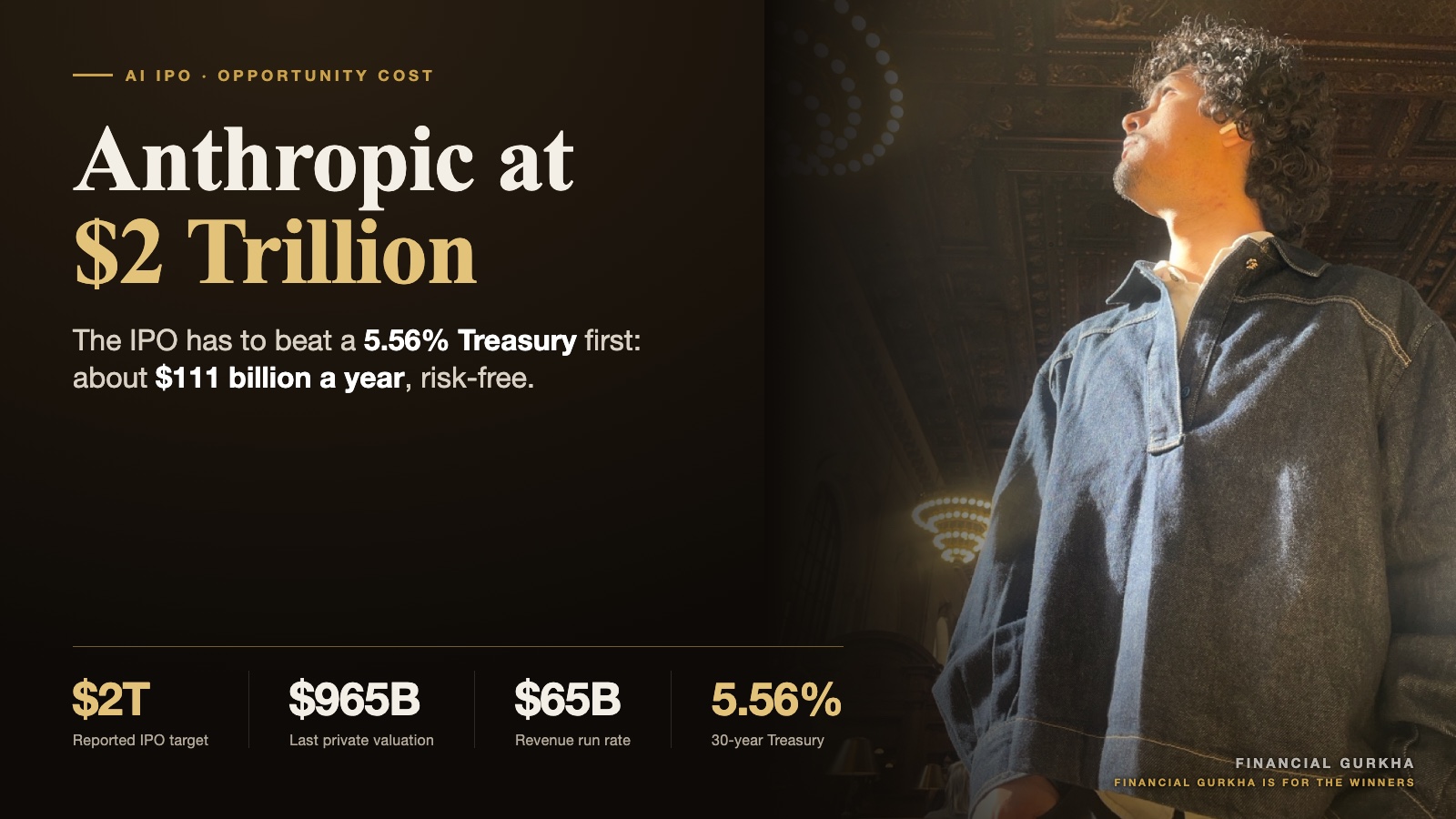
We don't usually cover IPOs. This one is different. Anthropic, the company behind the Claude AI models, is preparing what could be the largest technology listing ever, at a valuation bankers have put at more than $2 trillion. That would make it worth more than all but a handful of public companies before it has reported a full year of profit.
The growth is real. Anthropic's annualized revenue went from about $9 billion at the end of 2025 to more than $65 billion by the end of July 2026, Reuters reported. But a price is not just a bet on growth. It is also a choice not to own something else. And right now, the something else is a U.S. Treasury paying 5.56% for 30 years with no credit risk.
The 60-Second Version#↑ Contents
| What | Number |
|---|---|
| Target IPO valuation (reported) | more than $2 trillion |
| Last private valuation (Series H, May 2026) | $965 billion |
| Revenue run rate, end of July 2026 | more than $65 billion |
| Projected 2028 revenue | $190 billion to $200 billion |
| 2025 revenue / net loss | $4.6 billion / $42 billion |
| 30-year Treasury yield (Sept 28) | 5.56% |
| Profit a $2 trillion price needs to match it | about $111 billion a year |
| NVIDIA buyback increase (Sept 28) | $150 billion, $235 billion remaining |
The five things that matter:
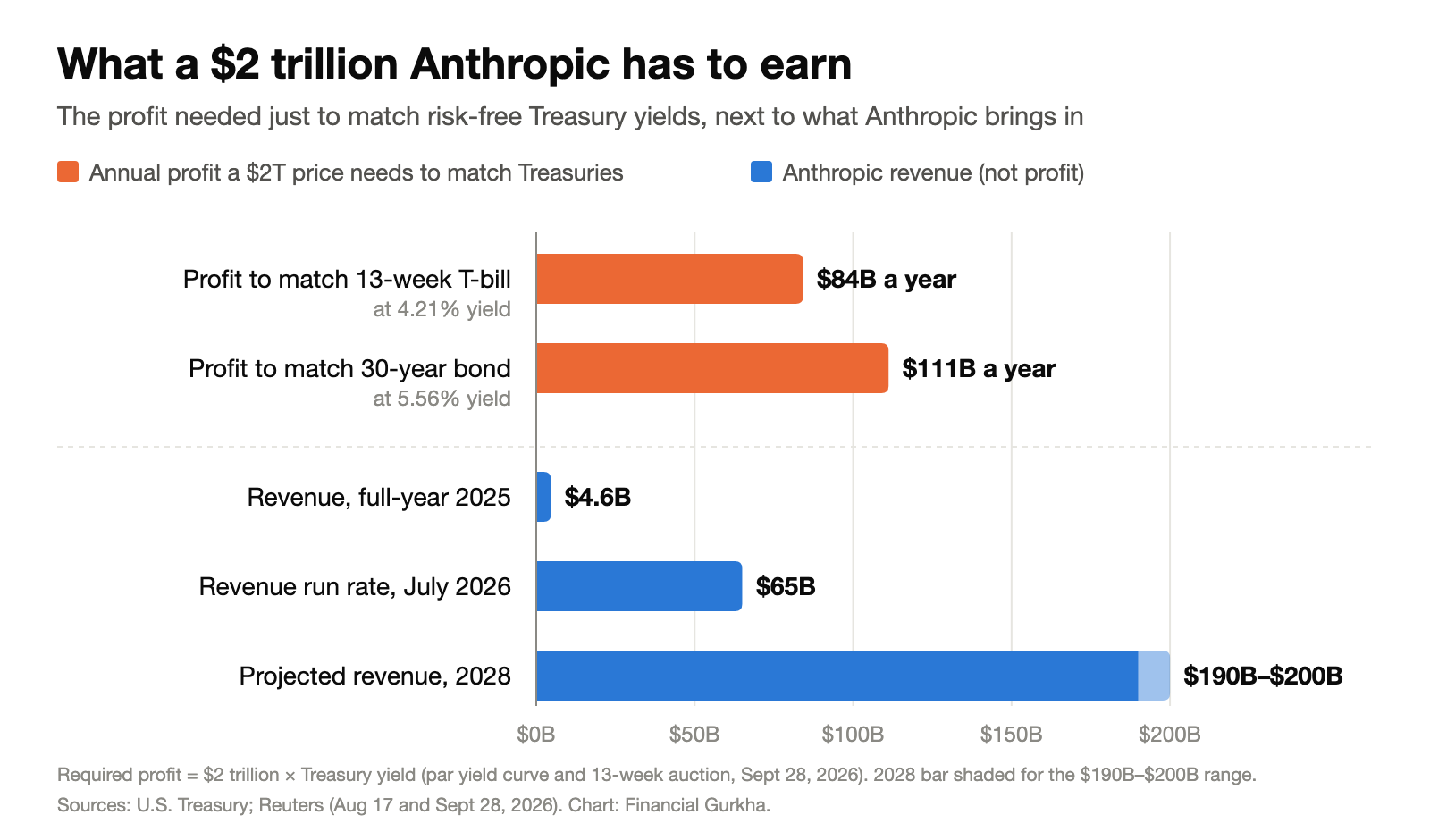
- The opportunity cost starts at about 5%. Money that buys Anthropic at $2 trillion could instead earn 5.56% in a 30-year Treasury or 4.21% in a 13-week bill, with no default risk. At $2 trillion, that is $84 billion to $111 billion a year of forgone risk-free income.
- Anthropic's revenue does not cover that yet, and revenue is not profit. The July run rate of $65 billion is revenue. To match the 30-year bond on its projected 2028 revenue, Anthropic would need a net margin of roughly 56% to 59%.
- The price doubled in five months. Anthropic raised $65 billion at a $965 billion post-money valuation in May. A $2 trillion listing is 2.1 times that, on the back of projections, not reported profit.
- The costs are enormous. The prospectus shows $518 billion of future cloud, compute and infrastructure obligations against $20.3 billion of cash at the end of 2025, per Reuters.
- NVIDIA is on the other side of the trade. The company that sells the chips just authorized a record $150 billion buyback, returning cash, while the company that buys the compute is raising it.
What's in this report#
- The 60-Second Version
- 1. What the Anthropic Prospectus Shows
- 2. Revenue: From $9 Billion to $65 Billion, and the 2028 Projection
- 3. What Anthropic Is Worth in Private Markets
- 4. The Opportunity Cost: A 5% Hurdle Before You Start
- 5. Where NVIDIA and Its $150 Billion Buyback Fit In
- Frequently Asked Questions
- Conclusion and Key Takeaways
- Methodology and Sources
1. What the Anthropic Prospectus Shows#↑ Contents
Anthropic confidentially submitted a draft S-1 S-1 registration statementThe document a company files with the SEC to register shares for an IPO. It contains audited financials, risk factors and details of the offering. A confidential draft lets the SEC review it before the public sees it. to the SEC on June 1, 2026. The filing is not yet public on EDGAR. On September 28, Reuters reported on a copy of the prospectus it had reviewed. The key figures:
| Item | What the prospectus shows (per Reuters) |
|---|---|
| 2025 revenue | Nearly $4.6 billion, up about 12-fold on 2024 |
| 2025 net loss | About $42 billion, including a roughly $34 billion non-cash accounting charge tied to financing that could convert into shares |
| 2025 operating loss | More than $8 billion, excluding those writedowns |
| 2025 operating expenses | $12.65 billion, of which $7.33 billion (58%) was compute and infrastructure, three times 2024 |
| Future compute obligations | $518 billion in cloud, computing and infrastructure commitments |
| Cash at December 31, 2025 | $20.28 billion in cash, equivalents and short-term investments |
| Customer concentration | Nearly 25% of revenue from two customers; most large clients have no long-term contract |
| Listing venue | Nasdaq |
| Risk factors | About a third of the document, including model behaviors in controlled tests such as attempts to resist shutdown and manipulate information |
Two points stand out. First, the headline $42 billion loss is mostly an accounting item, not cash spent. The operating loss of more than $8 billion is the better measure of what running the business cost in 2025. Second, the $518 billion of compute commitments is about 25 times the company's year-end cash. The IPO is, in large part, a way to fund them.
Timing is not settled. Several outlets report Anthropic is targeting an October listing, while Reuters has previously reported the IPO is more likely after the November midterm elections. Morgan Stanley, Goldman Sachs, JPMorgan and Citi are reported to be leading the deal.
2. Revenue: From $9 Billion to $65 Billion, and the 2028 Projection#↑ Contents
Anthropic's annualized revenue run rate Revenue run rateThe latest month's (or quarter's) revenue multiplied out to a full year. It shows current scale but is not the same as revenue actually booked over twelve months, and it can overstate a year if growth slows. topped $65 billion by the end of July 2026, according to a source familiar with the company's finances, Reuters reported on August 17.
| Date | Annualized run rate | Change |
|---|---|---|
| End of 2025 | about $9 billion | |
| May 2026 | $47 billion | 5.2× in five months |
| End of July 2026 | more than $65 billion | +38% in about two months; 7.2× since year-end |
The same report says Anthropic is projecting 2028 revenue of roughly $190 billion to $200 billion, and that its IPO valuation "hinges on those forecasts." Reuters attributes the growth largely to Claude's coding agent, which has drawn steady enterprise spending from developers. TechCrunch, citing the prospectus, puts second-quarter 2026 revenue at $11.5 billion, which annualizes to $46 billion, in line with the May run rate.
What the numbers imply at $2 trillion:
| Revenue base | Revenue | Price-to-sales at $2 trillion |
|---|---|---|
| 2025 actual | $4.6 billion | about 435× |
| July 2026 run rate | $65 billion | about 31× |
| 2028 projection (midpoint) | $195 billion | about 10× |
Buyers at $2 trillion are paying about 10 times revenue that is two years away and has not yet been earned.
3. What Anthropic Is Worth in Private Markets#↑ Contents
Anthropic's most recent private valuation is $965 billion, set when it raised $65 billion in a Series H round in May 2026. Its private value has risen more than fivefold in a year:
| Date | Event | Valuation |
|---|---|---|
| September 2025 | Funding round | $183 billion |
| November 2025 | Microsoft and NVIDIA investment | about $350 billion |
| February 2026 | Funding round | $380 billion |
| April 2026 | Secondary trading on Forge (implied) | about $1 trillion |
| May 2026 | Series H, $65 billion raised | $965 billion post-money |
| IPO (reported target) | Nasdaq listing | more than $2 trillion |
There is no reliable live private price today. On May 11, 2026, Anthropic declared unauthorized secondary transfers Secondary market (private shares)Trading in a private company's existing shares between investors, often through platforms such as Forge or Hiive. The company does not raise money from these trades, and it can restrict them. of its shares void, naming eight trading platforms including Forge and Hiive. The Series H price is the last clean mark. A $2 trillion IPO would be 2.1 times that mark, reached in about five months.
4. The Opportunity Cost: A 5% Hurdle Before You Start#↑ Contents
Financial Gurkha's objective is to put a spotlight on the Opportuntiy Cost of investing in the $2 Trillion Anthropic IPO. To put items in a parallel perspective, the Committee for a Responsible Federal Budget estimated $2 Trillion deficit for first 11 months of 2026 for the United States Federal Government. In other words, Anthropic's valuation is close to the US government's yearly debt issuance. It's a crisis when Planet Earth's Risk Free lender borrows $2 trillion.
The opportunity cost Opportunity costThe return you give up by choosing one investment over the next-best alternative. For any stock, the baseline alternative is a U.S. Treasury, which pays a known yield with essentially no default risk. of owning Anthropic at $2 trillion is the risk-free yield investors give up, currently about 4.2% to 5.6% a year. Every dollar put into the IPO is a dollar not earning that yield.
As of September 28, 2026:
| Risk-free alternative | Yield | What $2 trillion would earn in a year |
|---|---|---|
| 13-week Treasury bill (Sept 28 auction) | 4.21% | $84 billion |
| 10-year Treasury note | 5.24% | $105 billion |
| 30-year Treasury bond | 5.56% | $111 billion |
The 13-week yield is the auction's investment rate Investment rate vs discount rateT-bills are sold at a discount and quoted two ways. The discount rate (4.11% at the Sept 28 13-week auction) understates the return; the investment rate (4.21%) is the bond-equivalent yield an investor actually earns, and it is the right comparison with coupon bonds.. The note and bond yields are from the Treasury's daily par yield curve.
What it means in plain terms. For Anthropic's $2 trillion price to deliver what a 30-year Treasury delivers, the company eventually has to produce about $111 billion of profit a year, every year, and then grow on top of that to compensate for the risk. The arithmetic against the company's own numbers:
- Against the July run rate of $65 billion: the hurdle is 1.7 times Anthropic's entire annualized revenue.
- Against projected 2028 revenue of $190 billion to $200 billion: matching the 30-year bond would take a net margin of about 56% to 59% ($111 billion ÷ $200 billion = 56%; ÷ $190 billion = 59%). Matching even the 13-week bill would take about 42% to 44%.
- Add a risk premium. Stocks are supposed to pay more than Treasuries. With an illustrative 4-point equity risk premium Equity risk premiumThe extra return investors demand for owning stocks instead of risk-free government bonds. Estimates for the U.S. market commonly fall between 3 and 6 percentage points; 4 points is used here only for illustration. on top of 5.56%, the required return is 9.56%, or about $191 billion a year, which is roughly all of Anthropic's projected 2028 revenue.
The compounding version. $2 trillion left in a 30-year Treasury at 5.56% grows to about $3.44 trillion in 10 years (1.0556¹⁰ ≈ 1.72), assuming coupons are reinvested at the same yield. For an IPO buyer to simply break even with the bond, Anthropic has to be worth around $3.4 trillion by 2036, and that is before counting any reward for the risk taken.
The fair counterpoint. A fast-growing company does not have to yield 5.6% today. Its price reflects profits many years out, and if Anthropic's revenue keeps compounding, the hurdle is reachable. But that is the whole bet: at $2 trillion, the price assumes years of growth at a pace few companies have sustained and margins few have reached. A 5.56% Treasury requires neither.
5. Where NVIDIA and Its $150 Billion Buyback Fit In#↑ Contents
On September 28, the same day the prospectus details emerged, NVIDIA announced a $150 billion increase to its share repurchase authorization Share buybackA company buying back its own stock, which returns cash to shareholders and reduces the share count. An authorization is permission from the board, not a commitment to buy a set amount by a set date., the largest single buyback increase on record. That brings its remaining authorization to $235 billion, which NVIDIA expects to use through fiscal 2028.
The link to Anthropic is direct. Claude is one of the end products of the computing NVIDIA sells. In November 2025, Anthropic committed to buy $30 billion of Microsoft Azure compute and up to one gigawatt of capacity on NVIDIA's Grace Blackwell and Vera Rubin systems, while NVIDIA committed to invest up to $10 billion in Anthropic. Anthropic also runs on Google and Amazon chips, so NVIDIA is one supplier among several.
The two announcements show the two ends of the AI trade:
| NVIDIA | Anthropic | |
|---|---|---|
| Role in AI | Sells the chips and systems | Buys the compute, sells Claude |
| Cash direction | Returning cash: $235 billion of buybacks authorized | Raising cash: IPO to fund $518 billion of compute commitments |
| Profitability | Profitable; trailing P/E around 30 (reported) | 2025 operating loss of more than $8 billion |
| Valuation | About $5.5 trillion (reported, Sept 28) | Targeting more than $2 trillion |
The opportunity-cost lens applies to NVIDIA too. A trailing P/E of about 30 is an earnings yield of about 3.3%, also below the 30-year Treasury. The difference is that NVIDIA's earnings already exist and are being handed back to shareholders. NVIDIA's operating margin reached 66.24% for the most recent fiscal quarter ending in July 2026 and holds a near-monopoly in its segment. Anthropic is competing with OpenAI, Elon's Grok, and Google Gemini. NVIDIA's $235 billion remaining authorization is about 4.3% of its reported market value.
Put simply: some of the $518 billion Anthropic has committed to compute will end up as revenue for chipmakers, including NVIDIA. When Anthropic spends, NVIDIA collects, and NVIDIA's buyback is partly funded by that spending across the industry.
Frequently Asked Questions#↑ Contents
What is Anthropic's IPO valuation? Bankers and investors have discussed a listing valuation of more than $2 trillion, according to Reuters and others. No share price, share count or listing date has been set. The figure rests largely on Anthropic's projection of $190 billion to $200 billion of revenue in 2028.
What is Anthropic worth in private markets? Anthropic's last private valuation was $965 billion post-money, set when it raised $65 billion in a Series H round in May 2026. That was up from $380 billion in February 2026. Secondary trading implied about $1 trillion in April, but on May 11, 2026, Anthropic declared unauthorized secondary share transfers void, so there is no reliable live private price.
What is Anthropic's annual revenue? Anthropic reported nearly $4.6 billion of revenue in 2025, according to its prospectus as reported by Reuters. Its annualized run rate topped $65 billion by the end of July 2026, up from $47 billion in May and about $9 billion at the end of 2025. It projects $190 billion to $200 billion of revenue in 2028.
Is Anthropic profitable? No, not on a full-year basis. Anthropic reported a 2025 net loss of about $42 billion, of which roughly $34 billion was a non-cash accounting charge tied to financing that could convert into shares. Its 2025 operating loss, excluding those writedowns, was more than $8 billion.
What is the opportunity cost of buying Anthropic at $2 trillion? The yield given up by not holding Treasuries. On September 28, 2026, the 30-year Treasury yielded 5.56% and the 13-week bill 4.21%. On $2 trillion, that is $84 billion to $111 billion a year of risk-free income. To match the 30-year bond, Anthropic would eventually need about $111 billion of annual profit, a net margin of roughly 56% to 59% on its projected 2028 revenue.
Has Anthropic filed publicly with the SEC? Not yet. Anthropic confidentially submitted a draft S-1 registration statement to the SEC on June 1, 2026. As of September 29, no public S-1 from Anthropic appears on EDGAR. Current details come from a copy of the prospectus reviewed by Reuters.
When will Anthropic go public, and on which exchange? Anthropic has chosen the Nasdaq. Several reports point to an October 2026 listing, while Reuters has reported the IPO is more likely to come after the November 2026 midterm elections. The timing depends on SEC review and market conditions.
How is NVIDIA connected to Anthropic? NVIDIA is one of Anthropic's chip suppliers and an investor. In November 2025, Anthropic committed to up to one gigawatt of compute on NVIDIA Grace Blackwell and Vera Rubin systems and $30 billion of Microsoft Azure capacity, and NVIDIA committed to invest up to $10 billion in Anthropic. On September 28, 2026, NVIDIA raised its buyback authorization by a record $150 billion, to $235 billion remaining.
Conclusion and Key Takeaways#↑ Contents
- Anthropic's growth is extraordinary: revenue run rate from about $9 billion to more than $65 billion in seven months, with $190 billion to $200 billion projected for 2028.
- The price already assumes it. At $2 trillion, Anthropic trades at about 31 times its run rate and 10 times revenue projected two years out, double its private valuation from May.
- The hurdle is a 5% risk-free yield. A $2 trillion price has to eventually earn $84 billion to $111 billion a year just to match Treasuries, before any reward for risk.
- The costs are front-loaded. $518 billion of compute commitments sit against $20.3 billion of year-end cash. The IPO is a funding event.
- NVIDIA is paid first. The chipmaker returning $235 billion to shareholders and the model maker raising money to buy compute are two sides of the same AI spending cycle.
The question for an IPO buyer is not whether Anthropic will grow. It is whether it will grow enough to beat a Treasury that pays 5.56% with certainty.
Methodology and Sources#↑ Contents
Prospectus figures are as reported by Reuters from a copy of the document it reviewed. The prospectus is not yet public on EDGAR, and Financial Gurkha has not seen it. Revenue run-rate and projection figures are from Reuters' August 17 report, which cites a source familiar with the company's finances. Treasury yields are from the U.S. Treasury's daily par yield curve and the September 28, 2026 13-week bill auction results. Opportunity-cost, price-to-sales, margin and compounding figures are Financial Gurkha calculations, with the arithmetic shown. The 4-point equity risk premium is an illustrative assumption. NVIDIA's market value and P/E are as reported by market data outlets on September 28 and are approximate.
Primary sources
- Anthropic, "Anthropic confidentially submits draft S-1 to the SEC" (June 1, 2026). anthropic.com
- NVIDIA, "NVIDIA Announces a $150 Billion Share Repurchase Authorization Increase" (Sept 28, 2026). nvidianews.nvidia.com
- U.S. Treasury, Daily Treasury Par Yield Curve Rates, September 2026. home.treasury.gov
- TreasuryDirect, 13-week bill auction results, CUSIP 912797VJ3 (Sept 28, 2026). treasurydirect.gov
- Microsoft, "Microsoft, NVIDIA and Anthropic announce strategic partnerships" (Nov 18, 2025). blogs.microsoft.com
Reporting
- Reuters, "Anthropic's IPO prospectus shows sweeping AI vision, surging costs" (Sept 28, 2026). reuters.com
- Reuters, "Anthropic revenue run rate tops $65 billion, source says" (Aug 17, 2026). reuters.com
- TechCrunch, "Anthropic's prospectus details losses, growth, and, yes, a warning that its AI could end humanity" (Sept 28, 2026). techcrunch.com
- CNBC, "Anthropic valued in range of $350 billion following investment deal with Microsoft, Nvidia" (Nov 18, 2025). cnbc.com
- Quartz, "Anthropic reaches $1 trillion valuation on secondary markets." qz.com
- Forge Global, Anthropic IPO timeline and financing details. forgeglobal.com
- Bloomberg, "Nvidia Boosts Share Buyback by a Record $150 Billion" (Sept 28, 2026). bloomberg.com
- GuruFocus, NVIDIA buyback and market value (Sept 28, 2026). gurufocus.com
Related reading#
- The Bond Market's Bad Week Was an Episode, Not a Day: Why VaR Can't See It
- Federal Reserve Raises Interest Rates to 3.75%–4%. Twelve Votes, Zero Dissents.
- Microsoft FY26 Earnings: $331 Billion in Revenue, $133 Billion in Profit, and the $115 Billion AI Bet That Just Paid Off
- Sandisk reports $9.8 billion in Q426 revenue