MARKETS · AI · COST OF CAPITAL · U.S. FINANCIAL STABILITY
By Niraj Neupane, CA (ICAI) Quantitative Researcher, Korvane · Financial Economist, Calderyn Institute
Key takeaways
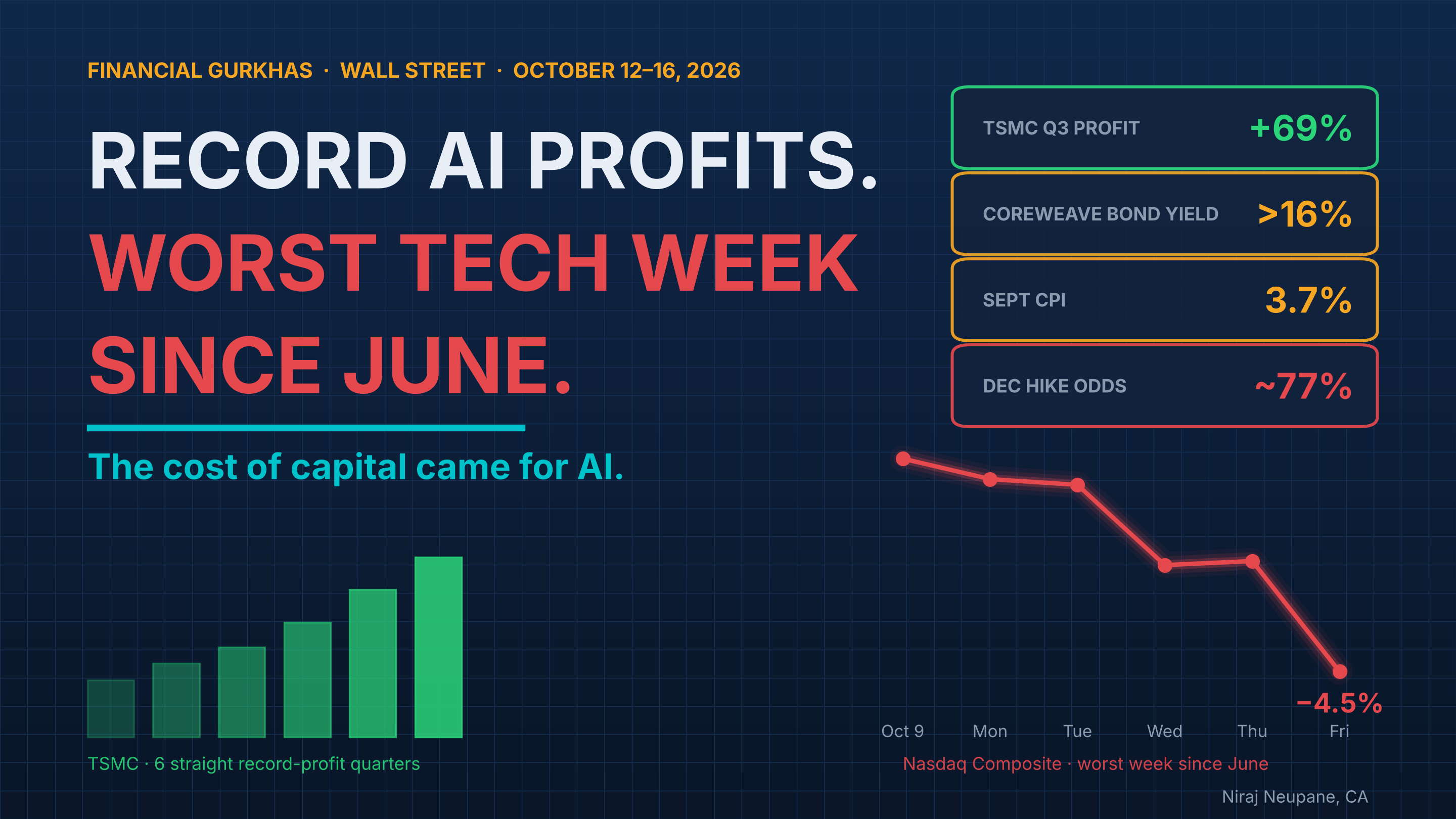
📉 The selloff. The Nasdaq fell 4.5% and the S&P 500 1.9%, both their worst weeks since June. The Dow rose 0.7%. This was a rotation, not a crash.
🔥 The trigger. Inflation came in hot across the board: September CPI 3.7%, PPI +1.3% in a single month, the largest jump since March 2022. Markets now price about a 77% chance of a December rate hike.
⚖️ The paradox. TSMC earned a record US$23.6 billion (+69%). CoreWeave, a debt-funded AI-cloud company, lost more than 22% of its value, and its bonds traded like distressed debt.
🧭 The risk lens. AI stocks and AI credit fell together for days: a sector-level stress episode. But Treasuries rallied and the Dow rose, so the market-wide test for a systemic episode was not met.
The week in 10 numbers#↑ Contents
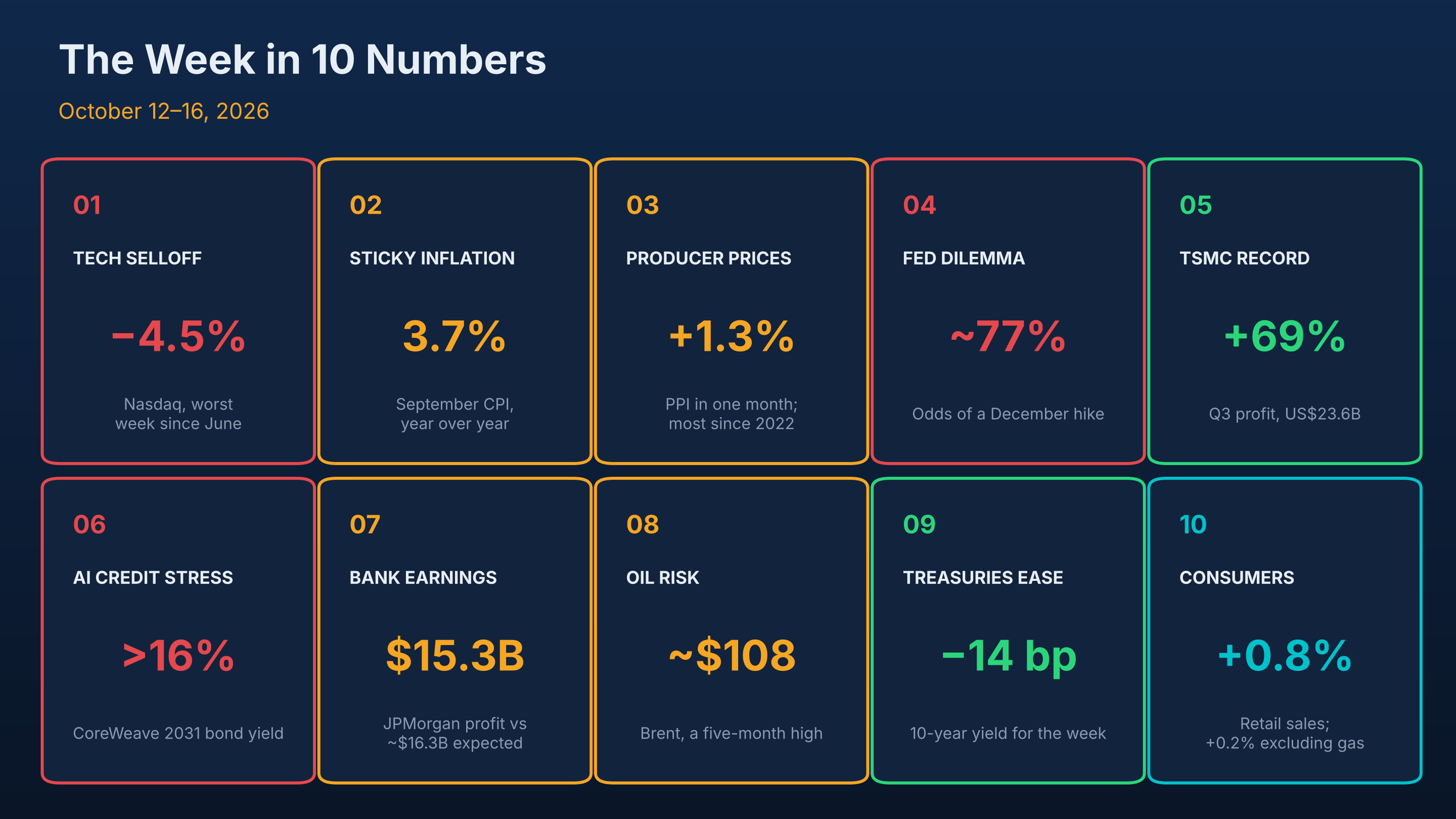
| # | Story | The number | Why it matters |
|---|---|---|---|
| 1 | Tech selloff | Nasdaq −4.5% | Worst week since June; chip makers led the decline |
| 2 | Sticky inflation | CPI 3.7% YoY | Above the 3.6% forecast; up from 3.4% |
| 3 | Producer prices | PPI +1.3% MoM | Largest monthly rise since March 2022; energy +10.8% |
| 4 | Fed dilemma | ~77% odds of a December hike | Hold expected in October; tightening not over |
| 5 | TSMC delivers | Profit +69% to US$23.6B | Sixth straight record quarter on AI chip demand |
| 6 | AI financing scrutiny | CoreWeave bond yield >16% | Default-insurance costs hit a record above 1,000 bp |
| 7 | Bank earnings mixed | JPMorgan $15.3B vs ~$16.3B expected | Dimon warns rate hikes are a major risk |
| 8 | Oil risk | Brent ~$108 | Five-month high on Middle East supply risk |
| 9 | Treasuries ease | 10-year −14 bp for the week | Flight to safety; bonds hedged stocks |
| 10 | Consumers | Retail sales +0.8% | Mostly gasoline; just +0.2% excluding gas stations |
1. The week: a rotation, not a crash#↑ Contents
Three weeks ago, the 30-year Treasury yield hit a 2002 high and stocks shrugged. Last week, stocks set records while yields climbed further. This week, the bill came due, but only for one part of the market.
| Index | Friday close (Oct 16) | Week | Year to date |
|---|---|---|---|
| Nasdaq Composite | 26,140.03 | −4.5% | +12.5% |
| Russell 2000 | 2,721.37 | −3.0% | +9.6% |
| S&P 500 | 7,659.44 | −1.9% | +11.9% |
| Dow Jones | 52,002.41 | +0.7% | +8.2% |
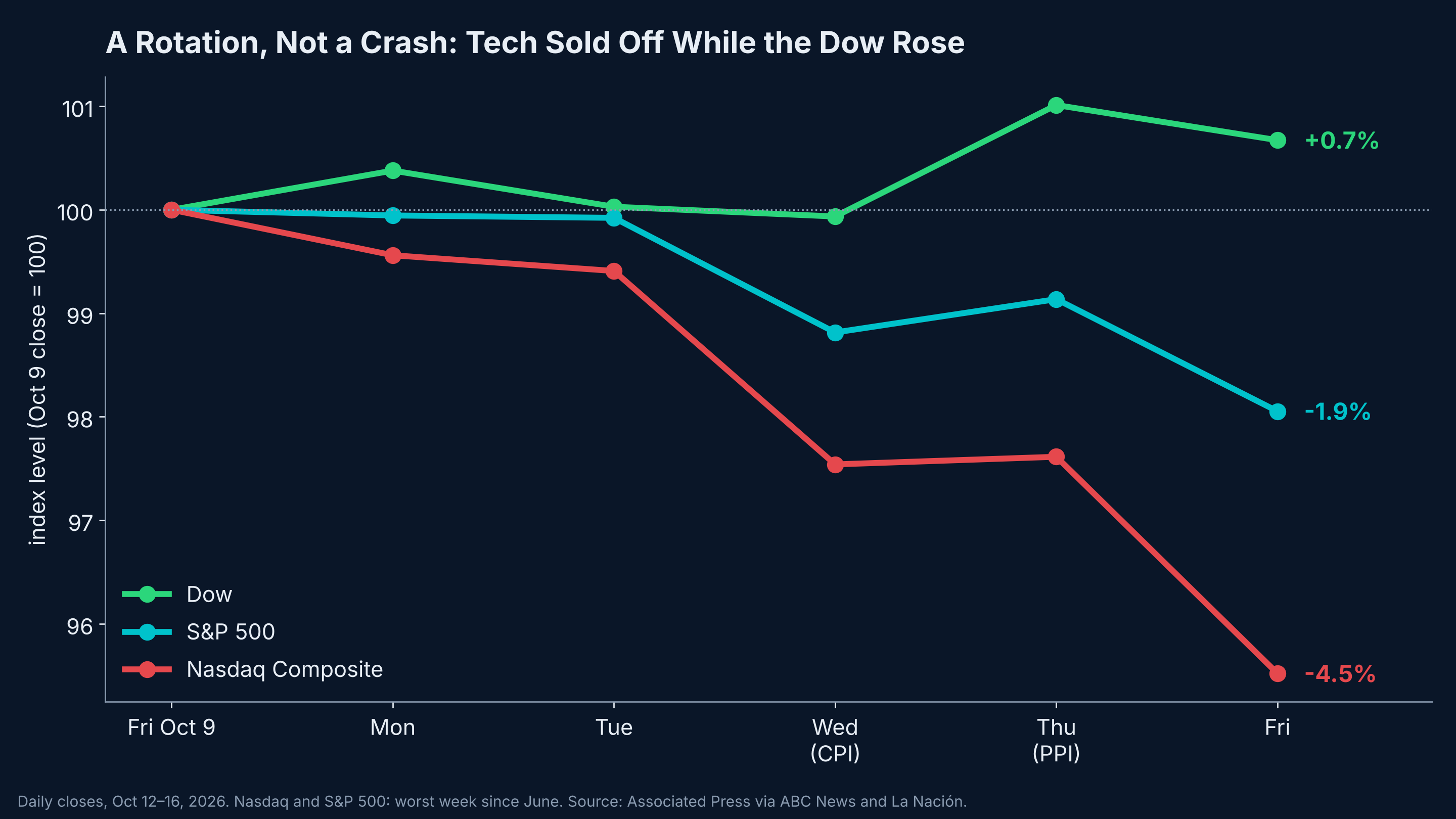
The damage came in two sessions:
- Wednesday, CPI day. The S&P 500 fell 1.1% and the Nasdaq 1.9%, the weakest session since July. AI stocks led the decline as investors priced in higher borrowing costs for AI data-center construction. Bank of America fell after missing profit estimates.
- Friday. The Nasdaq fell another 2.1%. Chip makers extended their pullback as investors questioned how long the AI spending boom can last: Micron fell 5.6% and Intel 5.8%.
Between them, Thursday brought a brief recovery. Strong corporate earnings lifted the Dow 1.1%, and the S&P 500 came back within reach of its record. That interruption matters, and I return to it in Section 6.
"The S&P 500 and Nasdaq each posted their worst week since June, while the Dow fell far less sharply." — Associated Press, October 16, 2026
2. The trigger: every major inflation print came in hot#↑ Contents
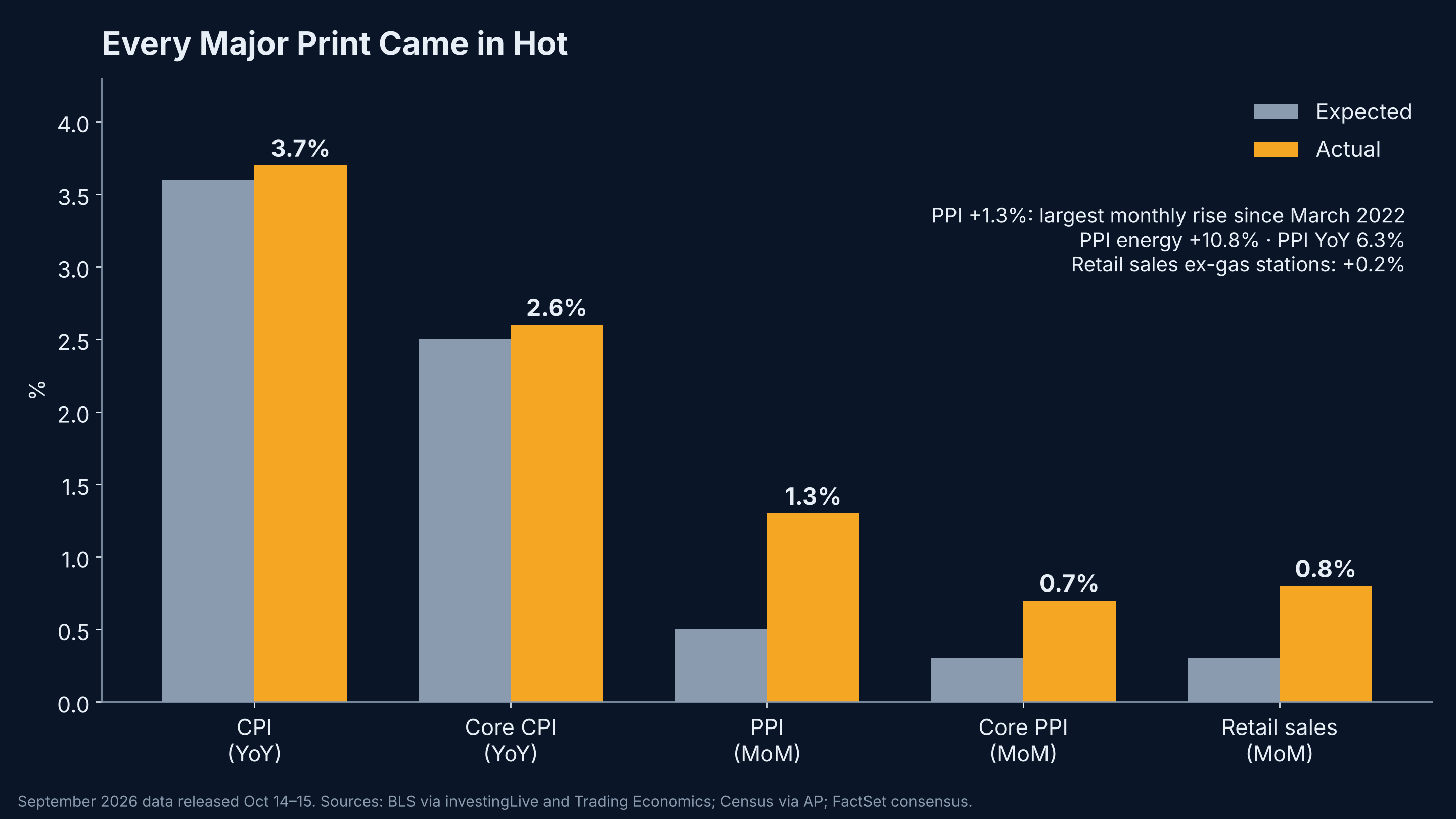
| September data | Actual | Expected | Prior |
|---|---|---|---|
| CPI, year over year | 3.7% | 3.6% | 3.4% |
| Core CPI, year over year | 2.6% | 2.5% | 2.4% |
| PPI, month over month | +1.3% | +0.5% | +0.4% |
| Core PPI, month over month | +0.7% | +0.3% | +0.2% |
| PPI, year over year | 6.3% | 5.3% | 5.4% |
| Retail sales, month over month | +0.8% | +0.3% | +1.3% (revised) |
Three details matter more than the headlines:
1. Energy is the engine. PPI energy costs jumped 10.8% in a single month, driven by the Middle East war. That pushed producer-price inflation to 6.3%, the highest since December 2022.
2. Consumers are paying more, not buying more. Gas station sales rose 6.4%. Excluding them, retail sales grew just 0.2%.
"The large jump in headline retail sales in September was almost entirely due to rising gasoline prices." — Michael Pearce, Oxford Economics
3. Core inflation is low, but rising. At 2.6%, core CPI is far below the headline. But it has now risen two months in a row, the first sign that energy costs are spreading into everything else.
The Fed response is now priced in. Markets expect a hold at the October 27–28 meeting (about 84–85% odds) and a hike in December (about 77%). Cleveland Fed President Beth Hammack warned the Fed may need to act more aggressively if public inflation expectations deteriorate.
3. The AI paradox: record demand, strained financing#↑ Contents
This week's most revealing contrast was between two companies at opposite ends of the AI supply chain.
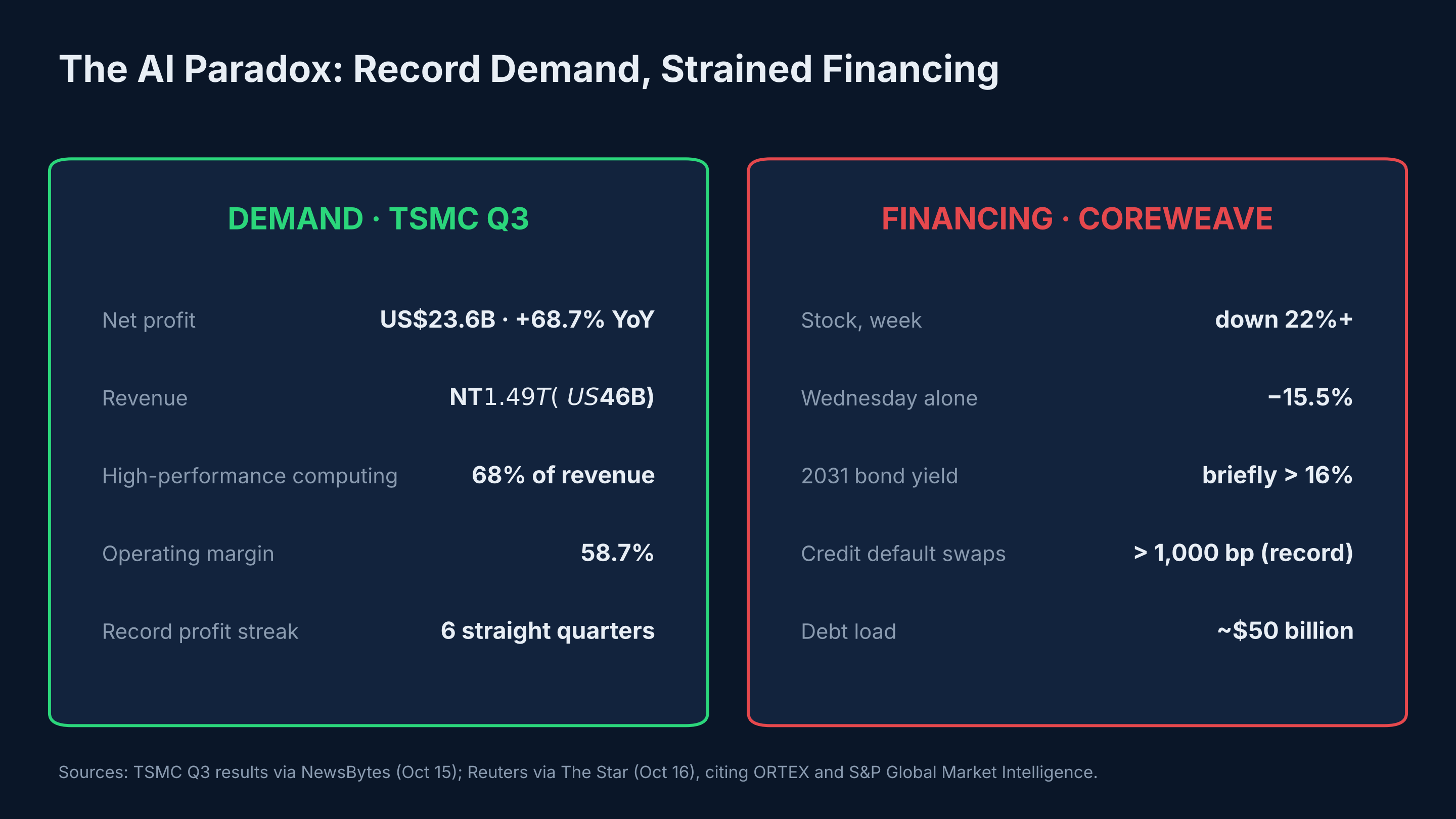
| 🟢 TSMC: AI demand | 🔴 CoreWeave: AI financing | |
|---|---|---|
| Business model | Sells the chips, paid in cash | Borrows to buy chips, rents out computing power |
| This week | Record Q3 profit of US$23.6B, up 68.7% | Stock down 22%+ for the week; −15.5% on Wednesday alone |
| Key metric | High-performance computing = 68% of revenue | 2031 bond yield briefly above 16% |
| Balance sheet | Free cash flow NT$477B, more than triple a year ago | About $50 billion of debt |
| Credit market view | Six straight quarters of record profit | Default-insurance cost above 1,000 bp, a record |
| The lesson | AI demand is real and accelerating | Debt-funded AI growth gets harder as rates rise |
Both are "AI companies," but they face completely different risks. TSMC sells picks and shovels and gets paid today. CoreWeave borrows today against revenue it expects tomorrow. When rate hikes return to the table, that bet gets more expensive.
The credit market moved first. CoreWeave's bonds are on track for a fifth straight weekly decline, and the selling spread to similar firms: Nebius fell 6.4%, IREN 5.5% and Applied Digital 4.2%.
Wall Street is divided:
"The market may be treating the higher bond yield as 'the business model has stopped working.'" — Evercore, which kept its outperform rating
"The revenue is just not going to be there to turn a profit." — Todd Schoenberger, CrossCheck Management
"You cannot take CoreWeave as the poster child for AI." — Tommaso Leodari, Index & Cie
The broader lesson: AI demand and AI returns are two separate questions. This week, the market began pricing them separately.
4. How oil became an AI problem#↑ Contents
The week's events form one chain, running from the Strait of Hormuz to Silicon Valley's cost of capital:
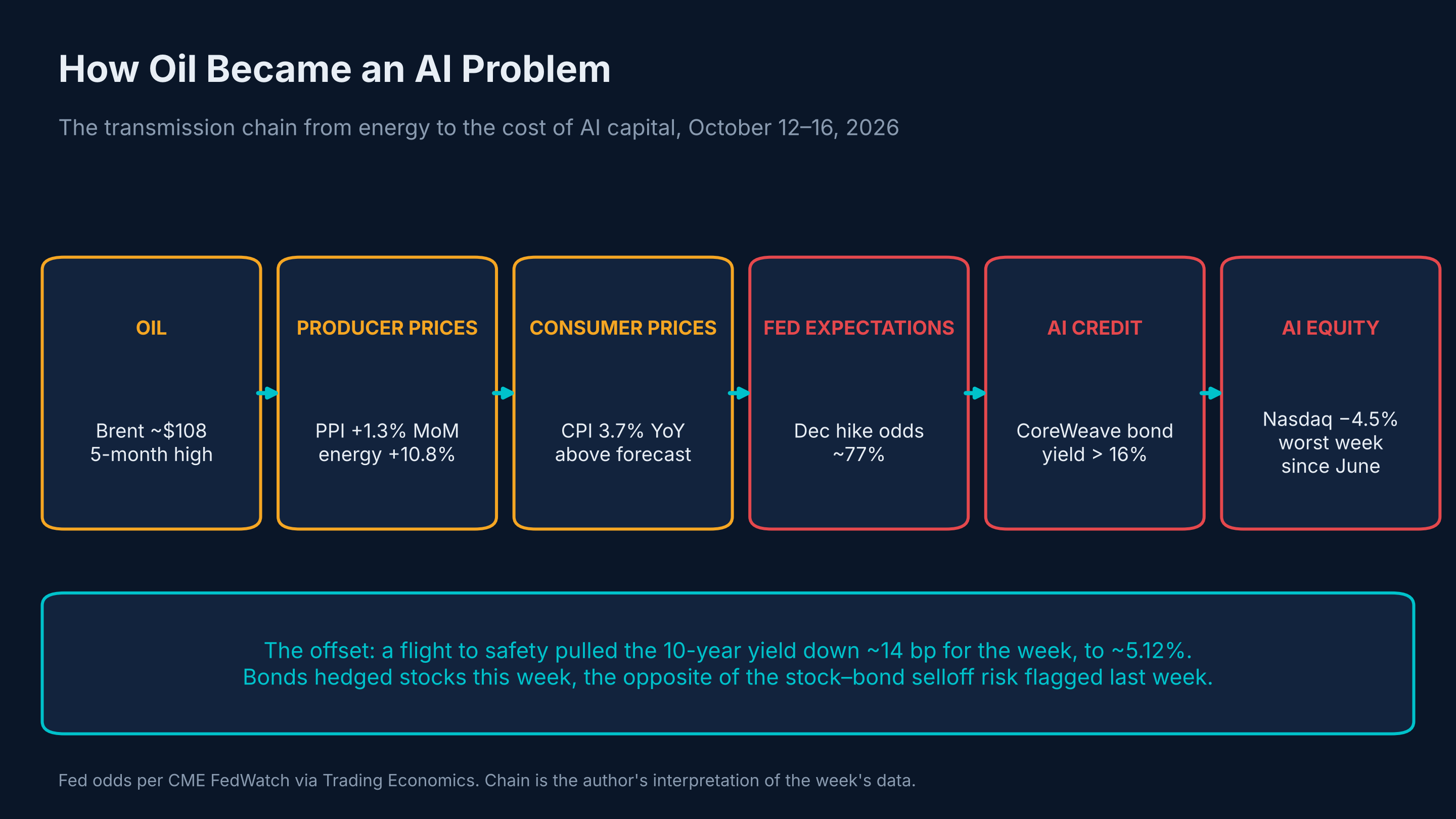
| Link | Evidence this week |
|---|---|
| 1. Oil | Brent near $108, a five-month high |
| 2. Producer prices | PPI +1.3%, energy +10.8% |
| 3. Consumer prices | CPI 3.7%, above forecast |
| 4. Fed expectations | December hike odds about 77% |
| 5. AI credit | CoreWeave bond yield briefly above 16% |
| 6. AI equity | Nasdaq −4.5%, worst week since June |
The offset that kept the week contained. Despite hot inflation, the 10-year Treasury yield fell about 14 basis points, to roughly 5.12%, as investors moved out of AI trades and into government bonds. In other words, bonds hedged stocks. That is the opposite of the stock–bond selloff I flagged as the main risk last week, and it was the single most important stabilizer of the week.
5. Banks: strong trading, cautious bankers#↑ Contents
The third-quarter earnings season opened with a split message: booming markets businesses and worried executives.
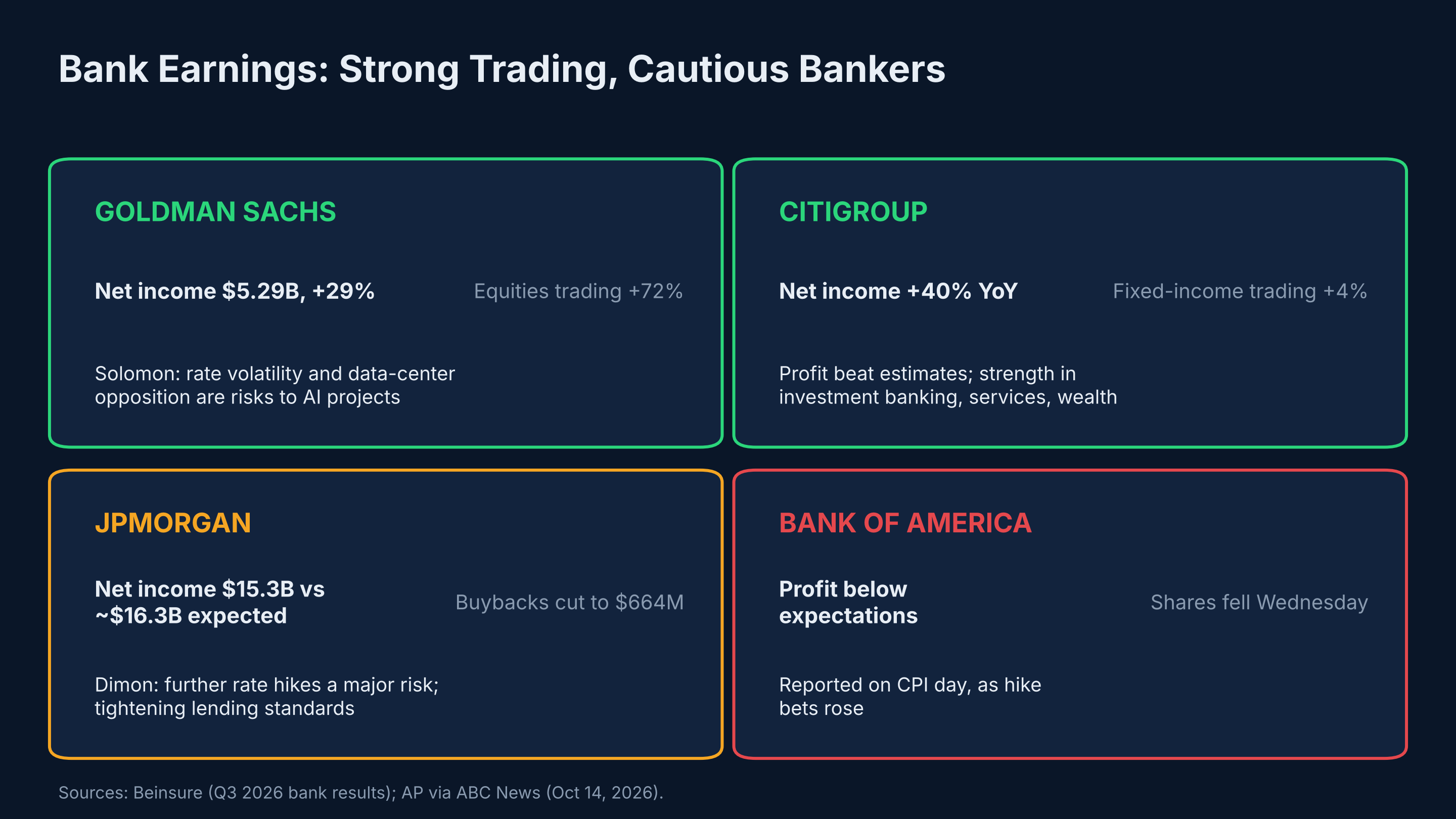
| Bank | Result | What leadership said |
|---|---|---|
| Goldman Sachs | Net income $5.29B, +29%; equities trading +72% | Rate volatility and data-center opposition are risks to AI infrastructure projects |
| Citigroup | Net income +40% year over year | Strength in investment banking, services and wealth |
| JPMorgan | Net income $15.3B vs ~$16.3B expected; buybacks cut to $664M | Further rate hikes are a major risk; the bank is tightening lending standards |
| Bank of America | Profit below expectations; shares fell | Reported on CPI day as hike bets rose |
JPMorgan's warnings deserve the most attention. Jamie Dimon pointed to weaker loan covenants and more payment-in-kind interest, where borrowers pay interest with new debt instead of cash. These are classic late-cycle credit signals, and they connect directly to the AI financing story: the companies most exposed to higher rates are the ones that borrowed most to grow.
6. The risk lens: a sector episode, not a systemic one#↑ Contents
My research measures market stress as episodes: connected runs of extreme losses, rather than one bad day at a time.
| Paper | What it measures |
|---|---|
| 📄 Conditional Tail Episode Risk (TER/CTER) | How severe a connected run of extreme losses becomes in one market |
| 📄 Systemic Tail Episode Risk (STER) | Whether several markets are in their tails at the same time, for how long, and with what cumulative damage |
The episode view of this week#
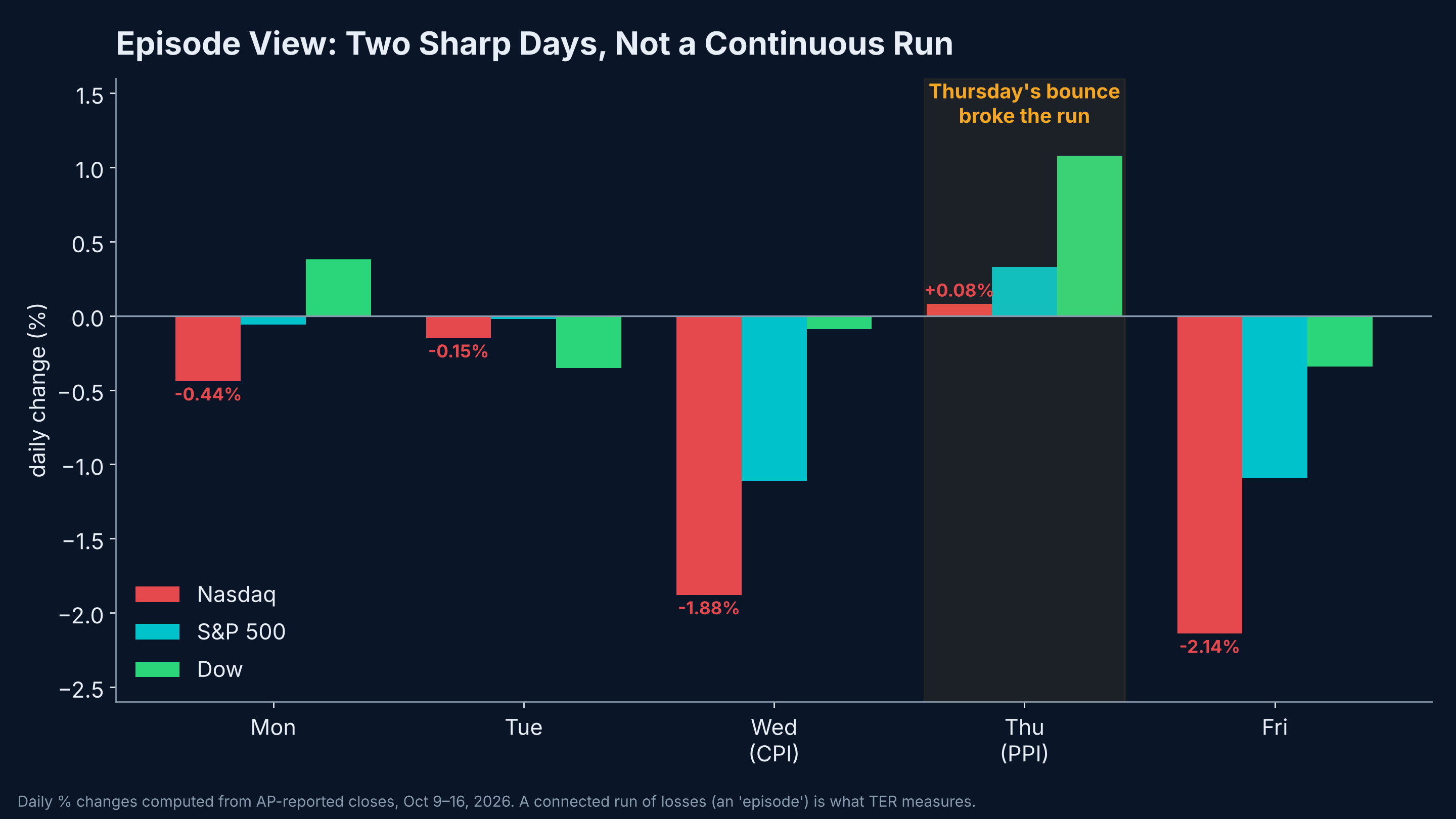
The Nasdaq's 4.5% weekly loss came mostly from two sharp days, Wednesday (−1.88%) and Friday (−2.14%), separated by Thursday's small gain. In TER terms, Thursday broke the run. That matters: a market that gets a day to reset, meet margin calls and rebalance is in a very different position from one that suffers the same losses back to back.
The systemic view of this week#
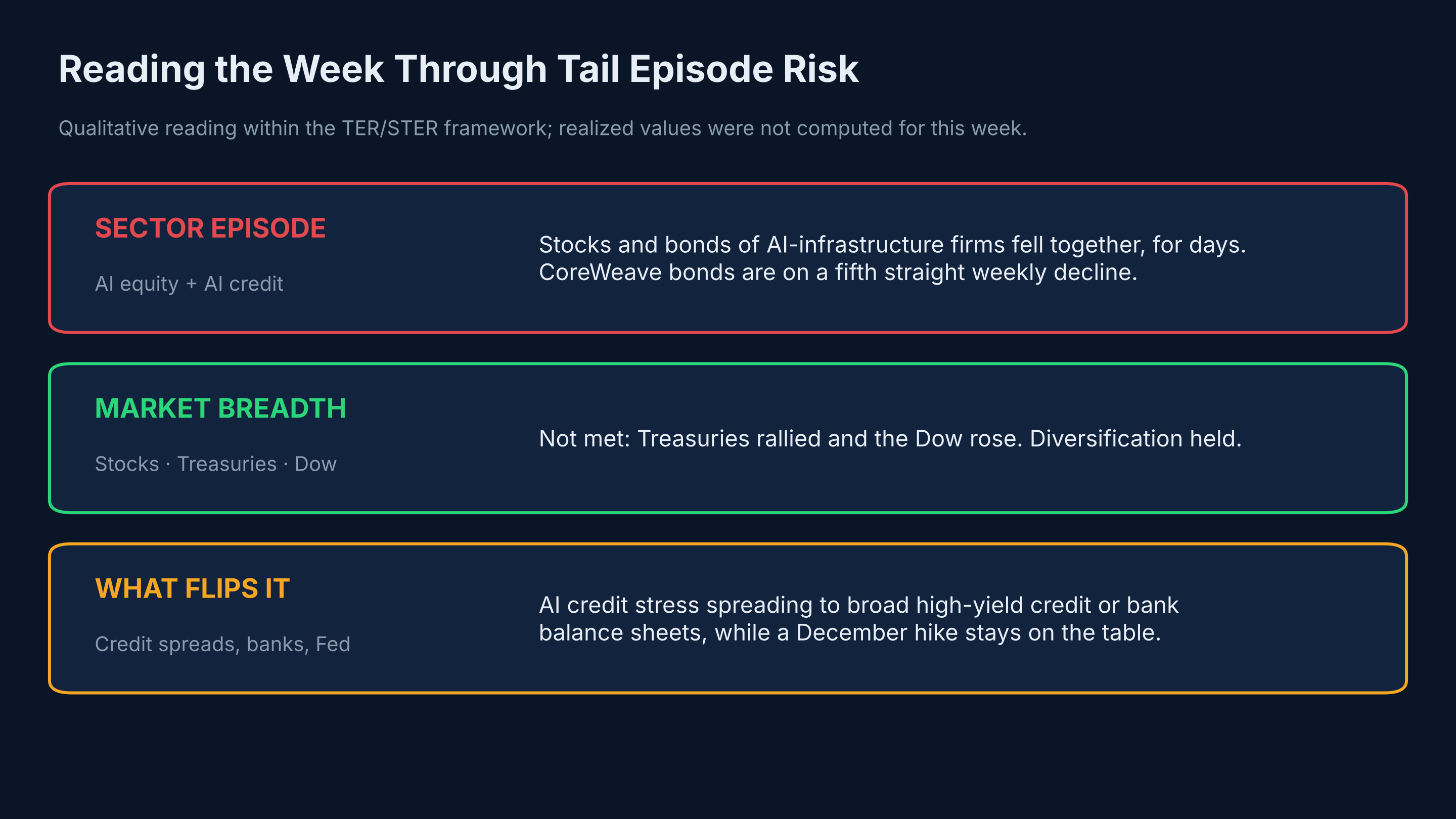
(A qualitative reading within the TER/STER framework; realized values were not computed for this week.)
| Lens | This week | Interpretation |
|---|---|---|
| Sector episode | AI stocks and AI bonds fell together; CoreWeave bonds down five straight weeks | A synchronized, persistent episode inside the AI-infrastructure complex |
| Market episode | Two sharp Nasdaq days, interrupted by Thursday's recovery | The run was broken, limiting cumulative severity |
| Systemic breadth | Treasuries rallied; the Dow rose | Not met. Diversification held across asset classes |
| What flips it | AI credit stress spreading to broad high-yield credit or bank balance sheets, with a December hike on the table | The path from a sector episode to a systemic one |
Three weeks, one pattern#
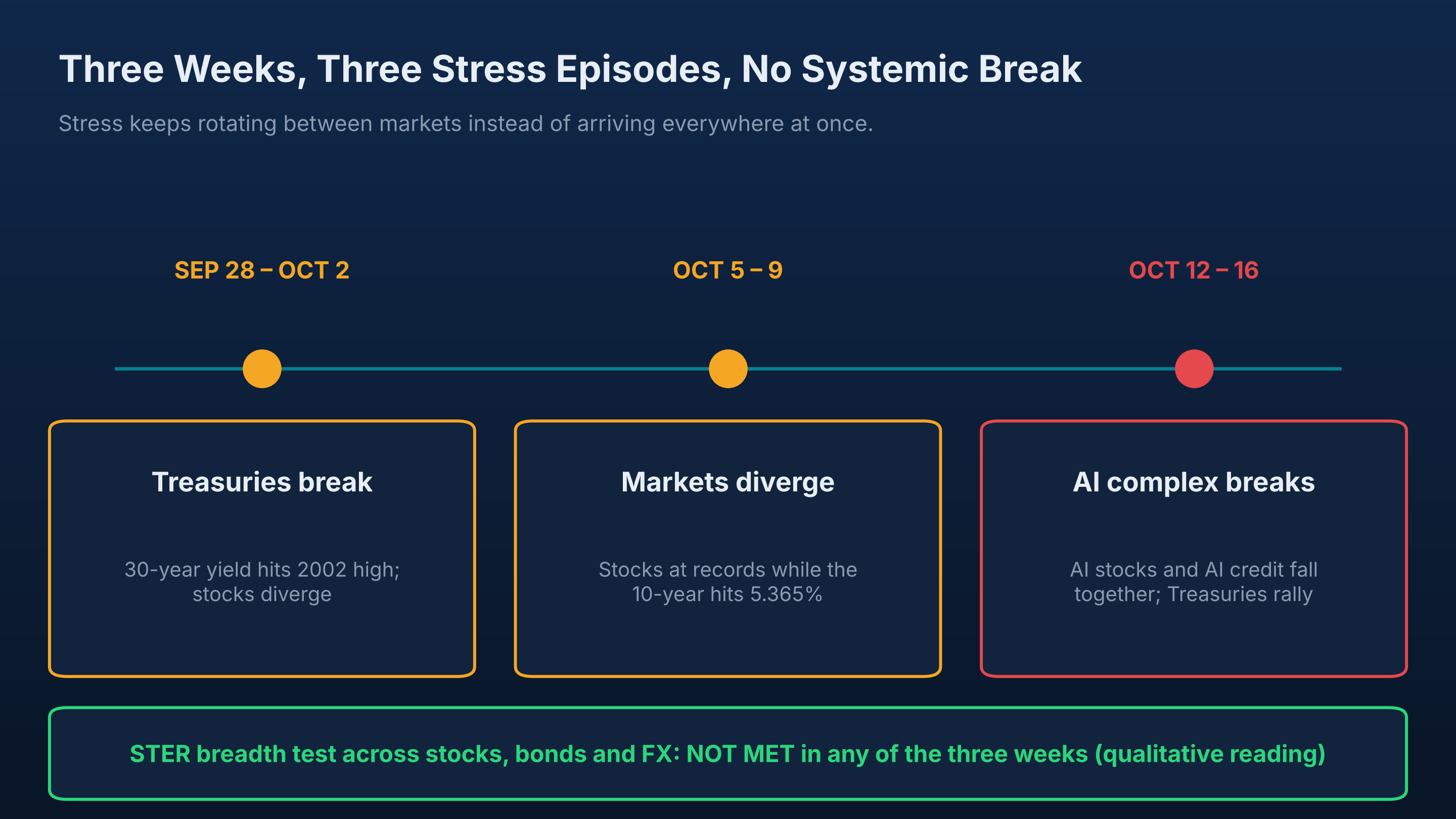
| Week | What broke | Episode type |
|---|---|---|
| Sep 28 – Oct 2 | 30-year yield hit a 2002 high; stocks didn't follow | Single-market episode (Treasuries) |
| Oct 5 – 9 | Stocks hit records while the 10-year hit 5.365% | Treasury stress persists; markets diverge |
| Oct 12 – 16 | AI stocks and AI credit fell together; Treasuries rallied | Sector episode; breadth still not met |
The pattern is clear. Stress keeps appearing, but it keeps rotating between markets instead of arriving everywhere at once. That rotation is what has kept this a difficult market rather than a crisis. The moment to worry is when the rotation stops, and credit, equities and Treasuries come under pressure together. That is exactly the condition STER is built to measure.
7. Why this matters beyond Wall Street#↑ Contents
| Who | Why this week matters |
|---|---|
| 🏠 Households | Gasoline is absorbing spending; retail sales outside gas stations barely grew |
| 🏗️ Workers and local economies | AI data-center construction is now sensitive to borrowing costs and local opposition |
| 🏦 Banks and lenders | Tighter lending standards and more payment-in-kind interest are late-cycle credit signals |
| 💼 Retirement savers | AI-linked stocks are a large share of major indexes; a sector episode moves 401(k)s |
| 🏛️ Policymakers | Energy-driven inflation forces a hard choice between fighting prices and protecting investment |
8. What risk managers should watch next#↑ Contents
| # | Signal | Why it matters | Where it would show up |
|---|---|---|---|
| 1 | AI-infrastructure credit spreads | Earliest warning that sector stress is spreading | CoreWeave and peer bonds, CDS |
| 2 | Broad high-yield spreads | If they widen with AI credit, the episode is no longer contained | High-yield bond indexes |
| 3 | Stock–bond correlation | Bonds hedged stocks this week; a reversal sharply raises systemic risk | Treasuries and equities falling on the same days |
| 4 | The Fed, Oct 27–28 | A hold is priced in; the December signal matters more | Statement and press conference |
| 5 | Big-tech earnings and AI capex guidance | A cut in AI spending plans would hit chip makers and their lenders | Late-October mega-cap reports |
| 6 | Oil above $100 | The first link in this week's whole chain | Brent, Middle East supply news |
The bottom line#↑ Contents
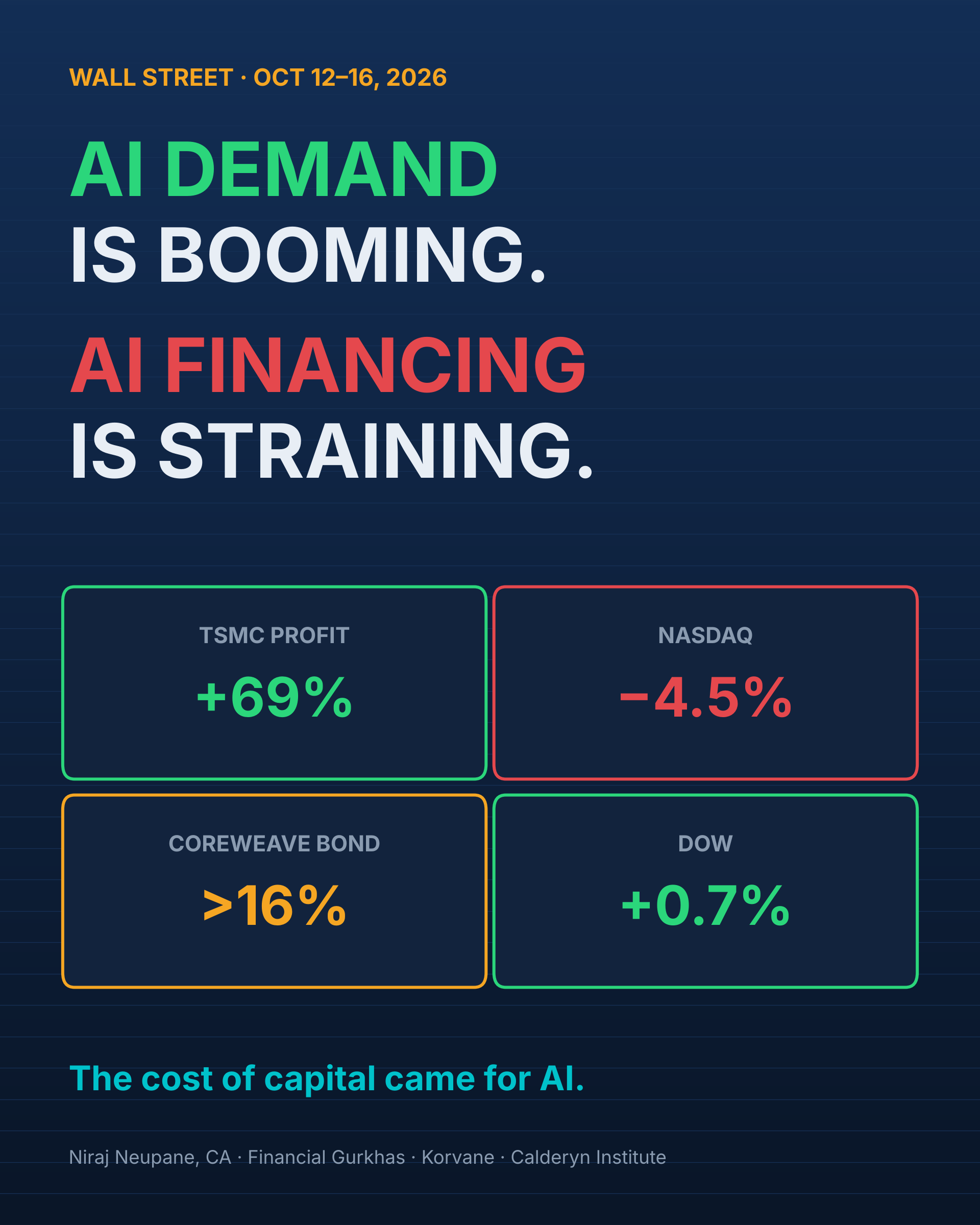
This week, the AI story split in two.
Demand is booming. TSMC's record profit shows companies are still buying AI chips as fast as they can be made.
Financing is straining. When inflation runs hot and rate hikes return to the table, debt-funded AI infrastructure is the first place the market looks for weakness.
The good news is that the stress stayed contained. Treasuries rallied, the Dow rose, and the market rotated rather than broke. The question for the weeks ahead is whether that containment holds.
AI's real test is no longer whether the demand exists. It is whether the returns can outrun the cost of the capital needed to meet it.
💬 Your take#
Is this week's AI selloff a healthy valuation reset, or an early warning that markets have underestimated the cost of capital? Share your perspective in the comments.
📚 Read the research
Conditional Tail Episode Risk: A Path-Dependent Framework for Extreme-Loss Episodes Beyond VaR and ES (SSRN) papers.ssrn.com/sol3/papers.cfm?abstract_id=7502499
Systemic Tail Episode Risk: Persistence and Cumulative Severity of Synchronized Extreme-Loss Episodes Across Markets (SSRN) papers.ssrn.com/sol3/papers.cfm?abstract_id=7534899
Earlier in this series: The 30-Year Hit a 2002 High. Why Didn't Wall Street Panic?
About the author#
Niraj Neupane, CA (ICAI), is a quantitative researcher whose work develops new measures of path-dependent and systemic tail risk for financial institutions and regulators. He is the founder of Korvane, an AI-powered trade, risk and validation platform, and Calderyn Institute, which trains professionals in quantitative finance and AI engineering. His research papers, Conditional Tail Episode Risk and Systemic Tail Episode Risk, are available on SSRN. ORCID: 0009-0003-7026-7026.
Views expressed are the author's own and do not represent any employer.
Sources#
Markets
- AP via La Nación, How major US stock indexes fared Friday 10/16/2026: https://www.lanacion.com.ar/usa/how-major-us-stock-indexes-fared-friday-10162026-nid16102026/
- AP via La Nación, Thursday 10/15/2026: https://www.lanacion.com.ar/usa/how-major-us-stock-indexes-fared-thursday-10152026-nid15102026/
- AP via ABC News, Wednesday 10/14/2026: https://abcnews.com/Business/wireStory/major-us-stock-indexes-fared-wednesday-10142026-137270020
- AP via La Nación, Tuesday 10/13/2026: https://www.lanacion.com.ar/usa/how-major-us-stock-indexes-fared-tuesday-10132026-nid13102026/
- Trading Economics, US Treasury yields post weekly decline: https://tradingeconomics.com/united-states/government-bond-yield/news/592783
- Trading Economics, Brent crude: https://tradingeconomics.com/commodity/brent-crude-oil%20
Economic data
- investingLive, US September CPI 3.7% vs 3.6% expected: https://investinglive.com/news/us-september-cpi-vs-3-6-expected-0/
- Trading Economics, US PPI soars the most in 4 years: https://tradingeconomics.com/united-states/producer-price-inflation-mom/news/592365
- AP via ClickOnDetroit, Retail sales up 0.8% in September: https://www.clickondetroit.com/business/2026/10/15/retail-sales-up-08-in-september-but-a-big-chunk-of-spending-went-to-paying-gasoline-bills/
Companies
- NewsBytes, TSMC Q3 profit jumps 69% to record $23.6 billion: https://www.newsbytesapp.com/news/business/tsmc-q3-profit-jumps-69-to-record-23-6-billion/story
- Reuters via The Star, CoreWeave stock, bond set for weekly plunge: https://www.thestar.com.my/tech/tech-news/2026/10/16/coreweave-stock-bond-set-for-weekly-plunge-as-rate-hike-fears-hit-ai-bet
- Beinsure, US banks report mixed Q3 2026 earnings: https://beinsure.com/news/us-banks-report-mixed-q3-2026-earnings-as-trading-results-diverge/
Research
- Neupane, N. (2026). Conditional Tail Episode Risk: A Path-Dependent Framework for Extreme-Loss Episodes Beyond Value-at-Risk and Expected Shortfall. SSRN 7502499. https://papers.ssrn.com/sol3/papers.cfm?abstract_id=7502499
- Neupane, N. (2026). Systemic Tail Episode Risk: Persistence and Cumulative Severity of Synchronized Extreme-Loss Episodes Across Markets. SSRN 7534899. https://papers.ssrn.com/sol3/papers.cfm?abstract_id=7534899