Disclaimer: This is an independent valuation exercise for educational purposes — not investment advice, and not a recommendation to anyone else. The author's personal view is stated as the author's own, in the spirit of our Figma piece. Rent the Runway is a distressed, highly leveraged micro-cap with negative book equity. Please consult a financial advisor before making any investment decisions.
The setup#↑ Contents
The thesis, stated plainly: Rent the Runway is growing revenue at 20%+, its net loss just halved, and a 2025 recapitalization cut its debt roughly in half. The stock trades at $1.72 — down 78% this year, hugging its 52-week low. Growing business, shrinking losses, cleaned-up balance sheet, all-time-low price. The kind of setup that makes you reach for a spreadsheet.
So I did. And the spreadsheet has opinions — some of them uncomfortable.
Revenue and the turnaround story#↑ Contents
The operating turnaround is real. Q2 FY2026 (quarter ended July 31, 2026, reported September 11) was the company's best quarter on record by revenue:
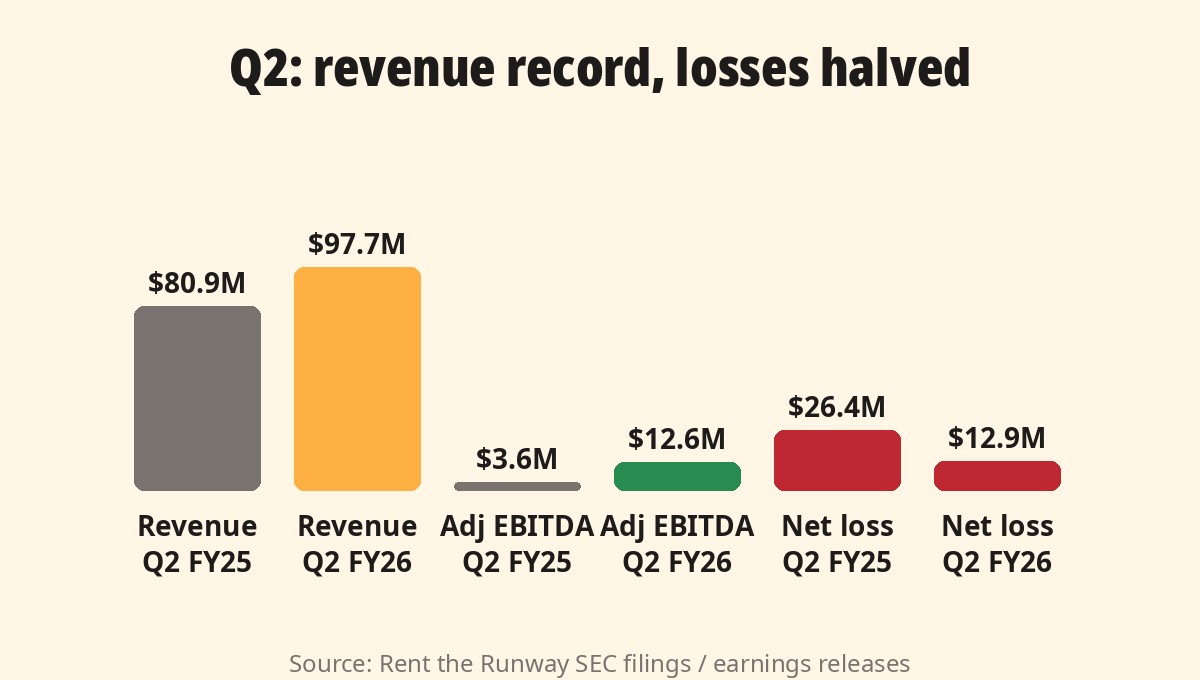
| Metric | Q2 FY2025 | Q2 FY2026 | Change |
|---|---|---|---|
| Revenue | $80.9M | $97.7M | +20.8% (all-time quarterly high) |
| Gross margin | 30.0% | 36.1% | +609 bps |
| Net loss | $(26.4)M | $(12.9)M | loss halved |
| Adjusted EBITDA | $3.6M (4.4%) | $12.6M (12.9%) | +3.5x |
| Ending active subscribers | 146,373 | 140,826 | −3.8% |
| Cash | $43.6M | $29.0M | — |
Two things to note. First, subscriber count actually slipped 3.8% — the growth is coming from monetization, not headcount: add-on bookings were up 81% year-over-year, and a third of subscribers now use add-ons. Second, Q1 was even hotter (+29.2% to $89.9M). Full-year FY2025 revenue was $329.8M (+7.7%), and management reaffirmed FY2026 guidance of double-digit revenue growth with 4–7% adjusted EBITDA margins.
The business is genuinely improving. Now the part the stock price is actually about.
The debt: halved, but at a price#↑ Contents
The October 2025 recapitalization did exactly what the thesis says — it cleared a lot of debt:
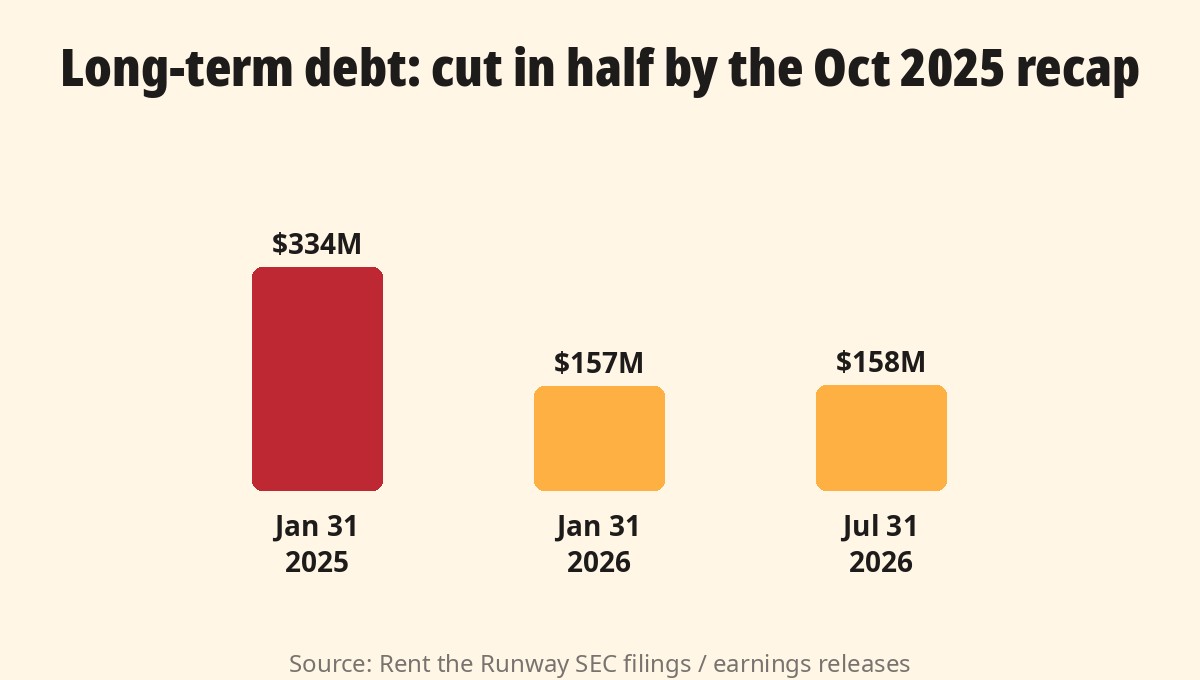
Long-term debt fell from $333.7M (January 2025) to $156.6M (January 2026), sitting at $157.5M as of July 2026. The mechanics: the lender exchanged $100M of debt for new term loans, contributed the rest above $100M in exchange for equity, and put in $20M of fresh loans. Remaining principal: $120M, maturing October 2029, at SOFR + 500 bps. Then, on September 1, 2026, the company drew another $10M incremental term loan for working capital — the debt is creeping back up.
But "cleared debt" is the wrong verb. The right one is converted — converted into equity. And that brings us to the dilution.
The dilution: this is the whole story#↑ Contents
In October 2025, lenders received 26,175,193 newly issued shares in exchange for their debt — taking roughly 86% of the post-recap equity. Existing shareholders were left with about 14% of a company they'd previously owned nearly all of.
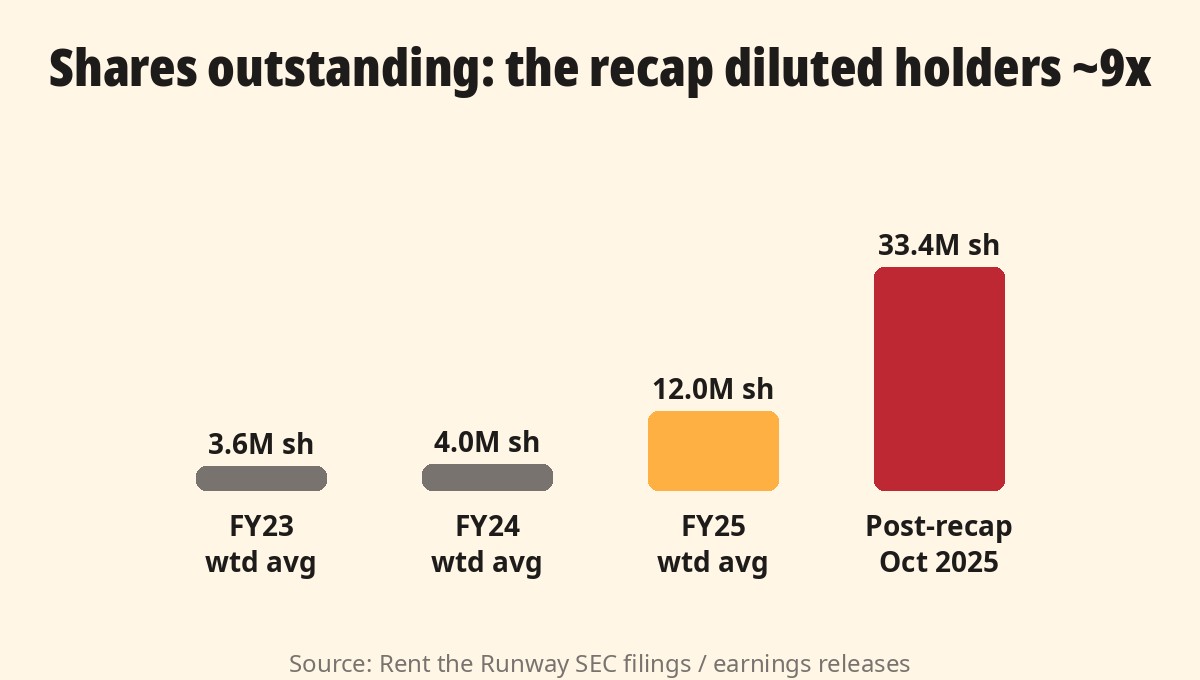
The longer history is worse. There was a 1-for-20 reverse split in April 2024 to stay Nasdaq-compliant. Weighted-average shares went from 3.59M (FY2023) to 11.96M (FY2025) to ~33.4M outstanding after the recap. And it's not over: a $15M rights offering at $3.55/share (up to ~4.2M shares, ~12.6% further dilution) expired October 14, 2026 — fully backstopped by the lender group, meaning any shares retail didn't buy went straight to the lenders, increasing their grip.
So: does the company have a history of diluting shareholders? The filings answer that one themselves. The lenders now own the company; public shareholders own a stub.
Two more balance-sheet facts for the file: stockholders' equity is negative $65.5M (the company is balance-sheet insolvent on a book basis), and no public credit rating exists — Moody's and S&P do not rate this debt; it's private credit. Don't let anyone tell you it's "rated CCC" — it's unrated.
Short interest#↑ Contents
As of September 30, 2026: 1.64M shares short, 6.79% of float, 13.26 days to cover. That's moderately elevated — and the days-to-cover figure is striking, but it reflects thin trading volume rather than a massive absolute short. Context: short interest spiked to ~32% of float in November 2025 during the recap chaos, then collapsed as the float expanded ~9x. The current 6.8% is a far cry from a crowded short — the price action is about the recap overhang and the 28.5M shares registered for resale by the selling stockholders, not a short squeeze setup.
The cultural asset: New York runs on RTR#↑ Contents
Here's the part the spreadsheet misses. Rent the Runway has roughly 562,000 Instagram followers and a brand that punches absurdly above its $62M market cap. This is a company the internet knows by name — "the Netflix for fashion," as the old tagline went — with a City Ambassador program that has members hosting RTR events in their own cities, reviewing looks, and recruiting their communities. Their influencer operation isn't a side project; the company's own hiring describes influencer and ambassador marketing as a key customer-acquisition and storytelling channel.
And the geography matters. Culture inspires fashion, and cities inspire the country on what to wear — and no city does that more than New York. RTR is a New York company with New York clout. Brooklyn loves Rent the Runway. The closet-in-the-cloud concept was born here, the density of young professional women here is the exact demographic, and the word-of-mouth here travels nationally. If the ambassador and creator programs take off the way the playbook suggests they can, that's not linear growth — it's the kind of cultural flywheel that brings tons of customers at near-zero acquisition cost. You cannot DCF a flywheel, but you'd be a fool to value the company as if it doesn't exist.
The grocery store problem#↑ Contents
Now the cold water. Strip out the $96.3M one-time gain on the debt restructuring and FY2025 wasn't a $22.6M profit — it was roughly a $74M net loss. Q2 FY2026 still posted a $7.8M operating loss. Underlying losses are running at on the order of $70–80M a year.
This is the entire debate in one paragraph: if the model can't make money, scaling revenue is pointless. It's a grocery store that loses money on every sale — great for the customer, fatal for the business. Growing 20% a quarter means nothing if each incremental subscriber doesn't eventually contribute margin. The add-on monetization (+81% YoY) and the gross margin expansion (30.0% → 36.1%) are the first real signs the unit economics might be turning. Might. The company has never produced a dollar of free cash flow, and until it does, every growth headline deserves a skeptical eyebrow.
What you're actually buying: a lottery ticket#↑ Contents
Forget price targets for a minute. Here's the objective view of what a share of RENT actually is.
The debtors are in charge. The October 2025 recap didn't clear the debt — it converted it into ~86% of the equity. The lenders own the company; public shareholders hold a stub. The lenders backstop every offering, buy every unsubscribed share, and sit on 28.5M shares registered for resale. When people say "the stock is at all-time lows," what they mean is: the stub the lenders left behind is priced like a stub.
So the equity is a call option. Book equity is negative $65.5M. The enterprise, on a straight DCF at an 11% discount rate (10-year at ~5.06%), is worth roughly its net debt under base-case assumptions — implying ~$0 of residual equity value. The $1.72 price, in that same arithmetic, implies a steady-state cash machine ~13x better than the base case. You are not buying a claim on current cash flows. There are no current cash flows. You are buying a ticket that pays if interest rates come down and equity valuations expand — because both of those lift enterprise value, and every dollar of enterprise value above the debt line accrues to the stub. Lower rates also directly cut the SOFR + 500 bps interest burden that's currently eating the P&L.
That's why the risk-reward looks better than the DCF suggests. A call option on a culturally relevant, revenue-growing business with 562K followers and a real New York flywheel, priced at $1.72 with the downside already this close to zero — the math of the option is more interesting than the math of the equity. If rates fall and the multiple environment normalizes, the stub reprices violently upward; a bull-case run of the same model lands around $5 on ~35M shares. If the grocery-store problem never gets solved, the ticket expires worthless — which, at these prices, is a small distance to fall.
Lottery ticket is not an insult. It's the accurate description. Price it like one, size it like one.
Final thoughts#↑ Contents
My take, stated as the author's and nothing more: at $1.72, with the cultural asset this company has in New York — we're in New York, we see the love for RTR here — I think the ticket is worth holding. The debt holders own the company, the business still loses money, and the dilution history is brutal. All true. But the optionality — falling rates, a multiple re-rating, an ambassador flywheel catching fire — is real, and it's priced like it isn't.
This is a personal view, not investment advice. Size any position like the lottery ticket it is, and please consult a financial advisor before making any investment decisions.
This analysis was researched and drafted with AI assistance (Muse, Meta). All figures are traced to Rent the Runway's SEC filings, earnings releases, or the sources linked above; aggregator-sourced market data is flagged as such. This is educational content, not investment advice.