Disclaimer: This article is for educational purposes only and is not investment advice. Trading and investing are subject to volatility and market risk, including partial or entire loss of capital. Please consult your financial advisor before making investment decisions. Financial Gurkha and its writers are not liable for your losses, nor do we take credit for your gains.
AI disclosure. This analysis was researched and drafted with the help of Claude, an AI model made by Anthropic, the company that filed this S-1. Every figure below is taken from the filing itself, with page references and arithmetic shown so readers can check it. The analysis, framing and conclusions are Financial Gurkha’s.
Author disclosure [The author of this article may hold equity/option position in the mentioned tickers, namely NVDA, MSFT, Google, AMD, Anthropic going public as ANT, and Amazon. The author's view of Anthropic is solely based on publicly available S-1 filing.]
Financial Gurkha | New York City | October 26, 2026
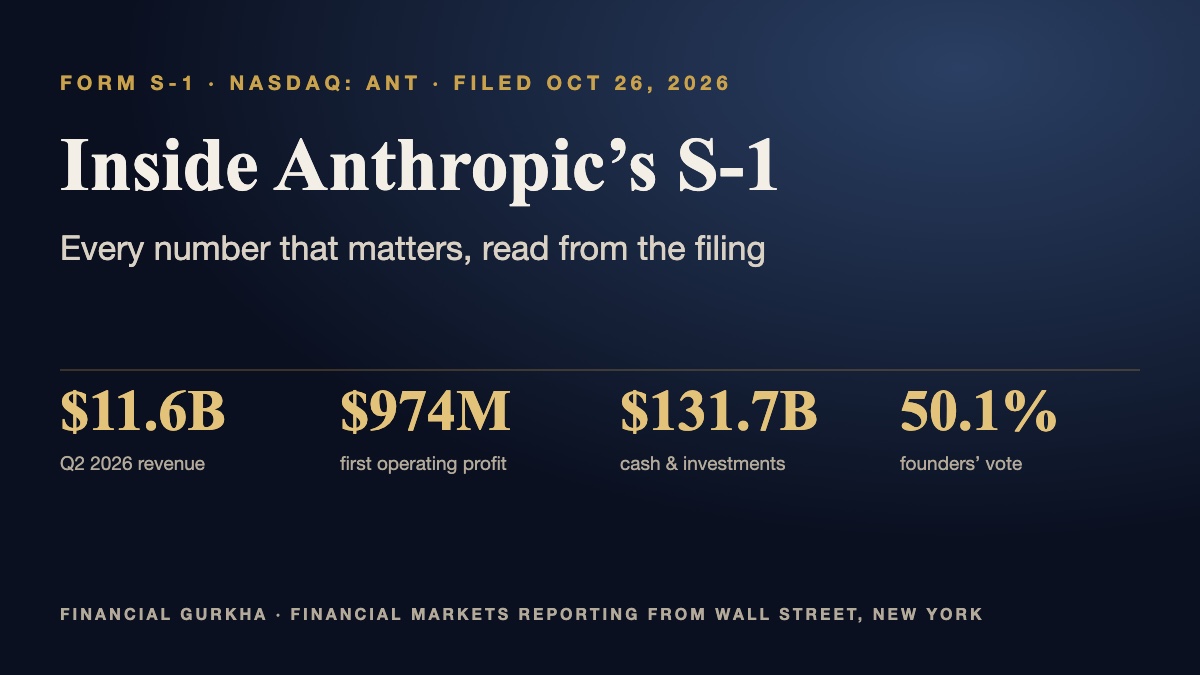
On October 26, 2026, Anthropic, PBC filed a Form S-1 with the Securities and Exchange Commission to list its Class A shares on the Nasdaq Global Select Market under the symbol ANT. In September we wrote about this IPO from press reports of a confidential draft. This is the primary-source version: we read the public filing.
It is a preliminary prospectus. The price range, share count and most September-quarter figures are still blank, and will be filled in by amendment before the shares price. Everything else is here, and there is a lot of it. This piece walks through all of it in plain English. Each major section also has a dedicated deep-dive, linked as you go.
The 60-Second Version#↑ Contents
| What the filing shows | Number |
|---|---|
| Revenue, 2023 → 2024 → 2025 | $41M → $386M → $4.59B |
| Revenue, first half of 2026 | $16.3B (14× the first half of 2025) |
| Revenue, Q2 2026 | $11.6B, up 2.44× on Q1 |
| Operating income, Q2 2026 | +$974M (first operating profit) |
| Net loss, first half of 2026 | $80.7B, almost all non-cash valuation accounting |
| Cash and short-term investments, June 30, 2026 | $131.7B |
| Cash from operations, first half of 2026 | +$3.9B (first positive period) |
| Minimum compute commitments, June 30, 2026 | $265.6B (audited), with more signed since |
| Customers paying $100K+ a year | more than 11,900 (from about 950 a year earlier) |
| Founders’ share of shareholder votes | 50.1%, through one share of Class F stock |
| Board majority elected by | the Long-Term Benefit Trust, through one share of Class T stock |
The seven things that matter:
- The growth is unprecedented at this scale. Revenue rose 9.4× in 2024, 11.9× in 2025, and the first half of 2026 alone brought in 3.6× all of 2025.
- Compute efficiency drove the turn to profit. Anthropic spent $2.51 on compute for every dollar of revenue in Q1 2025. By Q2 2026 it spent $0.48.
- The giant net loss is mostly an accounting entry. About $81 billion of the $80.7 billion first-half loss comes from marking up convertible notes and other instruments that rise in value as Anthropic becomes more valuable.
- The company is cash-rich. It raised $110.4 billion from preferred stock in the first half of 2026 and generated $3.9 billion from operations.
- The compute bill is the bet. Audited minimum compute commitments rose from $54.6 billion at the end of 2025 to $265.6 billion by June 30, 2026, and the filing describes several large deals signed after that.
- Public shareholders buy economics, not control. A purpose trust elects the board majority, and the seven co-founders hold 50.1% of shareholder votes through a single share.
- The bet rests on agents. The filing’s growth case is the “Virtual Collaborator”: AI that does hours of professional work inside a company’s systems. Its evidence ranges from Eli Lilly to AIG to Jane Street.
What's in this report#
- The 60-Second Version
- 1. Revenue Growth: Quarterly, Half-Yearly and Annual
- 2. Who Controls Anthropic: The Share Classes, Simply
- 3. Executive Compensation
- 4. The Total Addressable Market, According to Anthropic
- 5. How Anthropic Sees Itself and the Frontier Industry
- 6. Customer Results: Eli Lilly, AIG, Jane Street, BMS, DoorDash
- 7. Cash Flow, Balance Sheet and Free Cash Flow
- 8. Major Supplier Agreements
- 9. Taking a Research Lab Public as a Public Benefit Corporation
- 10. Depreciation and Fixed Assets
- 11. Products, and the Virtual Collaborator Bet
- 12. Quantitative Risk Factors
- 13. Qualitative Risk Factors
- 14. The Discount Rate and What It Means for the IPO
- The Offering Itself
- Frequently Asked Questions
- Conclusion and Key Takeaways
- Methodology and Sources
1. Revenue Growth: Quarterly, Half-Yearly and Annual#↑ Contents
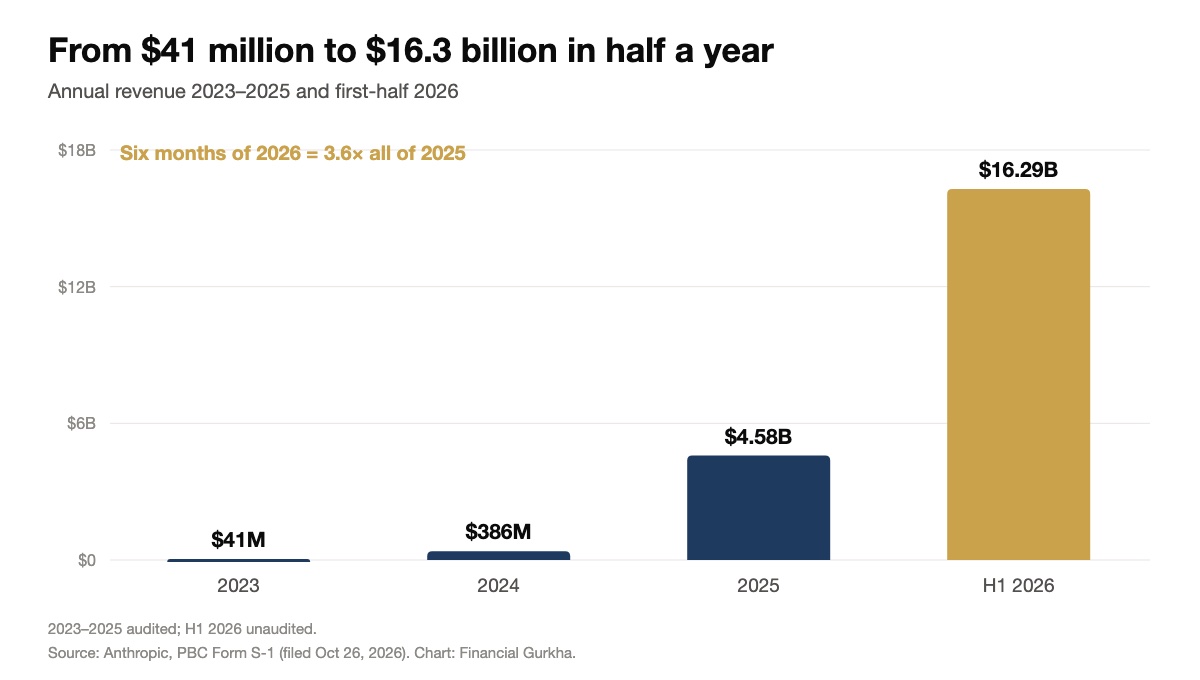
Anthropic’s revenue has grown roughly tenfold in each of its first full years of selling, and the curve steepened again in 2026.
| Period | Revenue | Growth |
|---|---|---|
| 2023 | $41M | — |
| 2024 | $386M | 9.4× |
| 2025 | $4,585M | 11.9× |
| First half 2025 | $1,163M | — |
| Second half 2025 | $3,422M | 2.9× H1 2025 |
| First half 2026 | $16,286M | 14.0× H1 2025; 4.8× H2 2025 |
Second-half 2025 is our arithmetic: full-year $4,585 million less first-half $1,163 million.
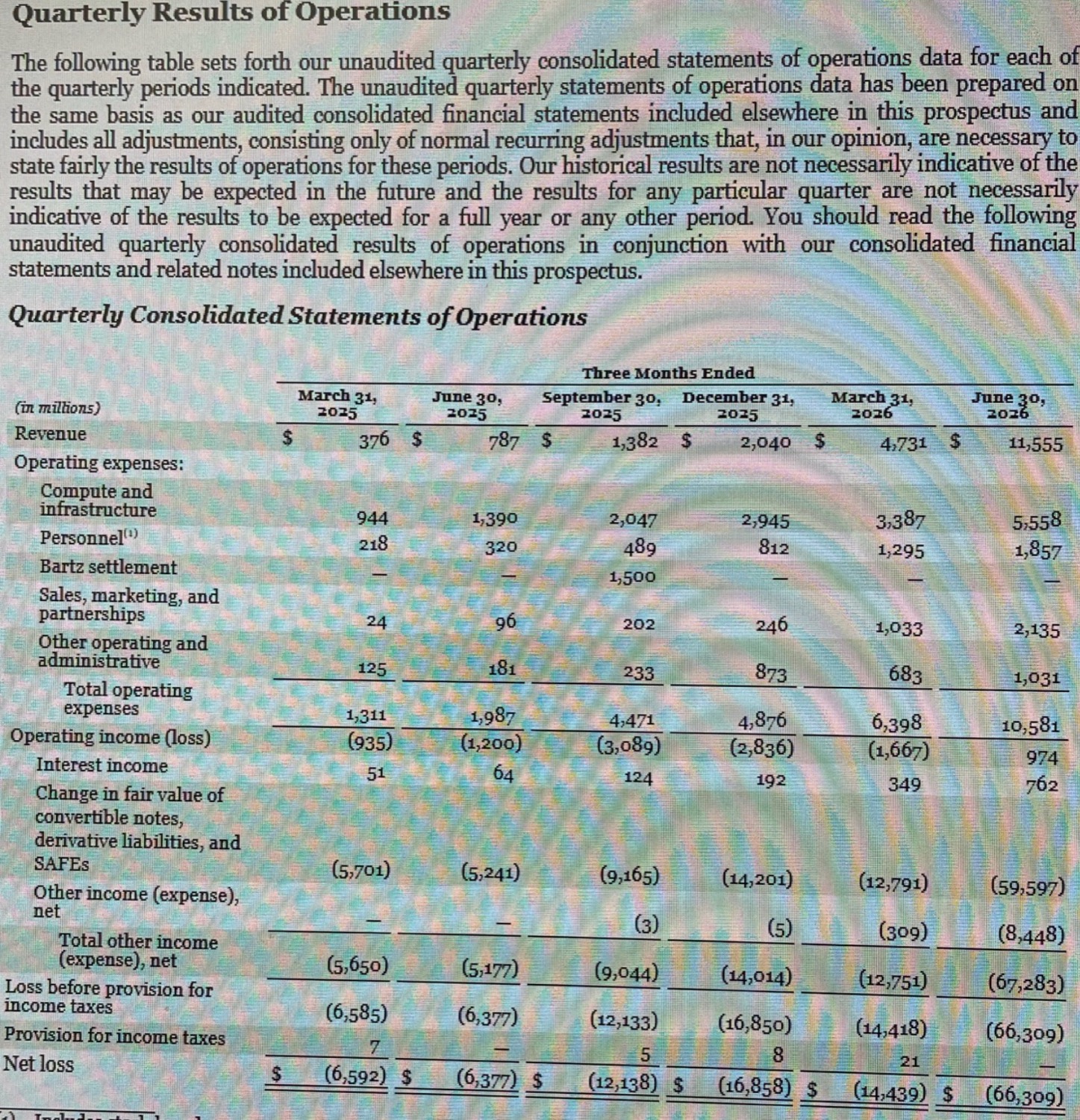
By quarter:
| Quarter | Revenue | vs prior quarter | Compute cost per $1 of revenue | Operating margin |
|---|---|---|---|---|
| Q1 2025 | $376M | — | $2.51 | −249% |
| Q2 2025 | $787M | 2.09× | $1.77 | −152% |
| Q3 2025 | $1,382M | 1.76× | $1.48 | −224%* |
| Q4 2025 | $2,040M | 1.48× | $1.44 | −139% |
| Q1 2026 | $4,731M | 2.32× | $0.72 | −35% |
| Q2 2026 | $11,555M | 2.44× | $0.48 | +8.4% |
*Q3 2025 includes a $1.5 billion copyright settlement (Bartz v. Anthropic).
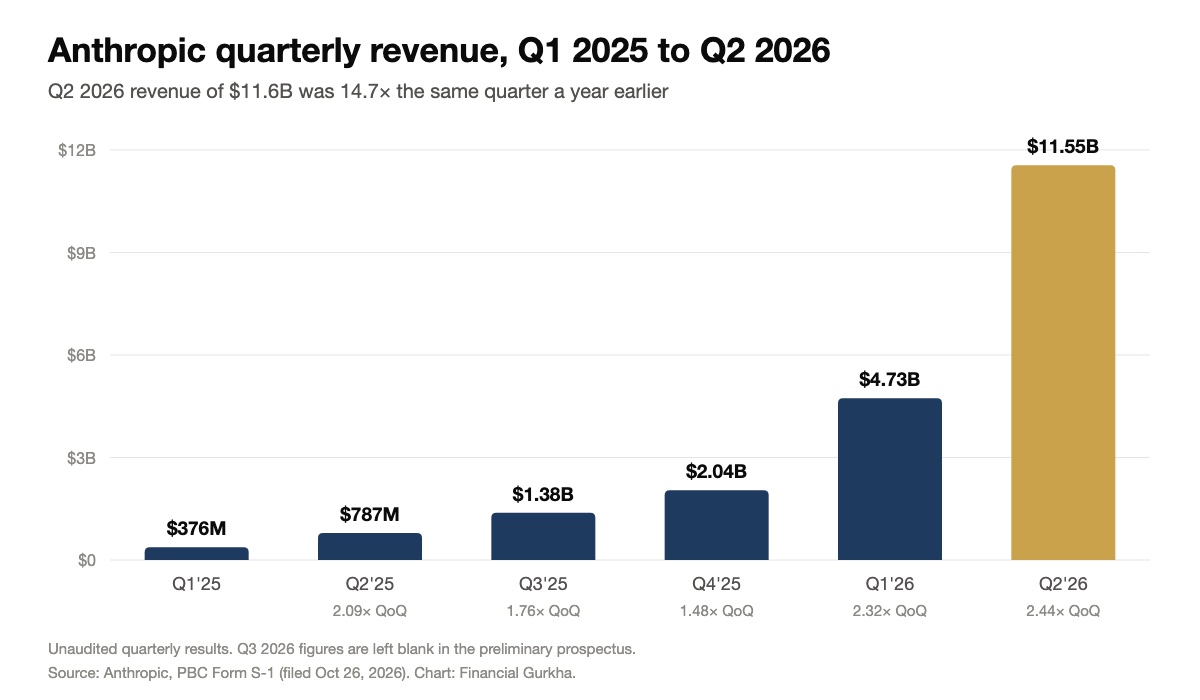
Two patterns stand out. Growth slowed through 2025, then re-accelerated sharply in 2026, from 1.48× quarter-on-quarter in Q4 2025 to 2.32× and 2.44×. That timing matches the spread of the agent products, Claude Code and Claude Cowork. And the cost of serving that revenue collapsed: compute went from 2.5 times revenue to less than half of it.
Where the revenue comes from. Most of it is consumption, which the filing calls “pay-for-intelligence”: customers pay per token TokenA small unit of text, roughly three-quarters of a word. AI models are priced per million tokens read and written. used. Subscriptions make up the rest.
| Consumption | Subscriptions | |
|---|---|---|
| 2024 | $288M (75%) | $98M (25%) |
| 2025 | $3.8B (83%) | $789M (17%) |
| First half 2026 | $13.1B (80%) | $3.2B (20%) |
The filing is direct about what this does and does not mean. It expects its growth rate to decline, “possibly significantly,” and notes that early adoption dynamics may not last. Model versions released in the prior six months produced more than 80% of revenue in Q3 2026, so revenue depends on a steady cadence of new releases.
Deep dive: Anthropic’s revenue growth, quarter by quarter
2. Who Controls Anthropic: The Share Classes, Simply#↑ Contents
Buyers of Anthropic’s public shares will own a slice of the profits but will not control the company. Two single shares carry the control.
| Class | Who holds it | Economic rights | Voting power |
|---|---|---|---|
| Class A | Public investors, employees, existing holders | Yes | 1 vote per share; 49.9% of votes combined |
| Class F (1 share) | Founder LLC: the 7 co-founders | None | A fixed 50.1% of shareholder votes |
| Class T (1 share) | Long-Term Benefit Trust | None | Elects the majority of the board |
| Class E | Employees (excluding co-founders) | None | Votes on certain limited matters only |
| Class N | Strategic partners (Amazon, AMD), the Public Benefit Fund | Yes | No vote |
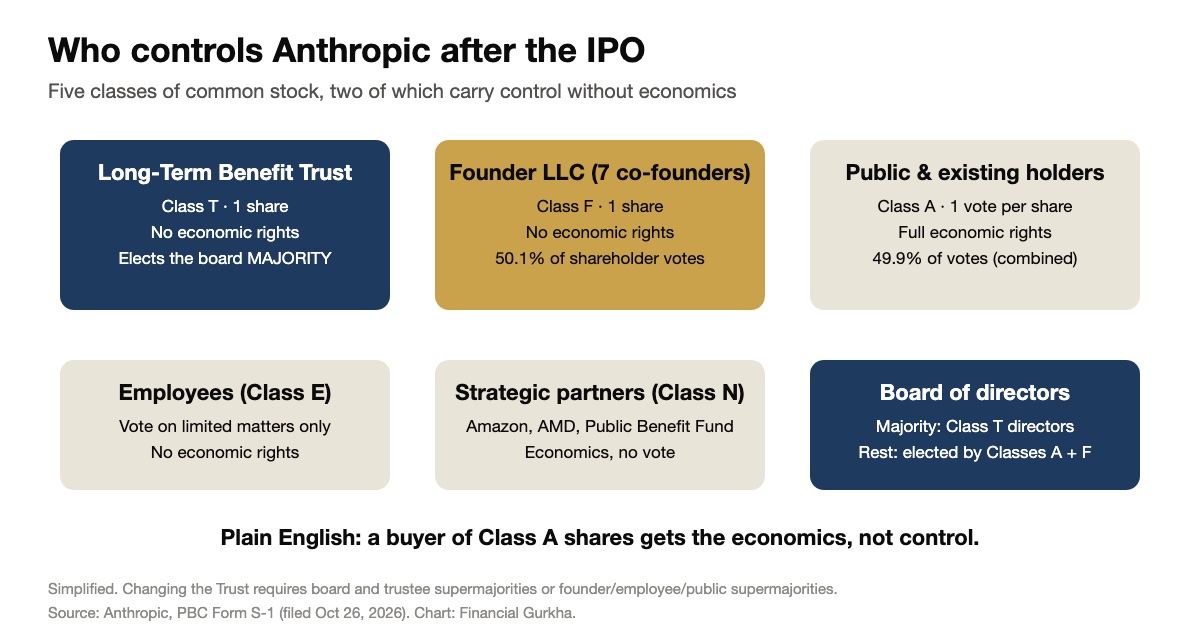
In practice, at the shareholder meeting, the founders’ single Class F share outvotes every public share combined. In the boardroom, directors chosen by the trust hold the majority. The trust and the Founder LLC have agreed to vote together on board composition, and “collectively… will have the ability to elect all members” of the board.
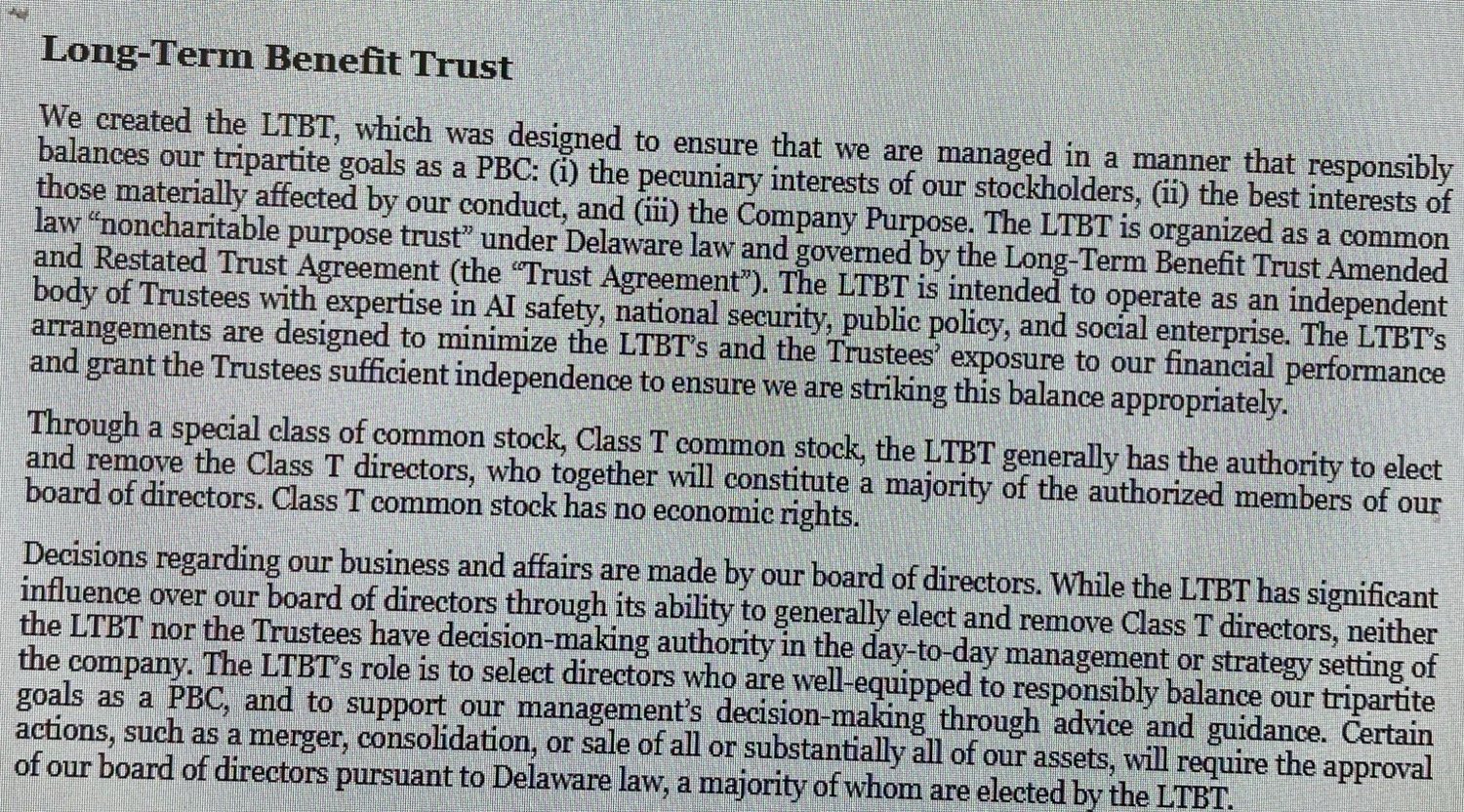
The Long-Term Benefit Trust Long-Term Benefit Trust (LTBT)A Delaware “purpose trust”, not a charity, created to make sure Anthropic balances shareholder returns, its impact on others, and its mission. Its trustees may not own Anthropic stock and are paid a fixed cash fee. has five trustee seats, one vacant. It is chaired by Dr. Neil “Buddy” Shah, CEO of the Clinton Health Access Initiative. Trustees serve annual terms with no limit, choose their own successors, and may not hold Anthropic stock.
The founder vote has an end date built in. The Class F share disappears once fewer than three co-founders remain active for 90 consecutive days, or if a supermajority of them redeems it.
Because the trust elects the board majority, Anthropic qualifies as a “controlled company” under Nasdaq rules. It says it will use that exemption only for its nominating committee.
The board today has six directors:
- Elected through Classes A and F: Dario Amodei (CEO), Daniela Amodei (President and Chair), and Yasmin Razavi of Spark Capital.
- Trust-elected (Class T): Reed Hastings, Christopher Liddell and Vas Narasimhan.
Deep dive: Who controls Anthropic? The share classes explained
3. Executive Compensation#↑ Contents
Anthropic’s two founder-executives are paid equally, mostly in equity and security costs. Their salaries have more than doubled in a year.
The 2025 summary compensation table:
| Executive | Salary | Stock awards | Option awards | All other | Total |
|---|---|---|---|---|---|
| Dario Amodei, CEO | $654,167 | $9,264,932 | $4,028,558 | $4,010,641 | $17,958,298 |
| Daniela Amodei, President | $654,167 | $9,264,932 | $4,028,558 | $2,461,341 | $16,408,998 |
| Krishna Rao, CFO | $706,250 | — | — | $14,000 | $720,250 |
“All other” for the Amodeis is mostly personal security: $2.75 million for Dario and $1.29 million for Daniela, plus $97,055 of personal private-air travel for Dario required by his security program. It also includes $1.15 million each from the gap between the price and fair value of shares Anthropic bought back from them in its June 2025 tender offer.
Current pay:
| Base salary | 2026 equity grants | |
|---|---|---|
| Dario Amodei | $600K → $700K (Jun 2025) → $915K (Jan 2026) → $1.38M (Jul 2026) | 1,431,490 options at $17.66; 2,374,010 RSUs; plus 537,430 co-founder RSUs (Jul 2026) |
| Daniela Amodei | same as Dario | same as Dario |
| Krishna Rao | $700K → $850K → $1.25M (Feb 2026) | 1,122,840 options at $17.66; 1,862,140 RSUs |
The policy behind this: pay targets the 90th percentile of the AI development market, all seven co-founders are paid the same, and most pay is equity that vests over years. The RSUs RSU (restricted stock unit)A promise of shares delivered once vesting conditions are met. Anthropic’s executive RSUs vest only after both a time condition and the IPO happen. vest only after the IPO registration takes effect.
New in October 2026: severance of 24 months’ salary for the Amodeis (12 for Rao) if terminated without cause. The company also paid $2.5 million each in antitrust filing fees on the Amodeis’ behalf, required because of the size of their holdings.
The real wealth is in their holdings, not their pay. Each co-founder holds roughly 232 to 245 million Class A shares. At the Series H price of $58.90 per share (May–June 2026), 240 million shares are worth about $14 billion. All seven co-founders have pledged 80% of their personal equity to philanthropy.
Deep dive: How Anthropic pays Dario and Daniela Amodei
4. The Total Addressable Market, According to Anthropic#↑ Contents
Anthropic frames its market as knowledge work itself, which it values at more than $40 trillion a year.
| Market-sizing claim in the S-1 | Figure | Source cited |
|---|---|---|
| Value of knowledge work, globally, 2025 | more than $40 trillion | Anthropic estimate |
| Cumulative economic impact of AI solutions and services by 2031 | $22.5 trillion | IDC |
| Knowledge workers worldwide by 2028 | more than 1 billion | IDC |
| Global pharmaceutical spend, 2026 | more than $2 trillion | IQVIA |
| IT spending, 2006 → 2025 | $1.2T → $4.3T (~7% a year) | cited in filing |
| Revenue of today’s 10 largest tech companies, 2000 → 2025 | $68B → more than $2.5T | cited in filing |
The historical comparison carries the argument. Over the same 25 years that global GDP rose from about $34 trillion to more than $118 trillion, the ten largest technology companies grew revenue about 38 times. The filing calls that roughly 11 times the rate of GDP growth. Anthropic’s claim is that frontier AI expands the market it enters, the way cloud computing grew from nothing to $1.9 trillion of spending.
How to read it: a $40 trillion figure is the value of the work, not money that will flow to Anthropic. The filing’s own penetration data are a better guide. Over 50% of the Fortune 500 already pay Anthropic $100,000 or more a year, yet that spending averages less than 0.1% of those companies’ total expenses. Its ten largest Fortune 500 customers spend under 1%, about eight times the average.
5. How Anthropic Sees Itself and the Frontier Industry#↑ Contents
The filing positions Anthropic as the company defining the frontier, and frontier AI as an industry where demand will outrun supply for years.
How it describes the industry:
- Scaling laws Scaling lawsThe finding that AI models improve predictably as they get more compute, data and size. The foundational 2020 paper was co-written by several of Anthropic’s co-founders. are “the primary engine of AI progress.” Several co-founders wrote the foundational paper.
- Demand is limited by compute. The filing expects demand for AI to “outstrip supply for the foreseeable future, limited principally by the availability of compute,” and concentrated at the frontier.
- The end state is “a country of geniuses in a data center”: millions of AI agents working in parallel, available to every organization.
How it describes its own position:
- The product benchmark: Claude Code made autonomous coding “the reference point for measuring the progress of frontier AI,” comparable in enterprise impact to the first chat assistants. NASA engineers used it to plan the first AI-planned drive of the Mars Perseverance rover.
- “Closing the loop”: each Claude model accelerates the next. More than 90% of contributions to Anthropic’s codebase in September 2026 were written by Claude. Claude’s success rate on hard internal engineering problems reached about 90%, up 50 points in nine months.
- Efficiency: in Q2 2026 revenue grew 1,368% year on year while compute costs grew 300%. Revenue per employee rose from $1.4 million to more than $6.6 million in a year.
- Safety as a selling point: enterprises “prefer models that are safe and aligned.” Anthropic withheld its most capable model, Mythos, from general release, offering it first only to vetted organizations through Project Glasswing, backed by up to $100 million for cyber-defense.
On competition, it names OpenAI and Google as direct rivals, plus open-weight models and, above all, the “status quo”: organizations that simply do not change. It argues its edge is focus on enterprises, frontier capability, research talent and compute efficiency.
6. Customer Results: Eli Lilly, AIG, Jane Street, BMS, DoorDash#↑ Contents
The S-1 backs its growth story with customer case studies that report measured outcomes, not just “adoption.” We picked five from different industries.
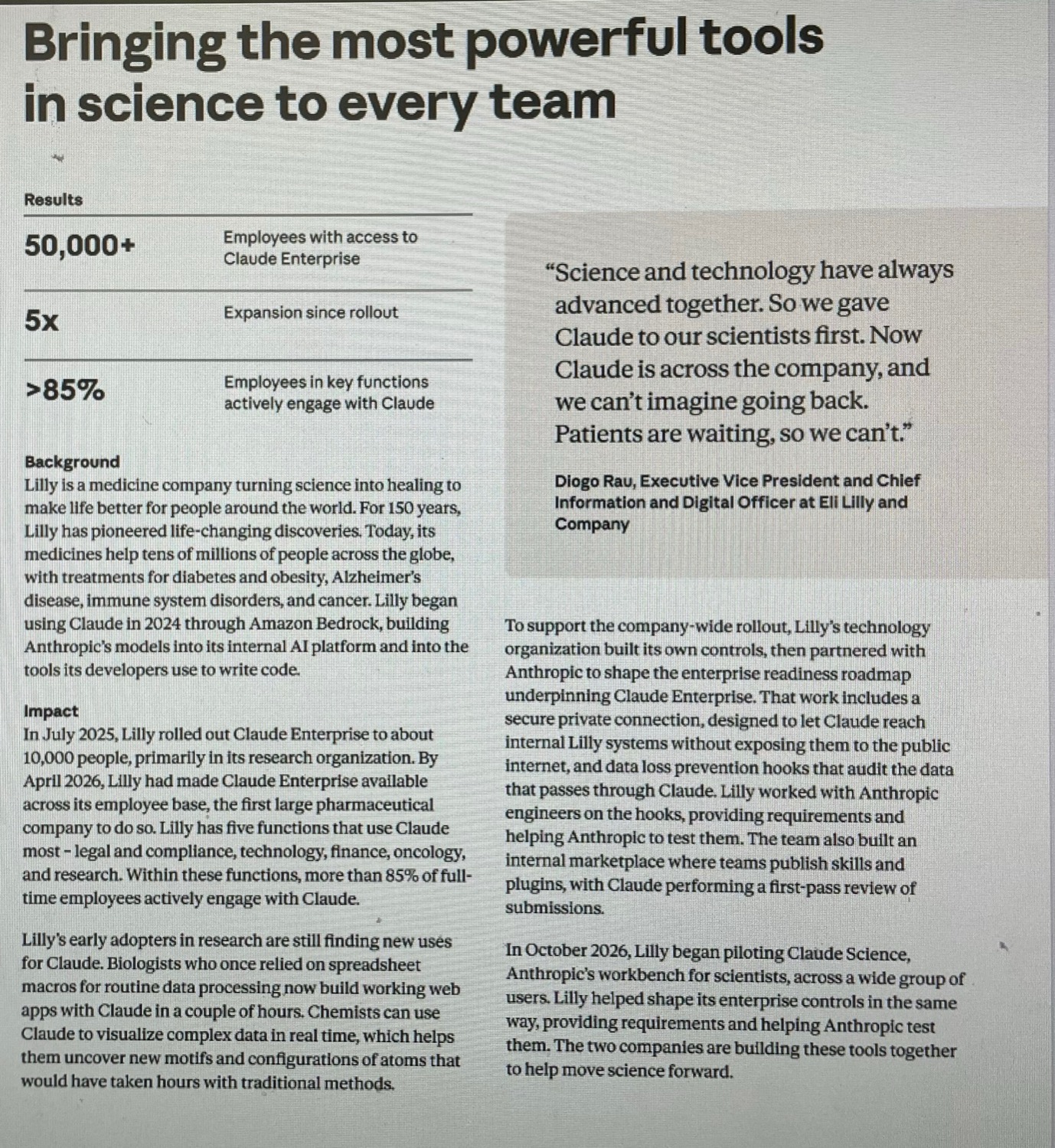
Eli Lilly, pharmaceuticals. Lilly began with Claude in 2024 through Amazon Bedrock.
- Rollout: about 10,000 people in July 2025, then company-wide by April 2026. The filing says Lilly was the first large pharmaceutical company to make Claude Enterprise available to all employees.
- Scale today: more than 50,000 employees have access, a 5× expansion since rollout. In its five heaviest-using functions (legal and compliance, technology, finance, oncology, research), more than 85% of full-time employees actively use Claude.
- In the lab: biologists build working web apps in a couple of hours, replacing spreadsheet macros, and chemists visualize complex data in real time.
- Co-building: Lilly helped Anthropic build Claude Enterprise’s security controls, including a private connection and data-loss-prevention hooks. It began piloting Claude Science in October 2026.
| Customer | Industry | Measured result in the S-1 |
|---|---|---|
| AIG | Insurance | Lexington Middle Market Property: +30% quoted submissions, −55% time-to-quote, +40% submissions bound; submission review time cut more than 90% |
| Jane Street | Trading | Codebase migration in about a week instead of months; Claude Fable 5.1 scored 32% above Fable 5 on its internal coding evaluation |
| Bristol Myers Squibb | Pharmaceuticals | A real-world-evidence question answered in about 5 minutes instead of up to 2 months; 30,000+ employees with access |
| DoorDash | Local commerce | Launch timelines for major products cut by more than half; 7,000+ monthly Cowork users |
Other case studies in the filing: Accenture (45,000 professionals trained; security test coverage from 10% to 80%) and the International Rescue Committee (464 staff hours returned each week).
Deep dive: Virtual Collaborators: Claude’s products and the customer evidence
7. Cash Flow, Balance Sheet and Free Cash Flow#↑ Contents
Anthropic enters public markets with $131.7 billion of cash and short-term investments, and with operating cash flow positive for the first time.
| Balance sheet ($M) | Dec 31, 2024 | Dec 31, 2025 | Jun 30, 2026 |
|---|---|---|---|
| Cash and cash equivalents | 3,141 | 17,388 | 112,389 |
| Short-term investments | — | 2,889 | 19,262 |
| Accounts receivable | 95 | 909 | 5,833 |
| Property and equipment, net | 19 | 146 | 1,187 |
| Total assets | 7,752 | 24,661 | 147,358 |
| Convertible notes payable | 14,116 | 41,677 | 108,566 |
| Deferred revenue | 28 | 269 | 1,650 |
| Total liabilities | 14,679 | 45,397 | 117,467 |
| Redeemable convertible preferred stock | 2,874 | 29,769 | 157,510 |
| Accumulated deficit | (10,040) | (52,154) | (132,902) |
| Cash flow ($M) | 2023 | 2024 | 2025 | H1 2025 | H1 2026 |
|---|---|---|---|---|---|
| Cash from operations | (1,627) | (5,692) | (2,637) | (1,513) | 3,929 |
| Capital expenditure | (2) | (15) | (131) | (18) | (482) |
| Operating cash flow less capex | (1,629) | (5,707) | (2,768) | (1,531) | 3,447 |
| Cash from financing | 2,320 | 7,248 | 19,960 | 4,749 | 110,774 |
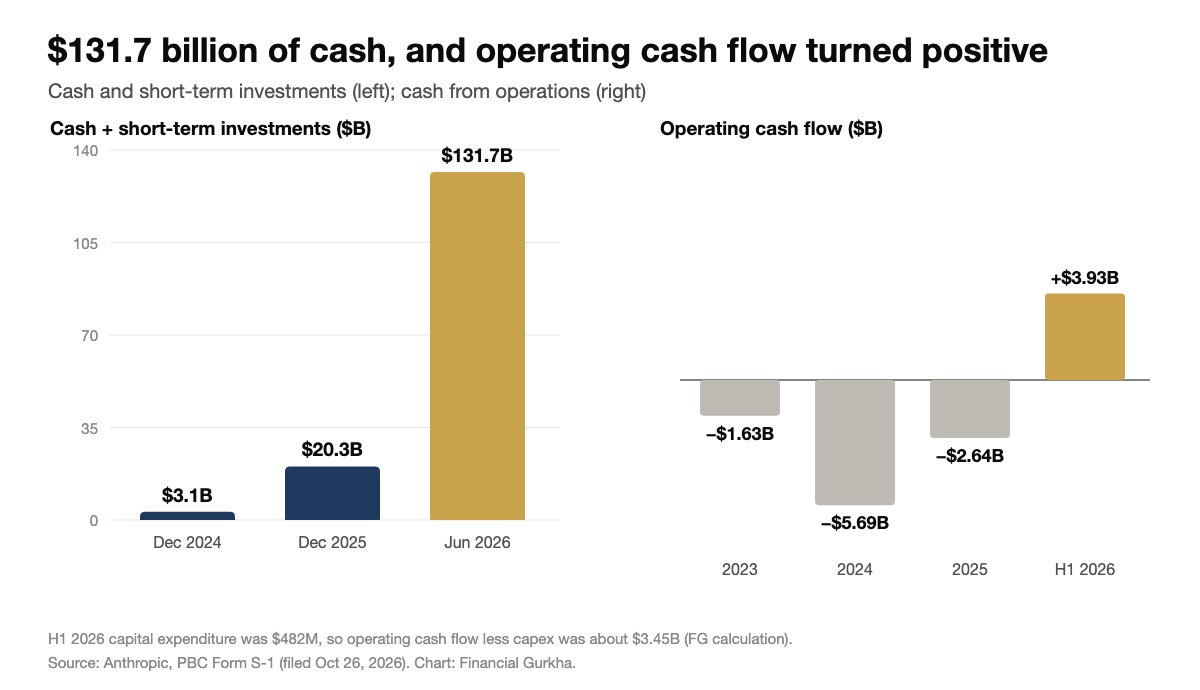
Free cash flow Free cash flowCash from operations minus capital expenditure: the cash a business generates after paying to maintain and grow its assets. Anthropic does not report a free cash flow figure; ours is calculated from its cash flow statement. is not a measure Anthropic reports. Calculated from its statements, it was about +$3.4 billion in the first half of 2026, after three years of outflows. A large part came from customers paying in advance: deferred revenue rose $1.4 billion.
Why the balance sheet shows a deficit despite all that cash. Convertible notes worth $108.6 billion sit as liabilities, and preferred stock worth $157.5 billion sits outside equity. Both convert to common stock at the IPO. Of the $132.9 billion accumulated deficit, $113.2 billion is fair-value changes on those notes and derivatives, not money spent.
The filing warns the cash profile will change. More compute will be bought as capital spending and leases paid upfront, “well in advance” of use. It expects “significant net cash used in operating and investing activities for the foreseeable future,” even if results improve.
Deep dive: Anthropic’s balance sheet, cash flow and depreciation
8. Major Supplier Agreements#↑ Contents
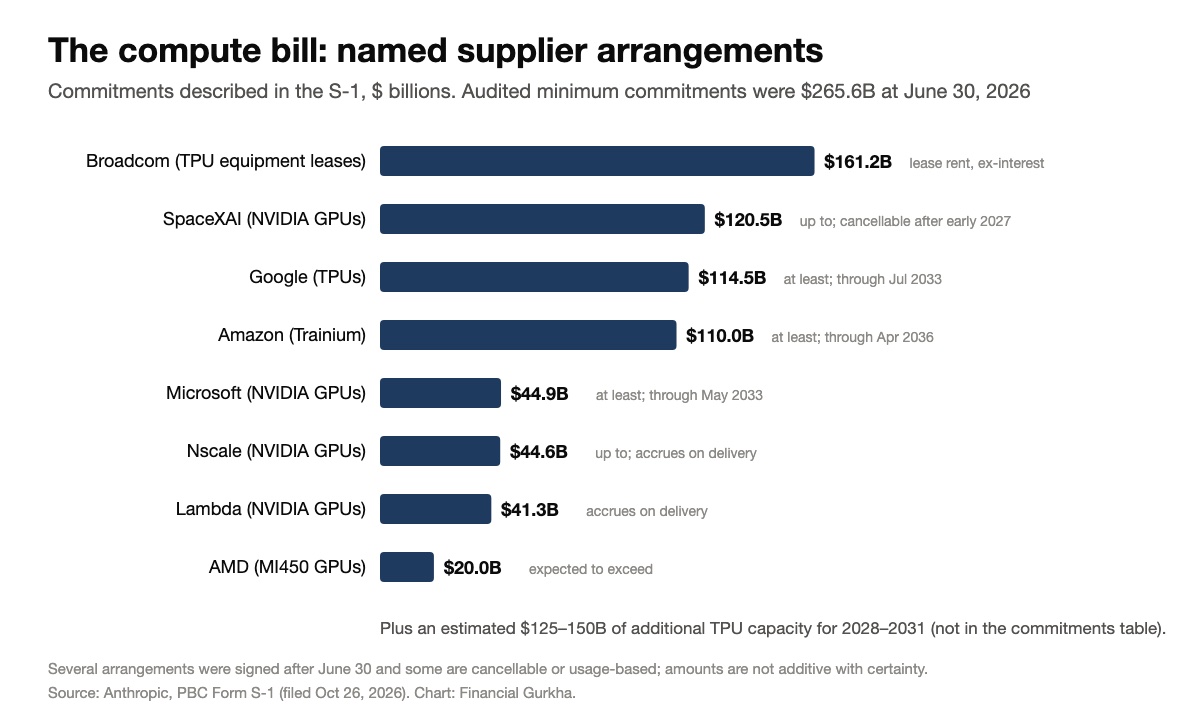
Anthropic buys compute from every major chip platform, and its minimum commitments quadrupled in six months. Audited minimum compute commitments were $54.6 billion at December 31, 2025 and $265.6 billion at June 30, 2026, with terms of 1 to 20 years. Several more deals were signed after that.
| Supplier | What it provides | Commitment described in the S-1 |
|---|---|---|
| Broadcom | Google TPU TPUTensor Processing Unit: Google’s custom AI chip. Anthropic accesses TPUs through Google Cloud and through hardware leased from Broadcom.-based hardware, leased | ~$161.2B of rent over five-year finance leases, excluding interest; up to $42B of convertible notes to fund that rent |
| SpaceXAI (formerly xAI) | Compute on NVIDIA GPUs | Up to $120.5B into 2029, about $3.1B a month at full delivery; cancellable on 90 days’ notice after early 2027 |
| TPU compute | At least ~$114.5B, Apr 2026–Jul 2033, plus an estimated $125–150B of additional TPU capacity for 2028–2031 | |
| Amazon | Compute including Trainium chips | At least $110B, May 2026–Apr 2036 |
| Microsoft | Compute on NVIDIA GPUs | At least $44.9B, Nov 2026–May 2033 |
| Nscale | Compute on NVIDIA GPUs | Up to ~$44.6B into 2033, paid as delivered |
| Lambda | Compute on NVIDIA GPUs | ~$41.3B into 2034, paid as delivered |
| AMD | Instinct MI450 GPUs in Helios racks | Expected to exceed $20B; AMD will buy up to $5B of Anthropic stock |
| NVIDIA | Strategic partner; Grace Blackwell and Vera Rubin systems through the clouds above | Co-design of future hardware |
Oracle does not appear anywhere in the filing.
A pattern runs through these deals: suppliers help finance their own sales.
- Amazon holds $6.2 billion of convertible notes that convert into about 1.84 billion shares at $2.09 and $5.05 a share.
- Google invested $10 billion in the Series H round, and Amazon $5 billion.
- AMD will buy up to $5 billion of stock as its chips are delivered.
- Broadcom can lend Anthropic the money to pay Broadcom’s own lease rent.
The filing names the tension itself: some suppliers “provide us capital or credit support, serve as our infrastructure vendors, and develop and offer AI models… that compete with ours.”
Deep dive: Anthropic’s compute deals with Google, Amazon, Broadcom, NVIDIA, AMD and Microsoft
9. Taking a Research Lab Public as a Public Benefit Corporation#↑ Contents
Anthropic is building a new template: a frontier research lab that sells shares to the public while legally obliged to weigh more than profit.
As a Delaware public benefit corporation Public benefit corporation (PBC)A for-profit company legally required to balance shareholder returns with a stated public benefit and the interests of people affected by its conduct., its directors must balance three things: shareholders’ financial interests, those materially affected by its conduct, and its stated purpose, “the responsible development and maintenance of advanced AI for the long-term benefit of humanity.”
What makes the template new:
- Control is separated from economics, twice: the purpose trust picks the board majority, and the founders hold the shareholder-vote majority. Neither share carries a dollar of economics.
- The trust is hard to dismantle. Changing it takes 80% of the board and 80% of the trustees. Without trustee support, it takes founder, employee and public supermajorities, or 85% of Class A shares once the founders’ share is gone.
- Employees get a voice. The new Class E shares give employees a vote on certain matters, including disputes over one trust-appointed director seat.
- Philanthropy is built into the capital structure:
- The Public Benefit Fund: 5% of fully diluted shares, 846,840,960 Class N shares, went to a wholly owned Anthropic Public Benefit Fund.
- More as the stock rises: the board may add up to 2% more each time the stock rises 50% above the prior milestone, starting at the IPO price.
- Employee donations are matched in stock: that program cost $541 million in 2025.
- Safety can override speed. The filing says model releases may be delayed or restricted on safety grounds, as Mythos was, even at a cost to short-term revenue.
For investors, this is the core trade: a company whose governance is designed to keep its mission ahead of its share price. The filing says so in its risk factors, and so should anyone pricing the stock.
10. Depreciation and Fixed Assets#↑ Contents
Depreciation is still tiny, because Anthropic has mostly rented its compute. That is about to change.
| Property and equipment ($M) | Dec 2024 | Dec 2025 | Jun 2026 |
|---|---|---|---|
| Servers, networking and infrastructure equipment | — | 34 | 618 |
| Construction in progress | 4 | 63 | 536 |
| Gross property and equipment | 23 | 158 | 1,234 |
| Accumulated depreciation | (4) | (12) | (47) |
| Net property and equipment | 19 | 146 | 1,187 |
- Policy: straight-line Straight-line depreciationSpreading an asset’s cost evenly over its useful life. A $5 million server with a five-year life is expensed at $1 million a year. depreciation over three to five years.
- Depreciation expense: $1M (2023), $3M (2024), $10M (2025), $35M in H1 2026. Total depreciation and amortization in H1 2026 was $97M.
- Finance leases began in 2026, with a weighted-average remaining term of 4.9 years at a 7.1% discount rate.
Why it matters: compute rented from cloud providers shows up as an operating expense. Leased or owned hardware shows up as an asset that is depreciated or amortized over time. The roughly $161 billion of Broadcom equipment leases, accounted for as finance leases Finance leaseA lease treated as if the company bought the asset with borrowed money: the asset is amortized and interest is charged on the lease liability., will move a large share of compute cost onto the balance sheet as it comes into service. Spread over five years, that is on the order of $30 billion a year of amortization and interest once fully in service. This is our illustration, not a company figure. It does not change the economics. It does change where the cost appears in the income statement.
11. Products, and the Virtual Collaborator Bet#↑ Contents
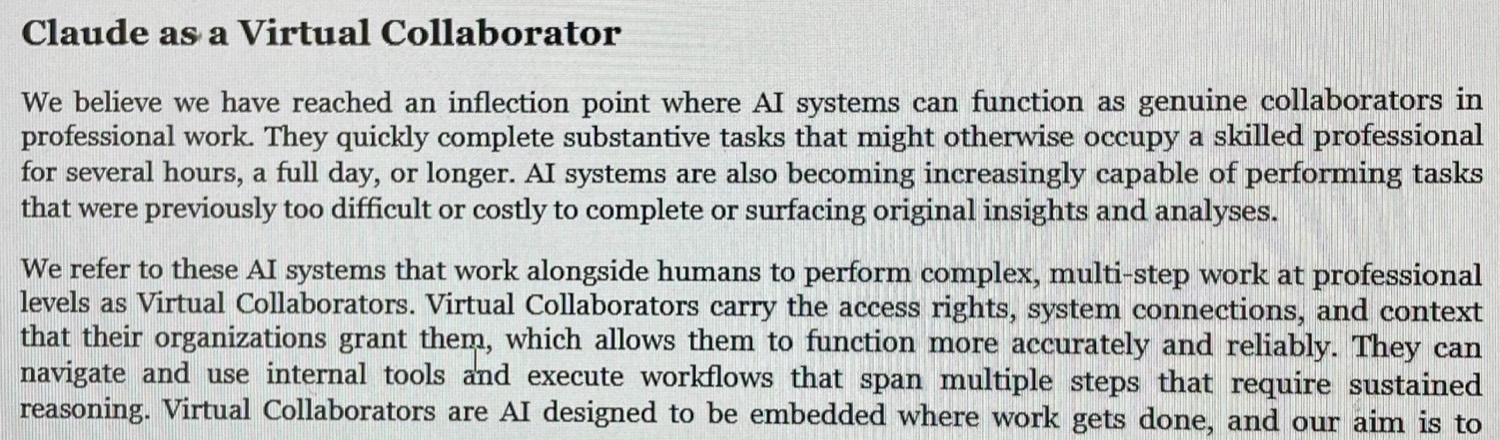
The filing’s central product idea is the “Virtual Collaborator”: an AI agent that works inside a company, with the access, connections and context of an employee.
| Layer | Products |
|---|---|
| Models | Mythos (most capable; general version Fable), Opus (Opus 5.5, the “enterprise daily driver”), Sonnet, Haiku |
| Platform | Claude Platform: the building blocks developers use to build agents (extended thinking, tool use, and more) |
| Applications | Claude Code (coding agent), Claude Cowork (knowledge-work agent with computer use, merging with Claude.ai), Claude Security, Claude Design, Claude Science |
Claude Code is the proof point. It plans, writes, tests and debugs code. Claude Cowork, launched as a research preview in January 2026, carries the same approach to non-technical work: it reads files, navigates applications and finishes multi-step tasks on a desktop. Cowork’s adoption has outpaced Claude Code’s at the same point after launch.
Where it is heading, in the filing’s words: Claude given “open-ended tasks lasting hours, days, or weeks,” executed with “the judgment and initiative of a brilliant colleague.” The target population is more than one billion knowledge workers by 2028.
The commercial evidence:
- Spending expands fast. Net revenue retention Net revenue retention (NRR)Revenue this quarter from customers who were already paying a year earlier, divided by their revenue in that year-ago quarter. 900% means those customers now spend about nine times as much. Anthropic excludes fixed-price Pro and Max subscribers. was about 900%.
- Big customers multiplied. Customers paying $100,000+ a year grew from about 950 to more than 11,900 in a year, 1,900 pay over $1 million, and about 250 pay over $10 million.
- The product cadence is relentless. Anthropic shipped 250 new model versions, features and applications in the first nine months of 2026.
Deep dive: Virtual Collaborators: Claude’s products and the customer evidence
12. Quantitative Risk Factors#↑ Contents
These are the risks you can put a number on.
| Risk | The number |
|---|---|
| Compute commitments vs revenue | $265.6B audited minimum (Jun 30) against $32.6B of revenue on a first-half annualized basis, about 8×; named deals since then add more |
| Channel concentration | 48% of first-half 2026 revenue came through cloud marketplaces (AWS, Google Cloud, Azure); 58% of receivables are from those channels |
| Customer concentration | No customer above 10% of revenue; the top five were about 21% in Q3 2026, down from about 36% in Q1 |
| Dilution | 5% Public Benefit Fund grant plus up to 2% per 50% share-price gain; Amazon notes convert into ~1.84B shares; Broadcom notes (up to $42B) convert at a 10% discount to market; AMD up to $5B of stock |
| Stock-based compensation | $2.2B in H1 2026, 13% of revenue |
| Model cycle | Models released in the prior six months produced more than 80% of Q3 2026 revenue |
| Seasonality | Customer spending fell about 20% in the two holiday weeks to Jan 2, 2026 |
| Earnings volatility | Fair-value marks swung net loss by $72.4B in H1 2026 |
| Debt covenant | $15B credit line requires at least $5B of liquidity at each quarter-end |
| Interest rate and FX | Immaterial, per the filing: a 100 bp move or 10% currency move would not have a material effect |
Deep dive: Anthropic IPO risks, the discount rate and valuation
13. Qualitative Risk Factors#↑ Contents
These risks are harder to measure, and the filing is unusually candid about them.
- Staying at the frontier. Success depends on keeping the most capable models, against well-funded competitors including OpenAI and Google.
- Compute supply. The chips come from a few suppliers and a few countries, are supply-constrained, and fall under export controls.
- Model behavior. The filing warns models may behave in “unintended, misaligned, or autonomous ways, including by taking harmful actions that no user or third party directed,” and that misuse could cause harm.
- Litigation. The $1.5 billion Bartz authors’ settlement was approved in July 2026. Suits remain from music publishers (Concord, Universal, Sony, Warner Chappell and others), Reddit, Canadian authors and news publishers, and consumer class actions over subscription marketing.
- Regulation. The EU AI Act imposes systemic-risk obligations on general-purpose models. On September 24, 2026, a coalition of state attorneys general led by New York and New Jersey urged Congress to legislate on frontier AI. Anthropic supports regulation and admits it may slow its own growth.
- Governance. Public shareholders cannot influence a change of control, and the trust and founders may favor the mission over share price.
- Conflicts with partners. Amazon, Google and Microsoft are suppliers, investors, sales channels and competitors at once.
- Key people and culture. The company depends on its seven co-founders and research talent.
14. The Discount Rate and What It Means for the IPO#↑ Contents
Every valuation starts with the risk-free rate, and today it is high. On October 26, 2026 the U.S. Treasury yield curve read:
| Maturity | Yield |
|---|---|
| 3-month bill | 4.22% |
| 2-year | 4.68% |
| 10-year | 5.00% |
| 30-year | 5.31% |
Anthropic’s own filings give a second anchor. It discounts its leases at 7.1% to 7.5%, the rate it uses to discount its own lease obligations. Equity investors demand more than lenders. A standard cost-of-equity Cost of equityThe return shareholders require to own a stock, usually built as the risk-free rate plus a premium for risk. It is the discount rate applied to the company’s future cash flows. estimate (risk-free rate plus beta times an equity risk premium) gives roughly 11% to 12%. That assumes a 5.0% risk-free rate, a beta of 1.3 to 1.6, and a 4.5% equity risk premium. Those are our illustrative assumptions; Anthropic has no trading history yet.
Why the rate matters so much here. Almost all of Anthropic’s value lies in profits years away, so its valuation behaves like a very long-duration bond. A rule of thumb from the perpetuity formula, value ≈ cash flow ÷ (discount rate − growth rate), makes the point. If the gap between the discount rate and long-run growth is 4 points, one extra point of discount rate cuts the value by 20%: 1/5 vs 1/4.
The price anchors so far:
- The Series H price was $589.01 per preferred share, or $58.90 per common share after the 10-for-1 conversion. Across about 16.9 billion fully diluted shares, that is roughly $1 trillion.
- The $2 trillion valuation reported in the press would be about $118 a share before new shares are issued.
- The earnings yield at $2 trillion: Q2 2026 operating income of $974 million, annualized, is about $3.9 billion. That is an earnings yield of about 0.2%, against 5.0% on a 10-year Treasury. The case for the stock is entirely about future growth.
We made the opportunity-cost argument in detail in September: Anthropic at $2 Trillion: The IPO Has to Beat a 5.56% Treasury First. The filing’s numbers make growth more believable than they looked then. They do not change the arithmetic of the hurdle.
Deep dive: Anthropic IPO risks, the discount rate and valuation
The Offering Itself#↑ Contents
| Item | Detail |
|---|---|
| Exchange and ticker | Nasdaq Global Select Market, ANT |
| Shares, price range, proceeds | Blank in the preliminary prospectus |
| Sellers | Anthropic and selling stockholders, including co-founders Tom Brown, Jack Clark, Jared Kaplan, Sam McCandlish and Christopher Olah |
| Lead underwriters | Goldman Sachs and Morgan Stanley, with J.P. Morgan, Citigroup, Barclays, Wells Fargo and 16 others |
| Use of proceeds | General corporate purposes including compute and infrastructure, hiring, possible acquisitions, and tax withholding on employee RSUs |
| Dividends | None planned |
| Company status | Controlled company; not an emerging growth company |
Frequently Asked Questions#↑ Contents
When did Anthropic file for its IPO, and what is the ticker? Anthropic, PBC filed a public Form S-1 with the SEC on October 26, 2026, after confidentially submitting a draft in June. It has applied to list Class A common stock on the Nasdaq Global Select Market under the symbol ANT. The price range and share count are not yet set.
How much revenue does Anthropic make? Revenue was $41 million in 2023, $386 million in 2024 and $4.59 billion in 2025. In the first half of 2026 it was $16.3 billion, including $11.6 billion in the second quarter alone.
Is Anthropic profitable? On an operating basis, it turned profitable in Q2 2026 with operating income of $974 million, an 8% margin. It still reported a first-half 2026 net loss of $80.7 billion. Nearly all of that comes from non-cash increases in the value of convertible notes and other instruments as the company’s valuation rose.
Who controls Anthropic after the IPO? Two single shares carry control. The Long-Term Benefit Trust holds one Class T share that lets it elect the majority of the board. The seven co-founders hold one Class F share, through a Founder LLC, with a fixed 50.1% of shareholder votes. Public Class A shareholders hold the remaining 49.9% of votes.
How much is Dario Amodei paid? Dario Amodei’s 2025 compensation was $17.96 million: $654,167 of salary, $13.3 million of stock and option awards, and $4.0 million of other compensation, mostly personal security. His base salary rose to $1.38 million in July 2026. Daniela Amodei is paid the same salary and equity; her 2025 total was $16.41 million.
How much cash does Anthropic have? As of June 30, 2026, Anthropic held $112.4 billion of cash and cash equivalents and $19.3 billion of short-term investments, a total of $131.7 billion. It also had $3.2 billion available under its credit facility, later replaced by a $15 billion facility.
How much has Anthropic committed to spend on compute? Audited minimum compute commitments were $265.6 billion at June 30, 2026, up from $54.6 billion at the end of 2025. The filing describes arrangements with Broadcom, SpaceXAI, Google, Amazon, Microsoft, Nscale, Lambda and AMD, several signed after June 30. Some are cancellable or usage-based.
What is a Virtual Collaborator? It is Anthropic’s term for AI agents that work alongside people on complex, multi-step professional tasks, using the access rights, system connections and context an organization grants them. Claude Code and Claude Cowork are the main examples today.
What are the biggest risks in Anthropic’s S-1? The largest measurable risks:
- Compute commitments far larger than current revenue.
- Heavy reliance on cloud marketplaces (48% of revenue).
- Dilution from convertible notes and the Public Benefit Fund.
- Revenue that depends on frequent new model releases.
The qualitative risks:
- Competition from OpenAI and Google.
- Compute supply.
- Model misbehavior.
- Copyright litigation.
- Governance that limits public shareholders’ influence.
Conclusion and Key Takeaways#↑ Contents
- Growth: about 10× a year, then 14× year on year in the first half of 2026. Q2 2026 revenue was $11.6 billion.
- Profitability: the first operating profit came in Q2 2026, driven by compute cost falling from $2.51 to $0.48 per revenue dollar.
- Cash: $131.7 billion on hand, and operating cash flow positive for the first time.
- The bet: at least $265.6 billion of compute commitments, much of it financed by the suppliers themselves.
- Control: a purpose trust and the co-founders hold control; public shareholders hold economics.
- The thesis: Virtual Collaborators, with Eli Lilly, AIG, Jane Street, BMS and DoorDash as the evidence.
- The hurdle: at the reported $2 trillion, today’s earnings yield is about 0.2% against a 5% Treasury. The price is a bet on the next decade.
Methodology and Sources#↑ Contents
All company figures are from Anthropic, PBC’s preliminary prospectus on Form S-1, filed October 26, 2026 (SEC accession no. 0001628280-26-067168), including its audited and unaudited consolidated financial statements. Figures labeled as Financial Gurkha calculations are our arithmetic from those statements, including:
- Second-half 2025 revenue, growth multiples, and compute cost per revenue dollar.
- Operating cash flow less capex, and per-share values.
- The amortization illustration and the cost-of-equity range.
Share counts and per-share prices reflect the company’s 10-for-1 stock split of September 17, 2026. Market valuations reported in the press are labeled as such. Treasury yields are from the U.S. Department of the Treasury’s daily par yield curve for October 26, 2026.
Primary sources
- Anthropic, PBC, Form S-1 Registration Statement (Oct 26, 2026). sec.gov
- U.S. Department of the Treasury, Daily Treasury Par Yield Curve Rates, October 2026. home.treasury.gov
The Anthropic S-1 series
- Anthropic’s revenue growth, quarter by quarter
- Who controls Anthropic? The share classes explained
- How Anthropic pays Dario and Daniela Amodei
- Virtual Collaborators: Claude’s products and the customer evidence
- Anthropic’s balance sheet, cash flow and depreciation
- Anthropic’s compute deals with Google, Amazon, Broadcom, NVIDIA, AMD and Microsoft
- Anthropic IPO risks, the discount rate and valuation
- Anthropic at $2 Trillion: The IPO Has to Beat a 5.56% Treasury First (September 2026)