Disclaimer: This article is for educational purposes only and is not investment advice.
AI disclosure. Researched and drafted with the help of Claude, made by Anthropic, the company discussed. All facts are from Anthropic’s S-1; the analysis is Financial Gurkha’s.
Part of our Anthropic S-1 series. Full analysis: Inside Anthropic’s S-1: The Complete Breakdown of the IPO Filing.
The 60-Second Version#↑ Contents
- Public buyers get Class A shares: full economic rights, one vote each, and 49.9% of shareholder votes combined.
- The seven co-founders hold one Class F share with a fixed 50.1% of shareholder votes, and no economic rights.
- The Long-Term Benefit Trust holds one Class T share that elects the majority of the board, also with no economic rights.
- Bottom line: a public shareholder owns a share of the profits, but cannot outvote the founders or replace the trust-picked board majority.
What's in this report#
- The 60-Second Version
- 1. The Five Classes in One Table
- 2. Who Picks the Board
- 3. Who Wins a Shareholder Vote
- 4. The Long-Term Benefit Trust
- 5. Can Any of This Change?
- 6. What It Means for Investors
- Frequently Asked Questions
1. The Five Classes in One Table#↑ Contents
| Class | Holder | Owns profits? | Votes |
|---|---|---|---|
| A | Public, employees, existing investors | Yes | 1 per share; 49.9% combined |
| F (1 share) | Founder LLC (7 co-founders) | No | Fixed 50.1% |
| T (1 share) | Long-Term Benefit Trust | No | Elects board majority |
| E | Employees (not co-founders) | No | Limited matters only |
| N | Amazon, AMD, Public Benefit Fund, other partners | Yes | None |
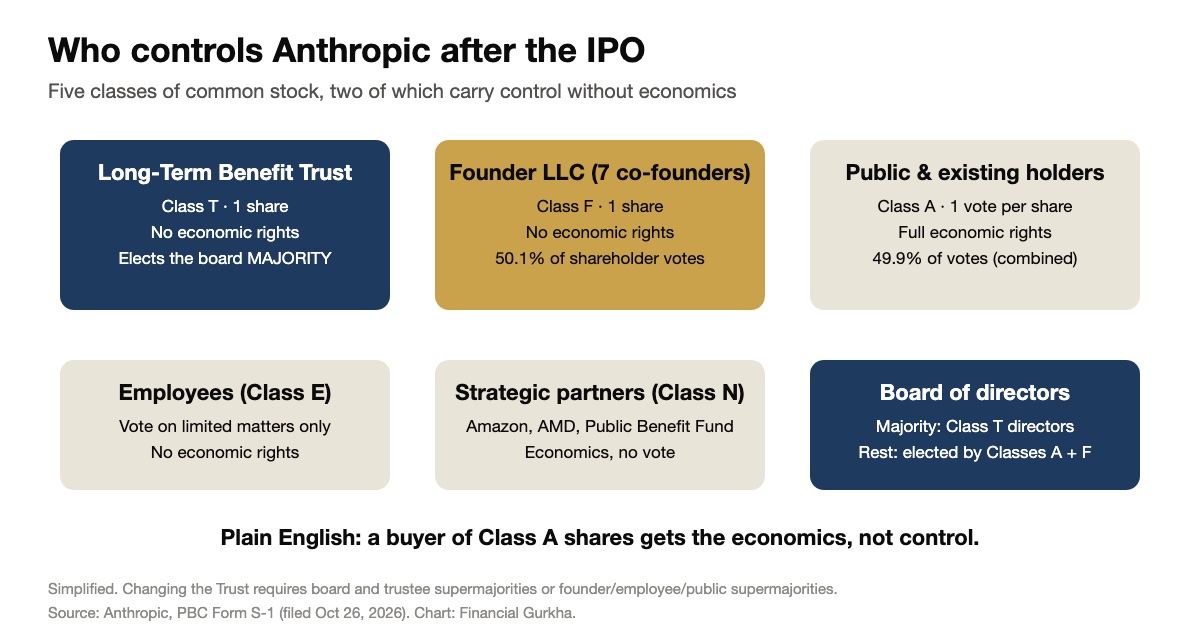
Class N converts to Class A when sold to an unaffiliated buyer, so partners’ stakes can enter the public float over time.
2. Who Picks the Board#↑ Contents
The trust elects the majority of directors; the founders and public shareholders, voting together, elect the rest.
| Director | Role | Elected through |
|---|---|---|
| Dario Amodei | CEO, co-founder | Classes A and F |
| Daniela Amodei | President, co-founder, Chair | Classes A and F |
| Yasmin Razavi | Spark Capital | Classes A and F |
| Reed Hastings | Independent | Class T (trust) |
| Christopher Liddell | Independent | Class T (trust) |
| Vas Narasimhan | Independent | Class T (trust) |
The trust and the Founder LLC have signed a stockholders’ agreement to vote together on board composition. Together, the filing says, they “will have the ability to elect all members” of the board.
Because the trust controls the board majority, Anthropic is a “controlled company” under Nasdaq rules. It plans to use that exemption only for its nominating and governance committee.
3. Who Wins a Shareholder Vote#↑ Contents
The founders, always, while their share exists. The single Class F share is fixed at 50.1% of votes on matters put to shareholders generally. That includes electing the non-trust directors. The Class A votes are scaled down to fill the other 49.9%, no matter how many Class A shares are issued.
Each founder still owns a large slice of the economics in their own right: roughly 232 to 245 million Class A shares each. The Founder LLC votes the Class F share as decided by a vote of the active co-founders, one vote each.
It ends when founders leave. The Class F share goes away once fewer than three co-founders remain active for 90 consecutive days, or if a supermajority of them redeems it.
4. The Long-Term Benefit Trust#↑ Contents
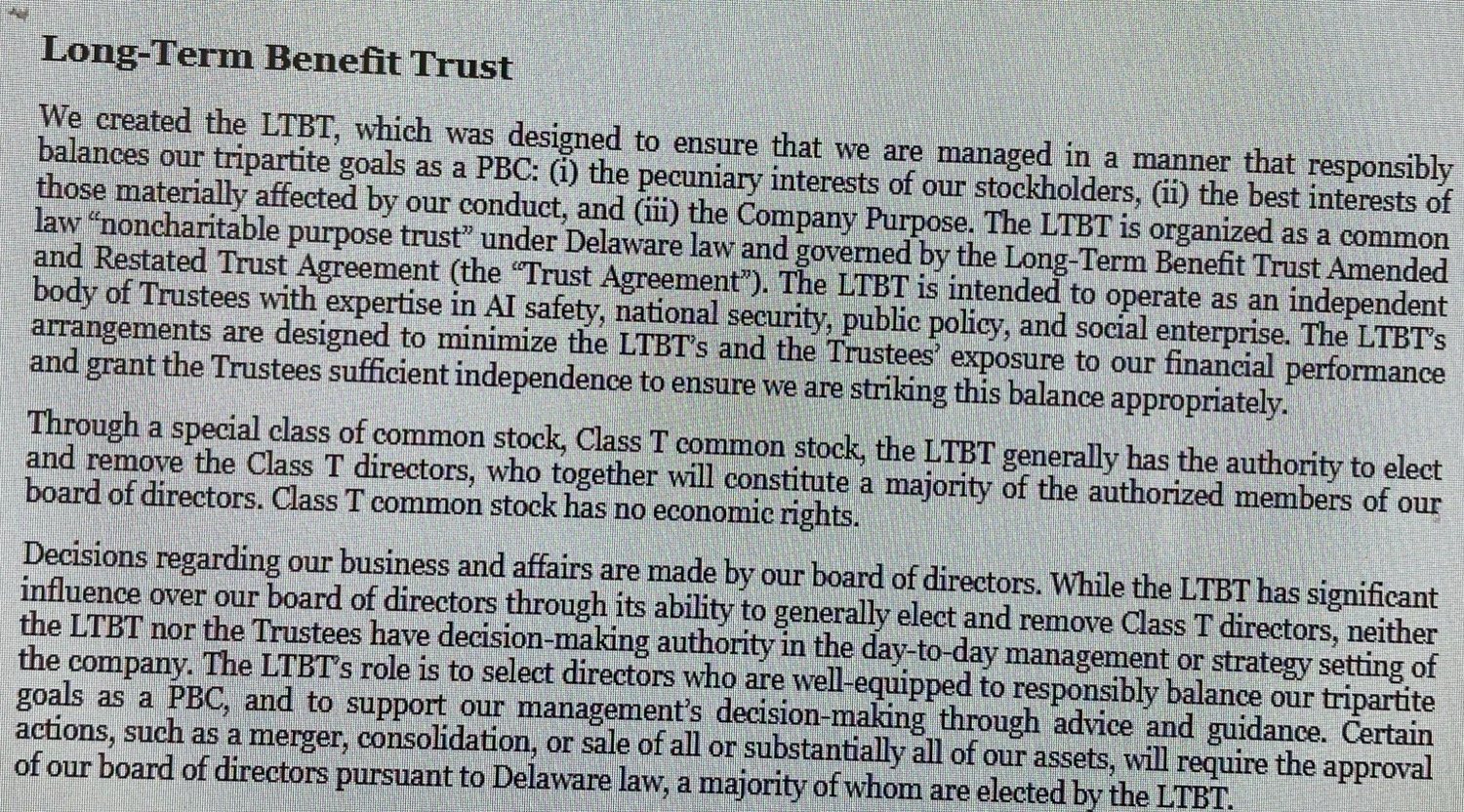
- What it is: a Delaware purpose trust, not a charity.
- Its job: pick directors who will balance shareholders’ financial interests, the interests of those affected by Anthropic, and its mission.
- Trustees: five seats, one vacant. Chaired by Dr. Neil “Buddy” Shah, CEO of the Clinton Health Access Initiative.
- Built for independence:
- Trustees may not own Anthropic stock and are paid a fixed cash fee unrelated to company performance.
- They serve one-year terms with no limit and appoint their own successors.
- What it does not do: run the company. It has no say in day-to-day management or strategy.
5. Can Any of This Change?#↑ Contents
Yes, but only with very broad agreement.
| Path to change the trust or Class T | Approval needed |
|---|---|
| Trustees agree | 80% of the board and 80% of trustees |
| Trustees disagree, founders’ share exists | All active founders + Class E majority + Class A majority (first 3 years); or ⅔ of founders + 75% of Class E + Class A majority |
| Trustees disagree, no founders’ share | 85% of all outstanding Class A shares |
6. What It Means for Investors#↑ Contents
- Economics without control. Class A holders share in profits but cannot force a sale, replace the board majority, or outvote the founders.
- The mission can come first. As a public benefit corporation, directors must weigh the company’s purpose and those it affects alongside profits.
- It is deliberate, and disclosed. The filing lists this structure among its key risk factors.
Frequently Asked Questions#↑ Contents
Will Anthropic’s public shareholders control the company? No. A Long-Term Benefit Trust elects the majority of the board through one share of Class T stock. The seven co-founders hold a fixed 50.1% of shareholder votes through one share of Class F stock. Public Class A shareholders hold 49.9% of votes combined.
What is Class F stock at Anthropic? A single share held by a Founder LLC owned by the seven co-founders: Dario Amodei, Daniela Amodei, Tom Brown, Jack Clark, Jared Kaplan, Sam McCandlish and Christopher Olah. It carries 50.1% of shareholder votes and no economic rights.
Who are the trustees of Anthropic’s Long-Term Benefit Trust? The trust has five seats, one vacant, and is chaired by Dr. Neil “Buddy” Shah, CEO of the Clinton Health Access Initiative. Trustees may not own Anthropic stock and are chosen for expertise in AI safety, national security, public policy and social enterprise.
Read the complete analysis: Inside Anthropic’s S-1: The Complete Breakdown of the IPO Filing
Methodology and Sources#↑ Contents
From Anthropic, PBC’s Form S-1 filed October 26, 2026: the sections on “Our Governance Structure and Its Goals,” “Management,” “Principal and Selling Stockholders” and “Description of Capital Stock.” SEC EDGAR.