Disclaimer: This article is for educational purposes only and is not investment advice. Valuation figures are illustrative; the IPO price has not been set.
AI disclosure. Researched and drafted with the help of Claude, made by Anthropic, the company discussed. All company figures are from Anthropic’s S-1; the analysis and assumptions are Financial Gurkha’s.
Part of our Anthropic S-1 series. Full analysis: Inside Anthropic’s S-1: The Complete Breakdown of the IPO Filing.
The 60-Second Version#↑ Contents
- Measurable risks:
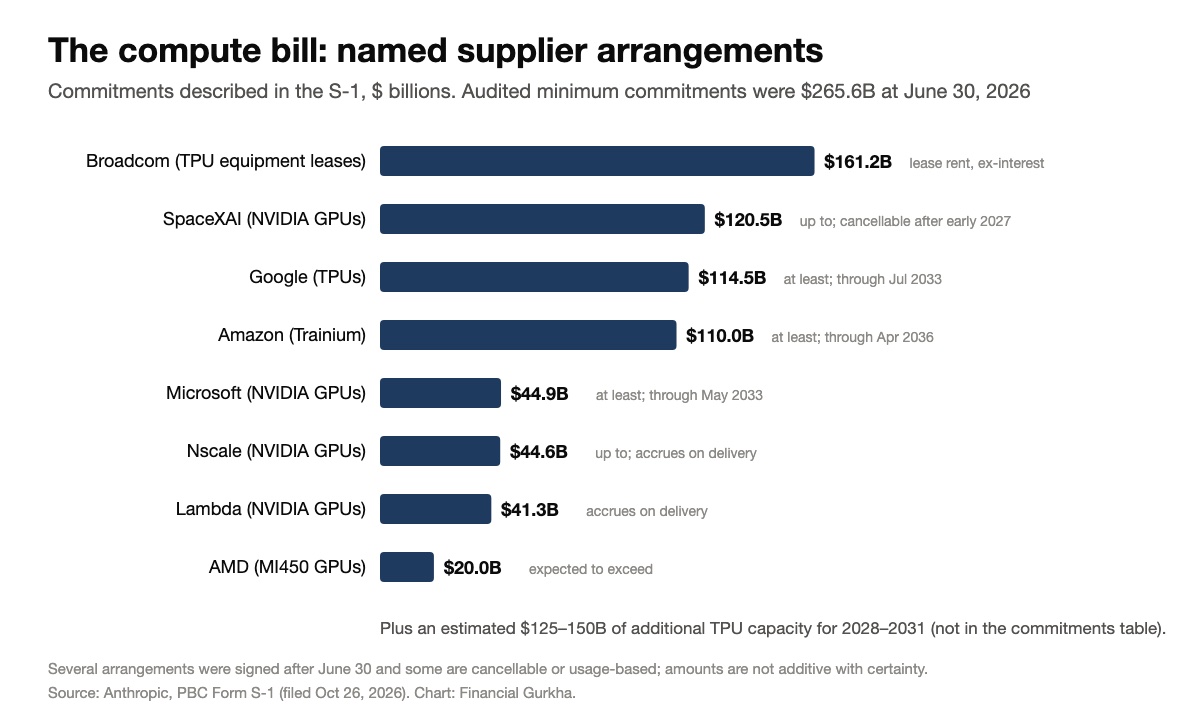
- Compute commitments of $265.6B, about 8× annualized revenue.
- 48% of revenue through cloud marketplaces.
- Built-in dilution.
- Revenue that depends on models less than six months old.
- Unmeasurable risks:
- Staying at the frontier, and compute supply.
- Model behavior and copyright litigation.
- A governance structure that limits public shareholders.
- The discount rate: the 10-year Treasury is at 5.00%, and an illustrative cost of equity is 11–12%. Because nearly all value lies years ahead, a one-point change in the discount rate can move fair value by about a fifth.
- The hurdle: at a reported $2 trillion, today’s annualized operating income is an earnings yield of about 0.2%.
What's in this report#
- The 60-Second Version
- 1. Quantitative Risks
- 2. Qualitative Risks
- 3. Today’s Discount Rate
- 4. How the Discount Rate Hits a Long-Duration Stock
- 5. The Price Anchors
- Frequently Asked Questions
1. Quantitative Risks#↑ Contents
| Risk | Measure | Why it matters |
|---|---|---|
| Compute commitments | $265.6B audited minimum vs $32.6B of annualized first-half revenue (~8×) | Fixed costs that persist if demand slows |
| Channel concentration | 48% of H1 2026 revenue and 58% of receivables via AWS, Google Cloud and Azure marketplaces | Dependence on partners who also compete |
| Customer concentration | Top 5 customers about 21% of Q3 2026 revenue (36% in Q1); none above 10% | Falling, but still meaningful |
| Built-in dilution | 5% Public Benefit Fund grant; up to +2% per 50% share-price rise; ~1.84B shares from Amazon notes; up to $42B of Broadcom convertible notes at a 10% discount; up to $5B of AMD stock purchases | Each issues new shares |
| Stock-based compensation | $2.2B in H1 2026 (13% of revenue) | A real cost excluded from “adjusted” margins |
| Model-release dependence | Models released in the prior six months produced 80%+ of Q3 2026 revenue | Revenue depends on continuous releases |
| Seasonality | Spending fell ~20% over the 2025 holidays | More visible as growth slows |
| Reported-earnings volatility | $72.4B non-cash fair-value charge in H1 2026 | Net income is hard to read until notes convert |
| Covenant | At least $5B of liquidity each quarter-end from Dec 2026 | Low today against $131.7B of cash |
| Rates and currency | A 100 bp or 10% FX move: “not material” per the filing | Low |
2. Qualitative Risks#↑ Contents
- Competition at the frontier. OpenAI, Google and well-funded large technology companies, plus open-weight models.
- Compute supply. A few suppliers and geographies, supply constraints and export controls.
- Model behavior. The filing warns of models acting in “unintended, misaligned, or autonomous ways,” and of misuse by bad actors.
- Litigation. The Bartz settlement of $1.5 billion was approved in July 2026. Suits are pending from music publishers, Reddit, Canadian authors and news publishers, plus consumer class actions and opt-out author suits.
- Regulation. The EU AI Act, state attorney-general pressure for federal rules, and export controls. The filing says Anthropic’s own support for regulation could slow its growth.
- Safety-driven release choices. Anthropic has delayed or limited releases, such as Mythos, and may again, at a cost to near-term revenue.
- Governance. Control sits with a purpose trust and the founders; public shareholders “may” see the mission prioritized over financial returns.
- Conflicted partners. The same companies are suppliers, investors, sales channels and competitors.
- People and culture. Dependence on seven co-founders and key researchers.
3. Today’s Discount Rate#↑ Contents
The U.S. Treasury yield curve on October 26, 2026:
| Maturity | Yield |
|---|---|
| 3-month bill | 4.22% |
| 1-year | 4.47% |
| 2-year | 4.68% |
| 5-year | 4.84% |
| 10-year | 5.00% |
| 30-year | 5.31% |
Anthropic’s own numbers give a second anchor: it discounts its leases at 7.1–7.5%. Shareholders bear more risk than lessors, so equity must require more.
| Cost of equity (illustrative) | Assumption |
|---|---|
| Risk-free rate | 5.0% (10-year Treasury) |
| Equity risk premium | 4.5% |
| Beta | 1.3 to 1.6 |
| Cost of equity | ≈ 10.9% to 12.2% |
These are our assumptions; Anthropic has no trading history.
4. How the Discount Rate Hits a Long-Duration Stock#↑ Contents
When almost all of a company’s value is in the future, small changes in the discount rate move the price a lot.
The perpetuity formula, value = cash flow ÷ (discount rate − growth rate), shows why. If the gap between the discount rate and long-run growth is 4 points, value is 25 times cash flow. Raise the discount rate one point and the gap is 5 points: value becomes 20 times cash flow, 20% lower.
That is why the IPO is sensitive to rates:
- Higher Treasury yields lift the required return on all stocks, hitting long-duration growth stocks hardest.
- Lower yields do the opposite.
The Federal Reserve’s next meeting and the path of long-term yields matter for this deal as much as the next quarter’s revenue.
5. The Price Anchors#↑ Contents
| Anchor | Per share | Implied value |
|---|---|---|
| Series G (Jan–Feb 2026) | $25.91 | ~$0.44T |
| Series H (May–Jun 2026) | $58.90 | ~$1.0T |
| Reported $2T target (press) | ~$118 | $2.0T |
| Employee grant valuations, 2026 | $21.56–$57.14 | — |
The implied values are our calculation, using about 16.9 billion fully diluted shares, derived from the 846.8 million share grant equal to 5%. Per-share figures reflect the 10-for-1 split. The new shares sold in the IPO would add to the count.
The earnings yield: Q2 2026 operating income of $974 million, annualized, is about $3.9 billion. At $2 trillion that is an earnings yield of about 0.2%, against 5.0% on a riskless 10-year Treasury. Buyers at that price are paying for many years of growth ahead. We worked through the full opportunity-cost math in Anthropic at $2 Trillion: The IPO Has to Beat a 5.56% Treasury First.
Frequently Asked Questions#↑ Contents
What are the main risks in Anthropic’s IPO? The measurable risks:
- $265.6 billion of compute commitments.
- Reliance on cloud marketplaces for 48% of revenue.
- Built-in dilution from convertible notes and the Public Benefit Fund.
- Revenue that depends on frequent model releases.
The unmeasurable risks:
- Frontier competition and compute supply.
- Model misbehavior and copyright litigation.
- A governance structure that limits public shareholders’ influence.
What discount rate should be used to value Anthropic? There is no single answer. With the 10-year Treasury at 5.00% on October 26, 2026, a 4.5% equity risk premium and a beta of 1.3 to 1.6, the cost of equity would be roughly 11% to 12%. Anthropic itself discounts its leases at 7.1% to 7.5%.
What price did Anthropic’s last private round imply? The Series H preferred shares sold for $589.01 each, which is $58.90 per common share after the 10-for-1 conversion. That implies about $1 trillion across roughly 16.9 billion fully diluted shares.
Read the complete analysis: Inside Anthropic’s S-1: The Complete Breakdown of the IPO Filing
Methodology and Sources#↑ Contents
Company figures are from Anthropic, PBC’s Form S-1 filed October 26, 2026: “Risk Factors,” “Quantitative and Qualitative Disclosures about Market Risk,” the financial statements, and the equity-financing disclosures. Treasury yields are from the U.S. Department of the Treasury for October 26, 2026. The cost of equity, implied values and perpetuity example are Financial Gurkha calculations. SEC EDGAR.