The Daily Brief
Anthropic Falls Back to Its $83 IPO Price as the AI Selloff Hits a Seventh Day
ANT traded within a dollar of its offer price at midday Friday, Nvidia fell about 7% and the Nasdaq dropped about 3% — while the 10-year yield slipped below 5% and the Fed AI-debt warning hangs over the December meeting.
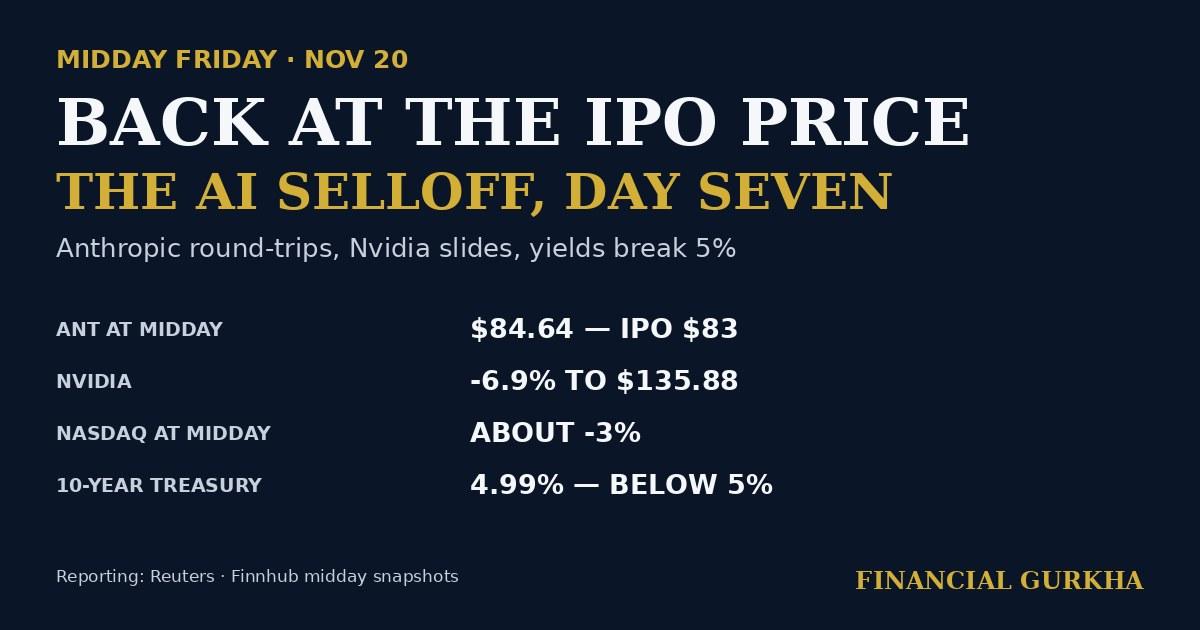
The largest IPO in history is two days old, and by midday Friday its stock was back within a dollar of the price it was sold at. Anthropic (Nasdaq: ANT) traded at $84.64 at about 12:35 p.m. ET, down 12.9% on the day, with an intraday low of $84.00 — against an $83 offer price. Around it, the AI selloff deepened into what is on pace to be a seventh straight down day for the S&P 500: the Nasdaq was down about 3% at midday, the S&P 500 about 2%, and the Dow about half a percent. Nvidia fell about 7% to $135.88. And in the bond market, the 10-year Treasury yield slipped below 5% — not because the Federal Reserve sounds friendlier, but because investors are running for safety.
Anthropic: the IPO worked, the aftermarket is another story#
Separate the deal from the stock, because they are telling two different stories. The deal was a triumph by any measure: priced at $83 on Wednesday night, above the $70 to $78 range, upsized to 980 million shares, $81.31 billion raised — the largest offering on record, as our pricing brief laid out. The company got its money. The $26 billion private placement from Google, Nvidia, AMD and others closes alongside, and the offering itself closes today.
The trading has been a round trip. Thursday's debut opened at $111.50, up 34%, touched $115.10, and closed at $97.17 — still up 17.1% on the day. About 840 million shares changed hands, according to CNBC's count — roughly 86% of all the shares sold in the offering, and far above SpaceX's first-day volume of about 522 million shares. Retail traders alone traded $772 million of stock, a first-day record in Vanda Research data going back to 2012 — but their net buying was only $60 million, about half what retail put into SpaceX. Friday, the stock gave the rest back: opened at $89.86, and by midday it was testing the level where the underwriters priced it.
This is the exact pattern our IPO guide warned about on pricing morning, using Figma as the template: the first print is the market's excitement, not its verdict. Figma opened at $85 against a $33 price and eventually fell about 85% from its peak while its business kept growing. Anthropic has compressed the opening chapters of that story into two sessions. What has not changed is the company underneath: $16.96 billion of third-quarter revenue, a run-rate near $81 billion, and about $900 billion of compute commitments — the same filing economics, at a very different market mood.
Nvidia and the chips: the centre of the trade is the centre of the selling#
Nvidia is down about 18% in five sessions and about 39% in a month. Friday's midday price of $135.88 compares with closes of $162.85 last Friday, $155.46 on Tuesday and $145.98 on Thursday. Reuters reported Friday that the slide has knocked Nvidia behind Alphabet to fourth place among US companies by market value — Apple at $5.08 trillion, Microsoft $3.72 trillion, Alphabet $3.44 trillion, Nvidia about $3.3 to $3.4 trillion — and that the stock is on course for a seventh straight weekly decline, its longest losing streak since 2008.
The rest of the complex fell with it: Micron was down more than 10% at midday and SanDisk more than 13%, with AMD under additional pressure from a report raising questions about its China ties. CoreWeave, the neocloud whose $9.44 billion single-quarter capex bill we broke down on November 11, dropped more than 5% in premarket trading, according to Reuters.
The striking part is what the selling is ignoring. Nvidia's numbers, printed Tuesday, were the biggest in its history: revenue of $115.8 billion, up 103%, with a $130 billion guide. Our valuation blog ran the math on Wednesday at $155.46: a trailing price-to-earnings multiple of 16.7 times on $9.31 of trailing earnings, an earnings yield of about 6% against a 10-year Treasury then at 5.11%, and a discounted-cash-flow band of $113 to $166 a share at 10% growth, depending on the discount rate. At $135.88, the same trailing earnings produce a multiple of about 14.6 times, and the price now sits between the blog's 11% and 12% discount-rate values ($143 and $125). The earnings did not get worse this week. The price the market will pay for them did — which is a statement about risk appetite and financing, not about the quarter. As Saxo's Charu Chanana put it to Reuters, Nvidia's blowout earnings and Anthropic's IPO have both failed to restore confidence.
The week and the month#
Thursday was the sixth straight loss for the S&P 500: the Dow fell 1,101 points, or 2.2%, to 49,097 — its first close below 50,000 since June — the S&P 500 fell 2.02% to 7,175.83, and the Nasdaq fell 2.25%. Thursday's session also contained the week's most telling reversal: both the Nasdaq and the S&P traded up more than 1% at their highs, then turned down after Anthropic shares began trading at midday.
Through Thursday, the Dow was down 6.2% on the week and the S&P 500 and Nasdaq about 5% each, according to Reuters — the steepest weekly declines since the April 2025 tariff shock, before Friday's losses are counted. For the month and the quarter, the S&P 500 is down 9.4% from its October high, near correction territory, and the Nasdaq is about 15% below its early-October record and briefly traded negative for 2026 on Friday morning. The selling is global: Reuters reported global equities on a seventh straight daily decline, Asian shares heading for their worst week since 2020, and the VIX volatility index at its highest since March.
Yields below 5%: safety, not relief#
The 10-year Treasury yield tells the other half of the story. On the Federal Reserve's H.15 release, the 10-year closed at 5.15% last Friday, 5.12% Monday, 5.10% Tuesday and 5.07% Wednesday. On Friday it slipped below 5%, trading near 4.99% at midday — down about 6 basis points on the day, according to MarketWatch, on safe-haven demand as risk assets slid.
That is sustained pressure on rates in an unusual direction: yields are falling while the Fed talks about raising them. The two forces meet in December. For readers of our mortgage blog, the connection is direct: the average 30-year mortgage was 7.11% in the week of November 12, with the 10-year then at 5.11%. If the 10-year holds below 5%, the lock-in math that has frozen the housing market starts, slowly, to loosen. If the yield is back above 5% by the December meeting, it was a flight-to-safety blip inside a rising-rate story. The level to watch is the close, not the intraday dip.
The Fed is watching the same trade — and said so on Wednesday#
On Wednesday, the minutes of the Fed's October meeting put the AI buildout into the financial-stability record, in the central bank's own words — the story of our FOMC brief. Most participants observed that AI-related debt had grown rapidly through "complex and opaque financing structures." Almost all commented on the risks of a scenario in which returns on AI investment disappoint investors. Many called the buildout itself a material source of inflation risk. Fed staff flagged circular financing and off-balance-sheet leasing — the same structures visible in Nvidia's $390 billion of purchase commitments and Anthropic's roughly $900 billion commitment stack.
The policy side of those minutes is just as important, and it points the other way from the bond rally. The Fed held at 3.75 to 4.00% on a 10–2 vote, with Lisa Cook and Beth Hammack dissenting in favour of a hike. Almost all participants judged further hikes likely appropriate, and a couple said a move larger than 25 basis points could be considered in December if inflation disappoints. Governor Christopher Waller has since said, in his personal capacity, that the Fed may need to "shock" markets with a 50-basis-point move. The inflation data since the meeting have not argued against them: core CPI rose 0.3% for a third straight month in October, as our CPI breakdown showed, and producer prices are up 6.5% year over year. Before the minutes, markets were pricing a December 25-basis-point hike at roughly 92 to 96% odds, depending on the venue.
So the setup into the December 8–9 meeting is genuinely two-sided. The equity market is pricing the disappointment scenario the Fed described — falling returns on AI capital, strained financing, forced selling. The bond market is buying safety today while the Fed's own record says the next move is more likely up than down. One of those positions is wrong, and the December meeting is where the argument gets settled. This site will report that meeting the way it has reported this week: figures first, attributed, with no recommendation attached. Nothing in this brief is financial advice.
What happens next#
The Anthropic offering closes today, Friday; options on ANT begin trading Monday, November 23, which gives the market its first cheap way to bet against the stock as well as on it. The greenshoe window runs 30 days from pricing. The week's data calendar is holiday-shortened by Thanksgiving. And the December 8–9 FOMC meeting is now the fixed point everything else trades around: the last major inflation prints land before it, and the Fed's AI-debt language will be quoted back at every official who speaks between now and then.
Even the buildout itself has not paused: on Tuesday, in the middle of the rout, Genesis AI raised $500 million to scale its robots, as our Genesis brief reported. Capital is still being raised and spent. What changed this week is the price of believing in it.
Sources#
- Reuters, "Wall St futures slip as Anthropic debut fails to reassure AI investors," November 20, 2026 — the premarket picture, the weekly declines through Thursday, the hyperscaler and chip moves, and CoreWeave.
- Reuters, "Stocks slide as AI selloff deepens, Asia set for worst week since 2020," November 20, 2026 — the global selloff, the seventh straight daily decline in world equities, the VIX, and the Saxo comment.
- Reuters, "Nvidia's share slide knocks it below Alphabet in valuation," November 20, 2026 — the market-value rankings and the seventh straight weekly decline.
- Finnhub quote snapshots, about 12:35 p.m. ET, November 20, 2026 — ANT at $84.64 and Nvidia at $135.88, with session ranges and recent closes.
- CNBC trading data, via Nasdaq reporting — about 840 million Anthropic shares traded on day one; Vanda Research via Yahoo Finance — $772 million of retail trading, $60 million of net retail buying.
- Federal Reserve, H.15 Selected Interest Rates (daily) — 10-year Treasury constant-maturity closes of 5.15% (Nov 13), 5.12% (Nov 16), 5.10% (Nov 17) and 5.07% (Nov 18); MarketWatch — the 10-year near 4.99% at midday Friday.
- Barron's and Investor's Business Daily live coverage, November 20, 2026 — midday index moves and the S&P 500's 9.4% decline from its October high.
- Federal Reserve, Minutes of the FOMC, October 27–28, 2026 — the AI-debt passages and the rate debate, as covered in Financial Gurkha's FOMC brief.
This article is written in collaboration with Muse by Meta. Try it today: redeem my code 5PLTO0 in Settings within 48 hours of joining and we'll both get 1 billion Muse tokens. Educational content only — not investment advice.
Where this came from
Plain-English explainers, not advice. Nothing here tells you to buy, sell, or hold anything.