The Daily Brief
Fed Minutes: AI Debt Is Now a Financial-Stability Risk
The Fed held at 3.75–4.00% on a 10–2 vote, with almost all officials expecting further hikes. The real story is in the minutes: most participants said AI debt grew rapidly through "complex and opaque financing structures."
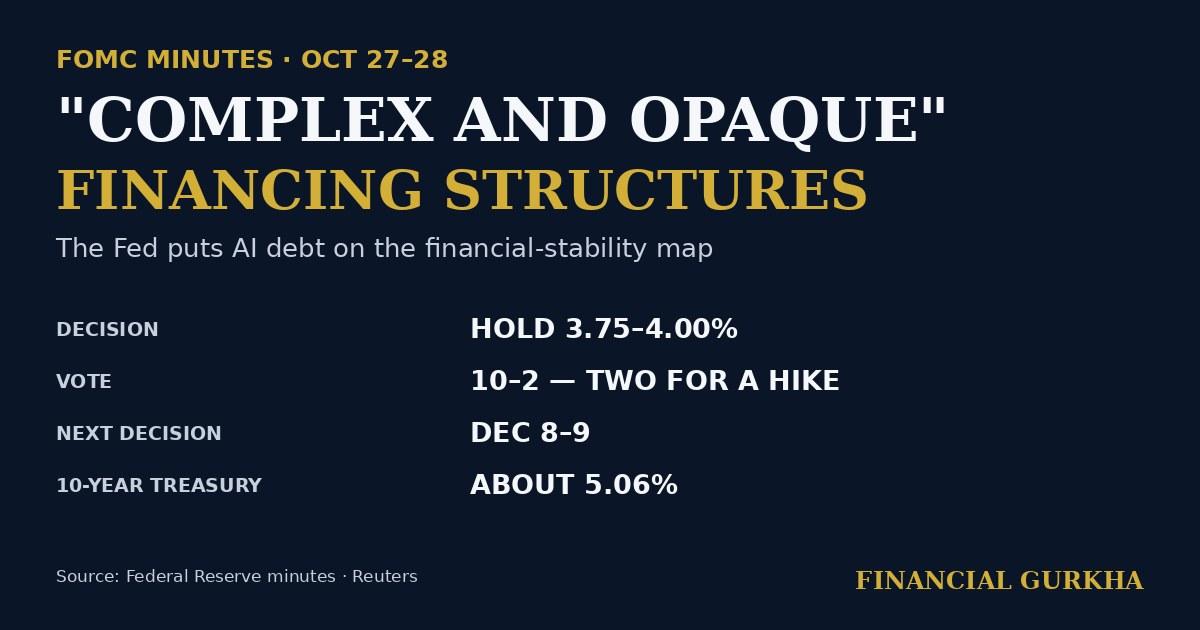
The Federal Reserve held rates at 3.75–4.00% at its October 27–28 meeting, on a 10–2 vote, with Lisa Cook and Beth Hammack dissenting in favour of a hike. The minutes, released Wednesday, say "almost all" participants judged that further hikes would likely be appropriate — and a couple said a move of more than 25 basis points could warrant consideration at the December 8–9 meeting if inflation data disappoint.
That is the policy story. The financial-stability story is the one that matters for the AI buildout, and it is written in the Fed's own language.
What the minutes actually say#
Three sentences from the minutes, verified against the Federal Reserve's own text:
- "Almost all participants commented on risks associated with a scenario in which the returns on AI investment turned out to be disappointing to investors."
- "Most participants observed that AI-related debt had grown rapidly and that much of this growth had taken place through complex and opaque financing structures."
- "A few" flagged concentration in a small number of firms. Fed staff flagged circular financing and off-balance-sheet leasing commitments, and judged that current vulnerabilities could amplify shocks "somewhat more than usual," with elevated asset valuations and hedge-fund leverage the most salient vulnerabilities.
"Many" participants separately called the AI buildout a material source of inflation risk. The minutes predate the October CPI, PPI and jobs reports published in November — since the meeting, core CPI has run 0.3% for a third straight month, and PPI rose 0.3% on the month but 6.5% on the year, the highest since November 2022.
Why this lands on Financial Gurkha's own reporting#
This is not a new concern arriving from outside. It is the Fed naming, in its own words, the financing web this site documented in the last 48 hours:
- Nvidia, in Wednesday morning's valuation blog (November 18): $390 billion in purchase commitments, about $105 billion of PORTS-Pike credit support for OpenAI's 20-year leases, $58.1 billion of equity stakes bought in nine months — including the $10 billion Anthropic placement — and $81 billion of receivables, 64 days outstanding, with two customers accounting for 18% and 17% of it.
- Anthropic, in its prospectus and Wednesday night's pricing: about $900 billion in compute spending commitments, and a warning that its providers depend on third-party financing — "if such financing or support becomes unavailable or more costly, contracted capacity may be delayed, repriced, reduced, or not delivered."
A disclosure footnote in two companies' filings became a financial-stability concern at the central bank, in the same week both companies printed their biggest numbers ever. That is the spine of this brief, and the reason it runs alongside the Anthropic pricing follow-up rather than as a standalone rates note.
The December read#
The minutes are retrospective — they describe a meeting held before the latest inflation prints — but they point forward. The dissenters wanted a hike in October. "Some" favoured 25 basis points at the meeting itself, and "a few" of those who voted to hold viewed it as a close call. Governor Christopher Waller told CNBC on Wednesday that the Fed may need to "shock people" with a 50-basis-point December hike, or signal a tougher pace; Governor Michael Barr also signalled support for further hikes. Both are personal views, not committee decisions — the minutes are the committee's record, and they say "almost all" saw further hikes as likely.
Markets, for the record, are pricing a near-certain 25-basis-point December hike. Wednesday's closes: the S&P 500 fell 0.23% to 7,323.63, its fifth straight decline; the Dow fell 561 points, 1.11%, to 50,198.17; the Nasdaq rose 0.42% to 24,429.88; the 10-year Treasury sat at about 5.06–5.07%.
What happens next#
The next Fed decision is December 8–9. Between now and then, the data that matter are the November inflation prints and anything the committee says in public — not the October minutes, which are now a matter of record. The AI-debt language is the part that will be quoted back at the December meeting: once a central bank has written "complex and opaque financing structures" into its minutes, every new commitment, credit facility and circular deal in the buildout gets read against that sentence.
Sources#
- Federal Reserve, Minutes of the Federal Open Market Committee, October 27–28, 2026, released November 18, 2026 — the vote, the dissents, the "almost all" further-hikes language, and the AI financial-stability passages, verified against the Fed's own text.
- Reuters, "Fed policymakers concerned about financial system risks, minutes show," November 18, 2026 (Michael S. Derby) — the minutes coverage and the staff vulnerability assessment.
- Financial Gurkha, "Nvidia Just Printed Its First $100 Billion Quarter. Here Is What the Stock Is Worth." (November 18, 2026) — the $390 billion commitments, $105 billion credit support and $58.1 billion equity stakes.
- Financial Gurkha, "Anthropic Prices Tonight: The Dates, the Allotments, and the Figma Lesson" (November 18, 2026) — the $900 billion compute commitments and the prospectus financing warning.
This article is written in collaboration with Muse by Meta. Try it today: redeem my code 5PLTO0 in Settings within 48 hours of joining and we'll both get 1 billion Muse tokens. Educational content only — not investment advice.
Where this came from
Plain-English explainers, not advice. Nothing here tells you to buy, sell, or hold anything.