The Daily Brief
Genesis AI Raises $500M Series A at $3.5B Valuation to Scale Its Eno Robot
Genesis AI, the Paris-headquartered robotics startup co-founded by Zhou Xian and former Mistral researcher Théophile Gervet, raised 500 million dollars at a 3.5 billion dollar valuation, Reuters reported, in one of the largest funding rounds in European robotics. The company is betting that owning the robot brain, the body and the data it learns from is how physical AI gets reliable.
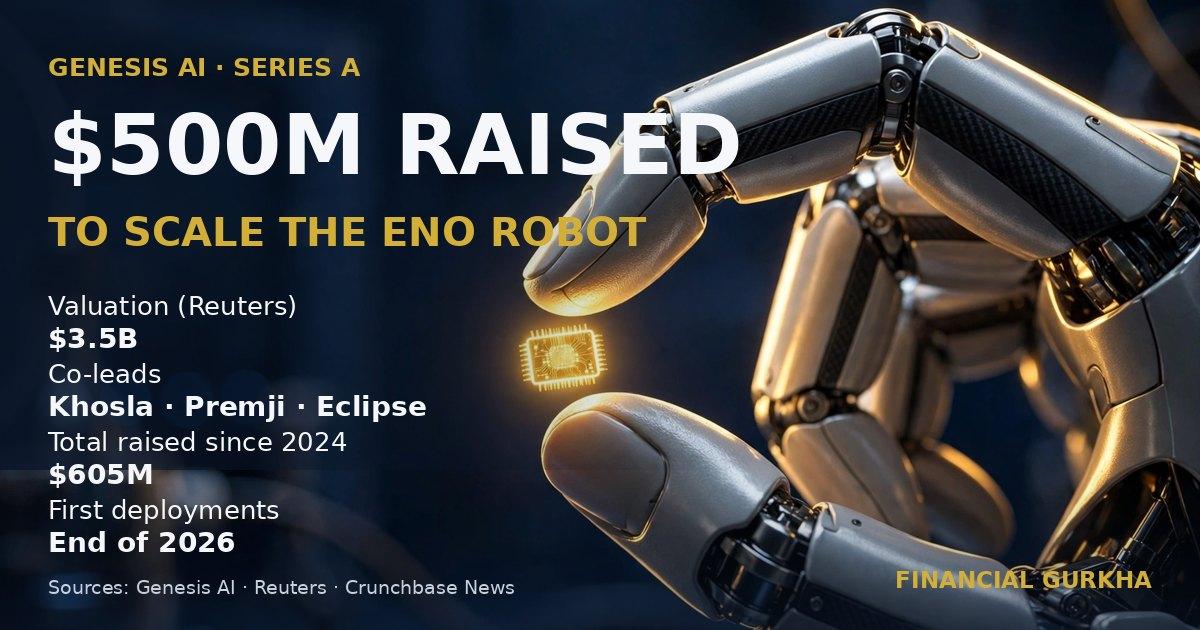
Genesis AI announced a $500 million Series A on Tuesday, in a post on its own site signed by co-founders Xian Zhou and Théophile Gervet. The round values the Paris-headquartered robotics company at $3.5 billion, Reuters reported, making it one of the biggest funding rounds in the history of the European robotics sector.
The company named no investors in its announcement. Reuters and Crunchbase News reported that Khosla Ventures, Premji Invest and Eclipse co-led the round, with participation from Nvidia, AMD Ventures, Bpifrance, T. Rowe Price Associates, Durable Capital Partners, HSG, Samsung Next, Ericsson and Zoom, and backing from former Google chief executive Eric Schmidt and French entrepreneur Xavier Niel. The raise brings the disclosed funding of Genesis to $605 million since its founding in 2024, after a $105 million round announced in July 2025, when the company emerged from stealth.
What Genesis is building#
Genesis describes its mission as building "the world's most capable robots" and removing "the physical limits on human ambition." Its first product is Eno, a general-purpose robot that, in the words of the company, combines compact mobility with high-precision dual-arm manipulation. Eno was unveiled in June 2026. Partner coverage describes a wheeled robot with two arms and hands built to human proportions, each hand carrying 20 actuated degrees of freedom.
The bet is dexterity. Manipulation, Genesis says, accounts for the overwhelming majority of physical work and remains the hardest problem in the field. Its system has four connected parts, per the announcement:
- The hand and human experience. The company says it has built one of the most dexterous robotic hands in the world, alongside data-collection devices that capture human expertise at scale. TechCrunch reported that the data engine is a sensor-enabled glove that records force data as humans work, and that the robots themselves wear the same gloves.
- GENE. Its robotics foundation model, which the company says approaches human-level dexterity. The current version, GENE 26.5, was released in May 2026.
- Genesis World. A simulator the company says closely matches reality, so failures can be exposed at the speed of software across millions of scenarios.
- Eno. The hardware that carries the intelligence into the physical world, and whose real-world failures feed back as new simulation scenarios, new training data and new hardware requirements.
The full-stack argument#
Genesis is explicit about why it builds all of it itself. Reliability, the founders argue, is the bottleneck in real production, and reliability is a systems problem: intelligence, hardware and deployment have to be built as one integrated system in a continuous learning loop. Owning the foundation model, they say, lets the company control its pace of improvement and integrate deeply with the hardware.
That is a deliberate counter-thesis to the structure our own Physical AI research described in October, in Physical AI: The Brain and the Body Have Become Their Own Markets, where the money was moving toward specialists: robot-brain companies such as Physical Intelligence, raising at an $11 billion valuation, and Skild AI, above $14 billion, selling intelligence across other makers' hardware. Genesis is the opposite wager with the same stakes — that the brain and the body improve fastest when one company owns both, plus the experience the robot learns from. The Series A is, so far, the largest European cheque written on either side of that argument.
Where the money goes#
The company said the funding will accelerate the development and deployment of its robots, starting in manufacturing and logistics, and help it recruit. Zhou told Reuters the money will also increase production of Eno, expand data collection and AI training, and improve the ability of the robot to manipulate objects with its hands; he told Crunchbase News the capital will expand computing infrastructure and hiring as well.
Deployment is the test ahead. Genesis said on its site that it plans to begin targeted customer deployments by the end of 2026, and Zhou told Reuters a wider customer rollout is expected in 2027. TechCrunch reported the company has built 30 to 40 Eno units so far and is piloting with a small number of customers it has not named, with a US contract manufacturer set to begin mass production next year. A June 2026 partnership with LG CNS, announced the same day Eno was unveiled, gives Genesis a first enterprise route into manufacturing and logistics operations in the United States.
Sources#
- Genesis AI, "Genesis raises $500M Series A to fund its next chapter," November 17, 2026, and the Genesis AI news index (Eno unveiling and LG CNS partnership, June 16, 2026; GENE 26.5, May 7, 2026).
- Reuters, "French robot maker Genesis raises $500 million at $3.5 billion valuation," November 17, 2026 — valuation, lead investors and the 2027 rollout.
- Crunchbase News, "Genesis AI Raises $500M At $3.5B Valuation To Bring Its Robots To Factories And Warehouses," November 17, 2026 — participant list and total disclosed funding.
- TechCrunch, "Genesis AI raises $500M to deploy glove-wearing robots," November 17, 2026 — the sensor-glove data engine, units built and pilot status. Company claims about capability are Genesis's own and are labelled as such above.
Plain-English explainers, not advice. Nothing here tells you to buy, sell, or hold anything.
Where this came from
Plain-English explainers, not advice. Nothing here tells you to buy, sell, or hold anything.