The Daily Brief
The Shadow Fleet Ran Dry: Iran's Offshore Oil Is Gone, Qatar Is Buying American Gas, and New Mexico Just Billed Meta $25 Billion
The blockade has emptied the tanker stash Iran spent years building off Asia — and the bill is landing everywhere at once: on China's discount refiners, on Qatar's checkbook, and on a Thursday tape where stocks slid, gold hit a two-month low and Brent touched its highest since May.
Yesterday we reported that total Gulf oil flows had passed their pre-war level — the tanker trade rebuilt the map around a closed strait (see The Oil That Wasn't Supposed to Flow). Today's number runs the other way, and it is the starkest of the war: the offshore oil reserve Iran spent years accumulating in Asian waters — the stock that kept its crude selling long after the blockade began — is gone. What replaces it is a market where Iran's old customers pay full price in dollars, the world's LNG giant signs up to buy American gas into the 2050s, and a US judge bills Meta $25 billion. Four stories, one tape.
The stash is empty#
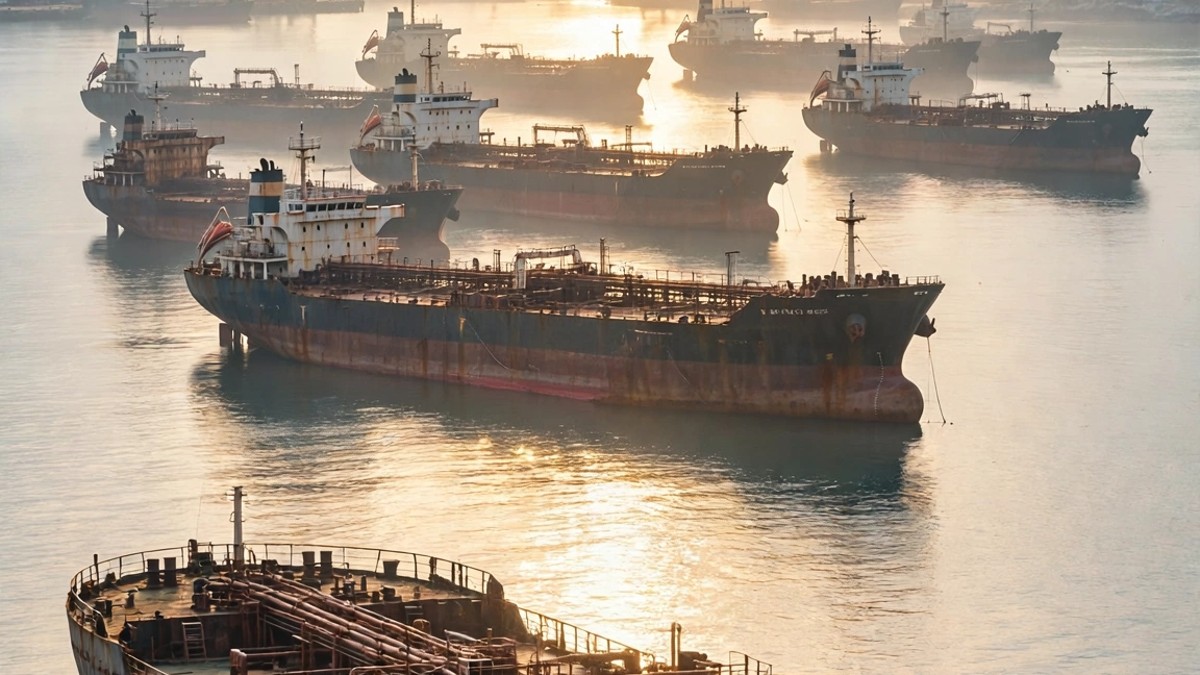
Iran's system was elegant: tankers ferried crude to waters off Malaysia and Singapore, transferred it ship-to-ship to other tankers bound for Chinese refineries, and the anchored fleet doubled as storage. At the start of the war in February, Iran had some 135 million barrels located overseas, likely worth around $10 billion or more after prices surged (WSJ). The United States first imposed its blockade in April; Iran kept selling from the offshore reserve. The blockade was lifted during peace negotiations in mid-June, Iran rebuilt the stock, and Washington reimposed it in mid-July.
That stock has now been drawn to nothing. The floating reserves, which peaked at nearly 90 million barrels, fell to less than 1 million barrels by October 5 and were completely exhausted by mid-October, according to analysts at Kpler (via the Wall Street Journal). "There's no more oil to discharge to China anymore," said Homayoun Falakshahi, Kpler's head of crude-oil analysis. Iranian seaborne exports fell to zero in the second week of September and stayed there — September was the first month with no Iranian crude exports at all since Kpler began tracking flows in 2013 (Reuters). US Central Command said on October 17 that the blockade has denied Tehran at least $25 billion in oil revenue; oil sales are roughly 30 to 40 percent of Iran's government revenue and its largest source of foreign exchange (Kpler, via WSJ). Iran's central bank governor, Abdolnaser Hemmati, told an IMF meeting in Bangkok last week that claims of economic collapse are "nothing more than an illusion."
One honest caveat, because the trackers do not fully agree: Vortexa counted about 6 million barrels of Iranian oil still off Singapore on October 9, and United Against Nuclear Iran put Southeast Asian floating reserves at 10 million barrels or less in early October. And a much larger stock — 83 million barrels of Iranian crude on the water in total, 43 million of it trapped west of the Strait of Hormuz — has not been sold at all (Vortexa, via Reuters). The distinction matters: oil trapped inside the Gulf cannot reach a buyer. The stock that could actually be delivered to China is the one that has run out.
China's discount just became a premium#
The buyer on the other end of the shadow fleet was overwhelmingly one country. China took more than 80 percent of Iran's shipped oil — an average of 1.38 million barrels a day in 2025, about 13.4 percent of China's total seaborne crude imports (Kpler data, via Reuters). The buyers were not China's state majors, which have stayed away since 2018-19, but independent "teapot" refiners, mainly in Shandong, which account for roughly a quarter of Chinese refining capacity. Their reward was price: Iranian Light traded at about $8 to $10 a barrel below the ICE Brent benchmark, delivered to China.
That trade is over, and the replacement barrels carry the opposite sign. Chinese independent refiners have bought at least 12 million barrels of Iraqi and Qatari crude for October and November delivery — one trader estimated 15 to 20 million — from trading houses including Mercuria, Totsa and Trafigura, at premiums of $12 to around $20 a barrel over ICE Brent on a delivered basis (Reuters). Most of it is Iraqi Basra Medium and Heavy; Hongrun Petrochemical and Shenchi also bought 3 million barrels of Qatar's al-Shaheen crude. A refiner that was paying $8 to $10 under Brent for Iranian Light is now paying $12 to $20 over it for substitutes — a swing of roughly $20 to $30 a barrel in feedstock cost, on our arithmetic from Reuters' figures. The margin damage is already visible: Shandong refinery utilisation fell to about 55 percent by the end of September, and refiners were losing money on each ton processed (Reuters).
Qatar, LNG giant, is buying American#
The second energy story of the day would have been unthinkable before the war: Qatar — one of the world's largest LNG exporters — is signing long-term deals to buy American gas. Cheniere Energy announced Thursday that its Sabine Pass and Corpus Christi subsidiaries have each signed long-term sale and purchase agreements with QatarEnergy totalling 4 million tonnes of LNG a year through 2054 — 2 million tonnes a year from each project, sold free on board at a price indexed to the Henry Hub benchmark plus a fixed fee. Deliveries begin in the early 2030s; 1 million tonnes a year of the Sabine Pass agreement depends on a final investment decision on that project's expansion. Cheniere chief executive Jack Fusco called them "pivotal, multi-decade agreements." No contract value was disclosed, and Cheniere's announcement gives no reason tied to the war.
Keep the strands separate, because there are three. Today's Cheniere agreements are a long-term commercial commitment that starts in the 2030s — they do not replace what Qatar has lost now. Separately, QatarEnergy bought 33 spot LNG cargoes from the United States in 2026, worth around $1 billion by Reuters' calculations, to keep supplying Asian customers after its own exports through Hormuz were halted and force majeure declared (Reuters). And in September, QatarEnergy was negotiating multi-year US supply of 2 to 3 million tonnes a year through 2031 specifically to replace lost output (Reuters): Iranian strikes in March damaged two of Ras Laffan's 14 LNG trains and a gas-to-liquids plant, and chief executive Saad al-Kaabi said repairs would sideline 12.8 million tonnes a year of capacity for three to five years. All of this is distinct from Golden Pass LNG in Texas, where QatarEnergy is a co-owner rather than a customer.
New Mexico bills Meta $25 billion#
The day's corporate story is a number with few precedents. On Wednesday, New Mexico judge Francis Mathew ordered Meta Platforms to pay the state a $25 billion civil penalty — one of the largest financial penalties in US history (Reuters). The penalty follows a September 25 jury verdict that found 26 of 29 statements by the company and its leadership misleading, and more than 43 million violations of New Mexico's consumer protection law. Judge Mathew found that a penalty of more than $219 billion was warranted under state law — which allows up to $5,000 per violation — but reduced it to $25 billion. The state had asked for $35 to $40 billion; Meta had urged a cap of $3.45 billion. Attorney General Raúl Torrez said the money is directed to New Mexico's school system. "Facebook's wrongdoing — over the course of years and systematically broadcast to the public — goes to the heart of Facebook's core business practices," the judge wrote.
This is the Cambridge Analytica privacy case, filed in 2021 after revelations that the British firm harvested personal data from as many as 87 million Facebook users through a third-party app — not the separate child-safety case New Mexico won in March, which produced a $375 million penalty. Meta's chief legal officer, C.J. Mahoney, said the ruling "makes it all but impossible to do business in the state of New Mexico," called the suit "a tax on speech," and said the company is confident it will win on appeal.
Meta shares fell about 3 percent in premarket trading and were down 6.59 percent by late morning Thursday. Attribution deserves care: the verdict landed the same evening as Meta's third-quarter earnings, and Reuters ties the stock's reaction primarily to investors weighing the company's AI ambitions against their cost — expected annual capital spending of $135 to $145 billion, a quarterly free-cash-flow deficit, and a plan for non-voting shares. No major outlet has isolated how much of Thursday's drop belongs to the courtroom.
The tape: stocks down, gold at a two-month low, oil up again#
The market backdrop tied the day together. The S&P 500 was down about 1.4 percent intraday Thursday, with futures pressured by the Meta-led wobble in AI spending sentiment (Reuters). Gold fell to about $4,060 an ounce, down roughly 1.9 percent — its lowest since August 4, per Reuters: a two-month low, driven by an oil rally reinforcing the higher-for-longer interest-rate outlook. It is not a one-year low, and $4,000 was not reached. The dollar index slipped about 0.1 percent on the day, trading around 101.5 to 101.8 near a three-week low — the dollar eased, it did not strengthen. Oil moved the other way: Brent rose 2.8 percent to $111.88 a barrel, its highest since May, and WTI changed hands near $99 to $100 after further Houthi attacks in Saudi Arabia (Reuters). The US 10-year Treasury yield fell about 7 basis points to 5.075 percent.
Our take#
For eight months the blockade's critics could point to the shadow fleet and say the oil was still moving. It was — out of a tank, not out of the ground. Storage is a bridge, and bridges end. What begins now is the expensive part: Iranian barrels replaced at a premium by the very refiners the discount built, Qatar writing long-dated contracts for the gas it used to sell, and every barrel of it priced against a Brent benchmark sitting at its highest since May, one week before the Federal Reserve meets. Tehran's central bank calls collapse an illusion. The arithmetic of an empty fleet, a $25 billion revenue hole (CENTCOM's figure) and customers paying $12 to $20 over the benchmark says the illusion is getting expensive to maintain.
Figures are as reported by the cited sources on the dates shown; tanker-tracking data from Kpler, Vortexa and UANI differ by definition and are preliminary. The roughly $20 to $30 a barrel feedstock swing is our arithmetic from the two Reuters price points, not a quoted price. This article is reporting and analysis, not financial advice.
Where this came from
- WSJ — Iran's Fleet of Shadow Tankers Has Run Out of Oil After Monthslong U.S. Blockade (Oct 21-22, 2026)
- Reuters — US blockade keeps Iranian crude exports at zero in October, report says (Oct 13, 2026)
- Reuters — Chinese independent refiners boost Iraqi oil purchases as Iranian flows fall, traders say (Oct 6, 2026)
- Cheniere Energy (Business Wire) — Cheniere Signs Long-Term Sale and Purchase Agreements to Supply QatarEnergy with LNG through 2054 (Oct 22, 2026)
- Reuters — QatarEnergy seeks US LNG deals through to 2031, sources say (Sep 11, 2026)
- Reuters — Meta ordered to pay $25 billion to New Mexico after jury finds company misled consumers about data privacy (Oct 21, 2026)
- Reuters — Gold drops over 1% as oil rally reinforces higher-for-longer rate outlook (Oct 22, 2026)
Plain-English explainers, not advice. Nothing here tells you to buy, sell, or hold anything.