Financial Gurkha | New York City | November 12, 2026
Disclaimer: This article is for educational purposes only and is not investment advice. Trading and investing are subject to volatility and market risk, including partial or entire loss of capital. Please consult your financial advisor before making investment decisions.
The 60-Second Version#↑ Contents
- What it is. A Rule 10b5-1 plan is a written trading instruction an insider sets up in advance, while not aware of material nonpublic information. If later trades follow the plan, the SEC's rule gives the insider an affirmative defense to insider-trading liability. It is the standing sell order of corporate America.
- How old it is. The SEC adopted the rule in August 2000 and it took effect on October 23, 2000: 26 years ago. The SEC tightened it in December 2022, with the changes effective February 27, 2023: cooling-off periods before the first trade, a good-faith certification, limits on overlapping plans, and public disclosure.
- Nvidia's insiders have used it since at least 2005. The earliest Nvidia insider sale footnoted as a 10b5-1 plan in the SEC's electronic filings is May 16, 2005.
- The computation. From August 2003 to September 2026, Nvidia officers and directors made 2,701 open-market sales worth $8.69 billion (1,560 million shares on today's split-adjusted basis). 554 million shares, or $3.83 billion, were sold under 10b5-1 plans: 35.5% of the shares and 44% of the dollars. That is 2.3% of Nvidia's shares outstanding today.
- Officers use plans. Directors mostly do not. Executive officers sold 93% of their dollars under plans. Directors sold 3%. Jensen Huang alone accounts for 75% of all plan dollars ($2.87 billion). The two largest sellers outside plans are directors: Mark Stevens ($2.74 billion) and Tench Coxe ($1.02 billion).
- Plans are followed to the share. Huang's 2024 and 2025 plans each sold exactly 6,000,000 shares, beginning 91 and 92 days after adoption. Nine of the twelve plans we traced sold exactly the authorized amount.
- One limit on "employees." The only employees whose sales are public are Section 16 insiders: officers and directors. Rank-and-file sales under plans are not visible.
What's in this report#
- The 60-Second Version
- 1. What a Rule 10b5-1 Plan Is
- 2. History: A 26-Year-Old Rule
- 3. The Rules Now
- 4. Why the SEC Changed It
- 5. How Nvidia's Insiders Use Plans
- 6. The Computation: How Many Nvidia Shares Were Sold Under 10b5-1 Plans?
- 7. Who Uses Plans, and Who Does Not
- 8. What the Data Can and Cannot Tell You
- 9. Nvidia Now: Which Plans Are Active
- Frequently Asked Questions
- Conclusion and Key Takeaways
- Methodology and Sources
- About This Analysis
1. What a Rule 10b5-1 Plan Is#↑ Contents
Insiders of public companies face a problem. Executives and directors are paid heavily in stock, so they need to sell it. But they also routinely know things the market does not: an unreleased earnings result, a deal, a product delay. Trading while holding that kind of information is illegal under the SEC's antifraud rule, Rule 10b-5. Even a sale made for an innocent reason, such as a tax bill or a house purchase, can invite suspicion if the timing is awkward.
Rule 10b5-1 is the SEC's answer. In the SEC's own summary, the rule provides an affirmative defense Affirmative defenseA legal argument that, if the defendant proves it, defeats a claim even where the underlying conduct is alleged. Here, it lets an insider show that a trade was pre-planned and not driven by inside information. to insider-trading liability where, subject to conditions, the trade was made under a binding contract, an instruction to another person to execute it, or a written plan adopted when the trader was not aware of material nonpublic information.
In practice, an executive meets with a broker and sets rules: sell this many shares, on these dates, or whenever the price reaches this level, or according to this formula. After that, the insider hands over the decision. The plan trades whether the news is good or bad.
A real Nvidia example. On March 20, 2025, CEO Jensen Huang adopted a plan to sell up to 6,000,000 shares through December 31, 2025; Nvidia disclosed it in its quarterly report filed May 28, 2025. His Form 4 filings Form 4The SEC form that officers and directors file within days of trading their company's stock, reporting what they bought, sold, received or gave away. show the plan executing: sales between June 20 and October 29, 2025 add up to exactly 6,000,000 shares, about $1.05 billion.
2. History: A 26-Year-Old Rule#↑ Contents
The rule has two eras: the original 2000 version, and the stricter version in force since 2023.
| Date | Event |
|---|---|
| August 2000 | The SEC adopts Rule 10b5-1 in its release "Selective Disclosure and Insider Trading" (Release 33-7881), alongside Regulation FD. |
| October 23, 2000 | The rule takes effect. It makes trading "on the basis of" inside information turn on whether the trader was aware of it, and adds the plan-based affirmative defense. |
| May 16, 2005 | The earliest Nvidia insider sale we found footnoted as made under a 10b5-1 plan, by a vice president (Form 4). |
| 2009 to 2016 | Academic studies begin to question whether plan trades are always neutral, including work by Alan Jagolinzer (2009) and others. The SEC cites them in 2022. |
| December 2018 | The Council of Institutional Investors asks the SEC to amend the rule to address potential abuse. |
| December 2020 | The SEC proposes adding a 10b5-1 checkbox to Forms 4 and 5. |
| September 2021 | The SEC's Investor Advisory Committee recommends "meaningful guardrails" around adopting, modifying and canceling plans. |
| January 2022 | The SEC proposes the amendments. |
| December 14, 2022 | The SEC adopts the final rule (Release 33-11138), published in the Federal Register on December 29, 2022. |
| February 27, 2023 | The final rules take effect. |
| April 1, 2023 | Insiders must use the new Form 4 and 5 checkbox on filings made on or after this date. |
| Aug 2023 onward | Companies disclose, quarterly, directors' and officers' plan adoptions and terminations (Item 408 of Regulation S-K). Nvidia's first such disclosure is in its 10-Q filed August 28, 2023, which reports no adoptions for the quarter. |
The long gap between 2000 and 2022 is the key part of the story. For two decades the rule operated with few guardrails: no mandatory waiting period after adoption, no required public disclosure of when plans were adopted or canceled, and no checkbox that let investors tell a plan sale from a discretionary one.
3. The Rules Now#↑ Contents
The 2022 amendments, effective February 27, 2023, added these conditions to the affirmative defense. This table follows the SEC's published fact sheet.
| Condition | What the SEC requires |
|---|---|
| Cooling-off period Cooling-off periodA mandatory waiting time between adopting a plan and the first trade under it. It stops an insider from setting up a plan and selling immediately. for directors and officers | The later of 90 days after adoption (or modification), or two business days after the company discloses results for the fiscal quarter in which the plan was adopted. Capped at 120 days. |
| Cooling-off for other persons | 30 days. The SEC did not require a cooling-off period for the issuer's own plans. |
| Certification | Directors and officers must certify at adoption that they are not aware of material nonpublic information and are adopting the plan in good faith, not as a scheme to evade Rule 10b-5. |
| Overlapping plans | Anyone other than the issuer is limited in using multiple overlapping plans. |
| Single-trade plans | Anyone other than the issuer may rely on the defense for one single-trade plan in any 12 months. |
| Good faith | All persons must act in good faith with respect to the plan. |
The new disclosure rules matter as much as the conditions:
- Quarterly disclosure by companies of directors' and officers' plan adoptions and terminations, including modifications (Item 408).
- A Form 4 and Form 5 checkbox indicating that a reported transaction was made under a plan intended to meet the defense.
- Gift reporting. Bona fide gifts of securities are now reported on Form 4.
4. Why the SEC Changed It#↑ Contents
The SEC's 2022 release gives the reasons. It says the amendments are designed to address concerns about abuse of the rule "to trade securities opportunistically" on the basis of inside information.
Two kinds of evidence sit behind that. First, the release cites academic studies finding that insiders trading under plans consistently outperform insiders who trade outside plans, which raises concern that some use plans in ways that harm investors. Second, it describes practices that raised concern: adopting several overlapping plans and selectively canceling some while aware of inside information, and starting trades soon after adopting a plan.
One study the release cites, from the Stanford Closer Look series (January 2021), analyzed plan sales from January 2016 to May 2020. It found that trades occurring within 30 days of adopting a plan were about 50% larger than trades made six or more months later.
Two points of balance belong next to that. These findings come from broad samples of public companies, and the SEC did not single out any company. And the research describes patterns in the aggregate, which cannot show that any particular insider traded improperly. A plan sale is also not suspicious by itself: it is the structure the SEC created so that insiders could sell without taking on that risk.
5. How Nvidia's Insiders Use Plans#↑ Contents
The disclosure ledger#
Nvidia's 10-Qs and 10-Ks list each director and officer plan adoption and termination. In 13 periodic reports from August 2023 to August 2026, Nvidia disclosed 23 plan adoptions and 4 terminations. The table pairs the plans we could trace with what the Form 4 filings show was actually sold. Plan sizes in Nvidia's earlier reports were stated before the June 2024 ten-for-one stock split, so we convert them to today's shares.
| Insider | Adopted | Authorized (shares) | First sale (days after) | Sold under plan | Outcome |
|---|---|---|---|---|---|
| Debora Shoquist | Aug 27, 2023 | 815,000 | Nov 27, 2023 (92) | 815,000 | Completed |
| Debora Shoquist | Mar 4, 2024 | 411,400 | Jun 3, 2024 (91) | 411,400 | Completed |
| Jensen Huang | Mar 14, 2024 | 6,000,000 | Jun 13, 2024 (91) | 6,000,000 | Completed |
| Colette Kress | Mar 22, 2024 | 500,000 | Jun 21, 2024 (91) | 500,000 | Completed |
| Ajay Puri | Apr 12, 2024 | up to 1,008,320 | Jul 12, 2024 (91) | 100,110 | Terminated Jul 22, 2024 |
| Ajay Puri | Sep 30, 2024 | 204,890 | Jan 6, 2025 (98) | 204,890 | Completed |
| Colette Kress | Mar 4, 2025 | 500,000 | Jun 20, 2025 (108) | 500,000 | Completed |
| Jensen Huang | Mar 20, 2025 | 6,000,000 | Jun 20, 2025 (92) | 6,000,000 | Completed |
| A. Brooke Seawell (director) | Mar 19, 2025 | about 1,153,049 (formula) | Jun 20, 2025 (93) | 770,522 | Terminated Jul 14, 2025 |
| Debora Shoquist | Sep 9, 2025 | 309,840 | Dec 9, 2025 (91) | 309,840 | Completed |
| Ajay Puri | Sep 19, 2025 | 1,000,000 | Jan 7, 2026 (110) | 1,000,000 | Completed |
| Colette Kress | Jun 16, 2026 | 375,439 (future vests) | Sep 17, 2026 (93) | 34,918 so far | In progress |
Four patterns stand out.
Plans run to the share. Nine of the twelve plans sold exactly the authorized amount. Two were terminated early, and one is still running. Two of the plans were also cross-checked against Nvidia's own disclosures: its 10-Qs state that 100,110 shares were sold under Puri's terminated plan and 770,522 under Seawell's. Our Form 4 totals match both to the share.
The cooling-off period is visible in the data. Nine of the twelve first sales came 91 to 93 days after adoption, which is what the 90-day minimum for directors and officers would produce. The longest gap was 110 days, inside the 120-day cap.
Adoption follows earnings. Of the 23 adoptions, the median came 22 days after the filing date of the most recent 10-Q or 10-K, and 19 came within 30 days. (Measured from the filing date; one August 2023 adoption fell the day before a 10-Q was filed.) That is a pattern in timing, and it says nothing about any individual's intent.
Some plans never trade. Colette Kress adopted a 500,000-share plan on December 18, 2025 and terminated it on April 10, 2026 with no shares sold, according to Nvidia's 10-Q. Aarti Shah's September 2024 plan was likewise terminated with no shares sold. Before 2023, an insider could cancel a plan with no public trace. Now each termination is disclosed.
The company uses them too#
Nvidia itself uses 10b5-1 plans for something else: buying back its own stock. Its 10-Q filed August 28, 2023 says that from July 31 through August 24, 2023 the company repurchased 2 million shares for $998 million pursuant to a Rule 10b5-1 trading plan. The cooling-off period does not apply to a company's own plans.
6. The Computation: How Many Nvidia Shares Were Sold Under 10b5-1 Plans?#↑ Contents
Method#
We downloaded every Form 4 and 4/A in Nvidia's electronic SEC record (1,447 filings made from 2003 to November 2026) and read each reported transaction. We counted open-market sales only (Form 4 transaction code S). Tax withholding on vesting stock, gifts, option exercises and new grants are not sales and are excluded. A sale counts as made under a plan if either of two independent signals says so: the Form 4's 10b5-1 checkbox (required since April 1, 2023) or a footnote on the transaction that cites Rule 10b5-1. Since April 2023 the two signals agreed on all 1,299 plan sales: there was not one case where only one flagged it.
Nvidia has split its stock six times since 2000, so a share sold in 2005 is not comparable to a share sold today. We convert every sale to today's share basis using the split ratios and ex-dates (the six splits compound to 480-for-1 overall). Dollar proceeds need no adjustment. We checked the split dates against the filings themselves: reported prices stay continuous across each split after adjustment (for example, $119.60 before and $120.42 after the June 2024 split).
Who counts as an "employee." The people whose sales are public are Section 16 insiders: executive officers and directors. Directors are not employees, so we show officers and directors separately. Sales by rank-and-file employees under their own plans are not reported to the public, and this analysis cannot see them.
The results#
| Period | Shares sold (M) | Proceeds ($B) | Under plans (M sh) | Under plans ($B) | Plan share of $ |
|---|---|---|---|---|---|
| 2003 to 2019 | 1,426.4 | 1.08 | 483.4 | 0.33 | 31% |
| 2020 | 37.1 | 0.38 | 19.9 | 0.23 | 61% |
| 2021 | 28.5 | 0.59 | 23.1 | 0.47 | 81% |
| 2022 | 16.2 | 0.36 | 7.6 | 0.21 | 58% |
| 2023 | 12.7 | 0.46 | 3.9 | 0.17 | 37% |
| 2024 | 18.4 | 2.03 | 7.0 | 0.83 | 41% |
| 2025 | 13.0 | 2.15 | 7.8 | 1.33 | 62% |
| 2026 (to Sept.) | 7.7 | 1.65 | 1.4 | 0.25 | 15% |
| All, 2003 to 2026 | 1,560.0 | 8.69 | 554.0 | 3.83 | 44% |
All share counts are on today's split-adjusted basis, so the early-year share totals are large: in 2005 a share traded for a small fraction of its current price. That is why shares under plans are 35.5% of all shares but 44% of dollars, and why dollars are the better measure of economic size.
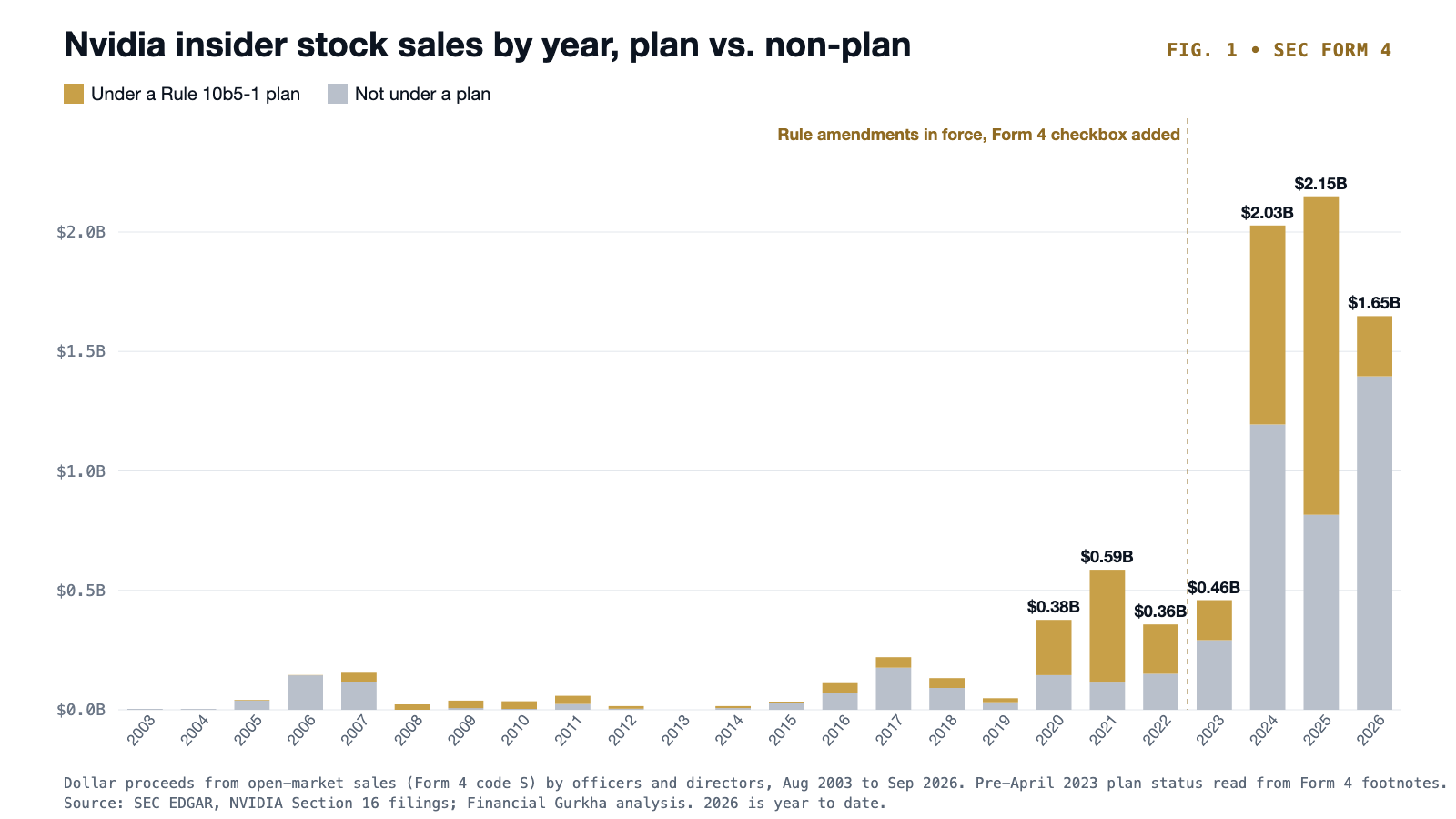
FIG. 1 · SEC Form 4. Dollar proceeds from open-market sales by Nvidia officers and directors, by year. Before April 2023, plan status is read from Form 4 footnotes. 2026 is year to date.
The arithmetic. Total sold: $8.687 billion. Under plans: $3.829 billion, and 3.829 ÷ 8.687 = 44.1% of dollars. In shares: 553.96 million ÷ 1,559.95 million = 35.5%. Against Nvidia's 24.31 billion shares outstanding (March 23, 2026), 553.96 ÷ 24,312 = 2.28%.
Since the checkbox. From April 1, 2023, the data show $6.223 billion sold, of which $2.578 billion (41.4%) was under plans, 19.6 million of 48.3 million shares (40.6%). For scale, Nvidia returned about $26.0 billion to shareholders in a single quarter (the quarter ended July 26, 2026, per its release), 10.1 times the plan sales of the roughly 3.5 years since the rules took effect: 26.0 ÷ 2.578 = 10.1.
Who sold under plans#
| Insider | Plan sales ($B) | Share of all plan dollars |
|---|---|---|
| Jensen Huang | 2.87 | 75.0% |
| Ajay Puri | 0.33 | 8.6% |
| Debora Shoquist | 0.23 | 5.9% |
| Colette Kress | 0.20 | 5.2% |
| A. Brooke Seawell (director) | 0.12 | 3.1% |
| All others | 0.08 | 2.2% |
Fifteen of the 27 insiders who sold stock over these years sold under a plan at some point. By role, executive officers sold $3.69 billion of their $3.98 billion under plans (92.7%). Directors sold $0.14 billion of their $4.70 billion under plans (2.9%).
7. Who Uses Plans, and Who Does Not#↑ Contents
The role split is the most striking result in the data, and it is easy to misread.
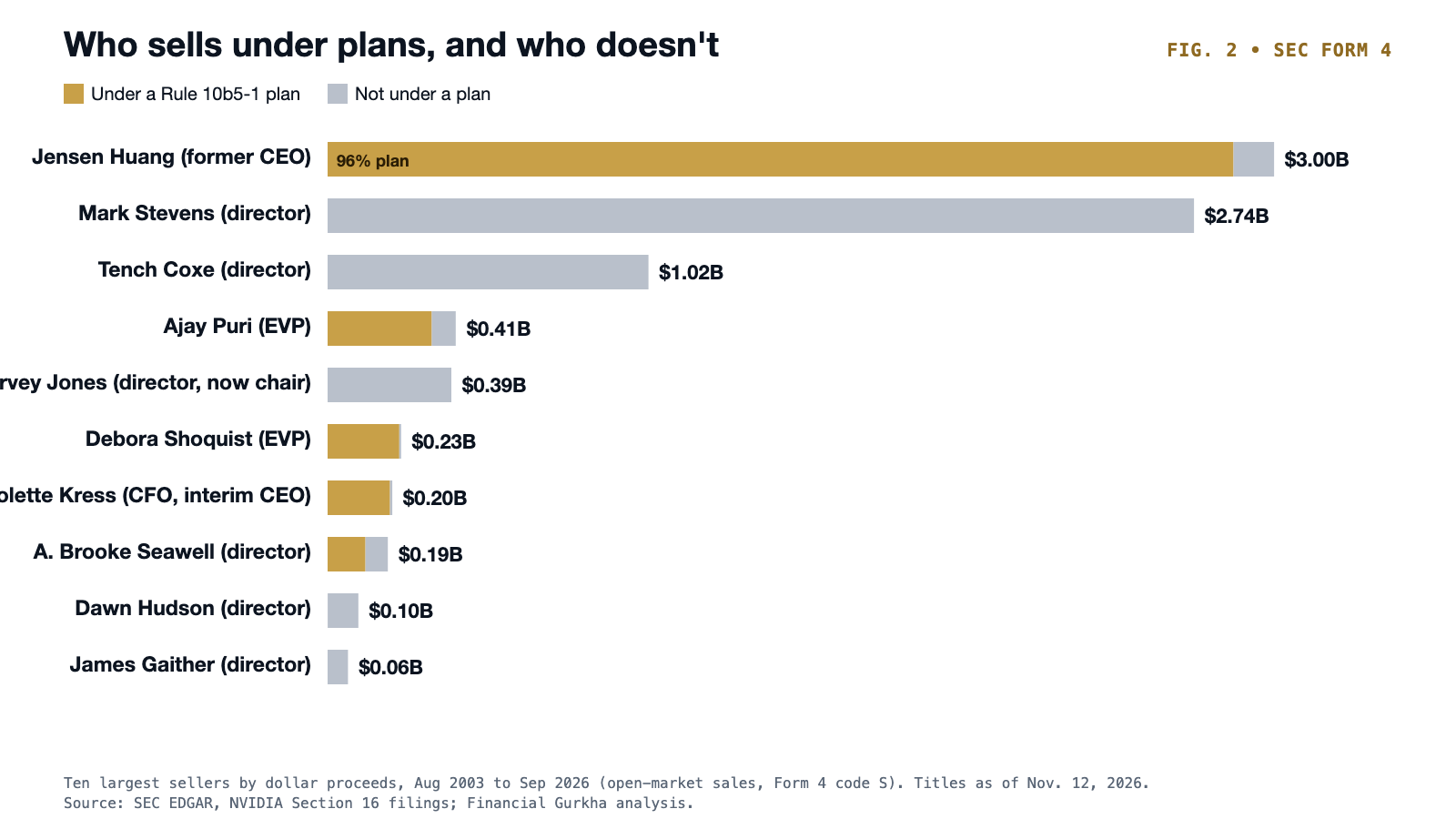
FIG. 2 · SEC Form 4. The ten largest sellers by proceeds, August 2003 to September 2026. Titles as of November 12, 2026.
Executives use plans almost universally. Huang's plan share is 96% of his dollars. Kress and Shoquist are about 97% and Puri about 80%. Every one of the 1,237 executive-officer sales we found from January 2023 onward was under a plan.
Directors mostly sell outside plans. The two largest non-plan sellers in Nvidia's history are directors: Mark Stevens, $2.74 billion, and Tench Coxe, $1.02 billion. Harvey Jones, who this week became Nvidia's first Chair, sold $0.39 billion across 77 transactions, none of them flagged as plan sales; his latest was on December 15, 2025.
Selling outside a plan is not improper. A director can sell in an open trading window while not holding inside information. The 10b5-1 plan is an option that provides extra legal protection, not a requirement.
One more data point sits at the edge of the category. Tench Coxe adopted a plan in March 2026 covering up to 8,000,000 shares, which Nvidia's 10-Q says is "solely for gifts to charitable donor-advised funds." It is a 10b5-1 arrangement that does not involve selling.
8. What the Data Can and Cannot Tell You#↑ Contents
- It covers officers and directors only. Form 144, which affiliates file before selling, also excludes rank-and-file employees. The sales of ordinary Nvidia employees, whether or not under plans, are invisible here.
- Before April 2023, plan status rests on footnotes. The checkbox did not exist, so we relied on footnote text. Since 2023 the footnote and the checkbox agreed every time, which suggests Nvidia's filers footnoted consistently. Still, the pre-2023 plan totals should be read as a lower bound.
- The Form 4 checkbox applies to the whole filing. If a filing mixes plan and non-plan sales, the checkbox cannot separate them. We cross-checked with transaction-level footnotes.
- Plans adopted in the last quarter are not yet public. Nvidia's next 10-Q, for the quarter ended in late October 2026, has not been filed. Any plan adopted after July 26, 2026 is not yet in the record.
- We do not test whether plan sales are well timed. The SEC cites research suggesting plan trades can be strategic. Our data cannot test that for Nvidia, and nothing here suggests any Nvidia insider acted improperly.
9. Nvidia Now: Which Plans Are Active#↑ Contents
This matters now because of last week's news. Huang resigned on November 11; for the circumstances and the filing, see our full analysis of what followed.
- Huang has no plan in the disclosures we found for 2026. His last sale was October 29, 2025, the final tranche of his 2025 plan, and his stake is covered in that analysis. Nvidia's fiscal 2026 10-K and its two 2026 10-Qs list no adoption by him.
- Kress's current plan was adopted June 16, 2026 for 375,439 shares of future equity vests, net of shares withheld for taxes, and runs to December 14, 2027. Her first sale under it was September 17, 2026, 93 days after adoption.
- Other active plans disclosed in the August 2026 10-Q: Timothy Teter (adopted May 22, 2026; up to 547,942 shares plus any future equity awards, through December 13, 2027) and Aarti Shah (adopted May 22, 2026; 6,500 shares, through May 29, 2027).
- Shoquist's September 2025 plan (309,840 shares) runs through December 31, 2026. Puri's September 2025 plan sold its full 1,000,000 shares by January 2026 and expired June 24, 2026.
Whether any of these plans continue, change, or terminate after a leadership change will show up in the next quarterly report, which is now an item to watch.
Frequently Asked Questions#↑ Contents
What is a Rule 10b5-1 plan? A written trading instruction that an insider sets up in advance, while not aware of material nonpublic information, specifying how many shares to sell and when, or by what formula. If later trades follow it, the SEC's Rule 10b5-1 gives the insider an affirmative defense to insider-trading liability.
When was Rule 10b5-1 created, and how long has it been around? The SEC adopted it in August 2000 and it took effect on October 23, 2000, which makes it 26 years old. It was substantially amended on December 14, 2022, with the changes effective February 27, 2023.
What changed in 2023? Directors and officers now face a cooling-off period before their first trade: the later of 90 days after adoption or two business days after the company discloses results for that quarter, capped at 120 days. They must certify they are not aware of inside information and are acting in good faith. Overlapping plans are limited, companies disclose adoptions and terminations quarterly, and Forms 4 and 5 carry a 10b5-1 checkbox.
Does a 10b5-1 plan guarantee no insider trading? No. It provides an affirmative defense if its conditions are met. Researchers cited by the SEC found that insiders can use plans opportunistically, for example by adopting several plans and canceling some, which is part of why the SEC tightened the rule.
How many Nvidia shares have been sold under 10b5-1 plans? From August 2003 to September 2026, Nvidia officers and directors sold about 554 million shares (on today's split-adjusted basis) for about $3.83 billion under plans, out of 1,560 million shares and $8.69 billion in total. Plans account for 35.5% of shares and 44% of dollars. Plan sales equal 2.3% of Nvidia's current shares outstanding.
Do Nvidia's executives sell under plans? Yes, nearly all of the time. Officers sold 92.7% of their dollars under plans. Directors sold only 2.9% under plans; the two largest non-plan sellers are directors.
How can I tell whether an insider's sale was under a plan? Check the Form 4 for the 10b5-1 checkbox and footnotes, and the company's quarterly report (Item 5 in a 10-Q, Item 9B in a 10-K) for plan adoptions and terminations. Form 144 also states a plan's adoption date.
Does Jensen Huang have a trading plan now? Not in any disclosure we found for 2026. His last sale was October 29, 2025, completing a 6,000,000-share plan adopted in March 2025. Nvidia's next quarterly report will show whether he adopted one afterward.
Is this financial advice? No. This article explains a rule and reports what public filings show. It makes no recommendation to buy, sell or hold any security.
Conclusion and Key Takeaways#↑ Contents
- Rule 10b5-1 is a legal defense built around timing. The plan is made before the insider knows the news, and later trades follow it. It has existed since 2000 and was tightened in 2023.
- In Nvidia's case, plans are the executives' tool. About 93% of officers' sales dollars moved under plans, while directors mostly sold outside them.
- The volume is real but small relative to the company. 554 million shares and $3.83 billion since 2003, which is 2.3% of today's shares outstanding, and $2.58 billion since the 2023 rules took effect, against $26.0 billion of company-wide capital returned in a single recent quarter.
- The rule shows up in the data. First sales came 91 to 93 days after adoption in most cases, plans sold exactly what they authorized, and terminations are now disclosed.
- The next facts are scheduled. Nvidia's next 10-Q will show plans adopted since July 26, 2026, and Form 4 filings will show further sales under Kress's current plan.
Methodology and Sources#↑ Contents
How we worked. We downloaded Nvidia's issuer filing index from the SEC's EDGAR system and then every Form 4 and 4/A (562 filings from September 2020 to November 2026, plus 885 older filings from 2002 to September 2020; three early paper-era text filings could not be parsed). We parsed each transaction, removed amended filings that duplicated originals, and excluded non-sale transaction codes. We then read Nvidia's 13 periodic reports since August 2023 for the plan disclosures.
Validation. We tested the results several ways. Huang's 2024 and 2025 plan sales each total exactly 6,000,000 shares, matching the disclosed plan sizes. Kress's March 2025 plan totals exactly 500,000. Nvidia's disclosed sales under two terminated plans (Puri, 100,110; Seawell, 770,522) match our Form 4 sums to the share. The checkbox and footnote signals agreed on all 1,299 post-April-2023 plan sales. And adjusted prices are continuous across split dates.
Stock splits. We used six splits: 2-for-1 (June 2000), 2-for-1 (September 2001), 2-for-1 (April 7, 2006), 3-for-2 (September 11, 2007), 4-for-1 (July 20, 2021) and 10-for-1 (June 10, 2024). The split dates come from aggregator sites and not from Nvidia filings, so we verified them against price continuity in the Form 4 data. The earliest filings in our dataset start in August 2003, after the first two splits, so those two do not affect any share count.
What we could not verify or do.
- Sales by rank-and-file employees, which are not public.
- Plan status before April 2023 beyond the footnote text.
- Plans adopted since July 26, 2026, which are not yet disclosed.
- Whether any plan was adopted, modified or timed improperly. The data cannot show that.
Primary sources (Tier 1)
- SEC — Fact Sheet: Rule 10b5-1: Insider Trading Arrangements and Related Disclosure (Dec. 2022)
- SEC — Insider Trading Arrangements and Related Disclosures, Release 33-11138 (Dec. 14, 2022)
- Federal Register — Selective Disclosure and Insider Trading, Release 33-7881 (Aug. 24, 2000)
- SEC EDGAR — NVIDIA Corp. filings index (Forms 4, 144, 10-Q, 10-K)
- NVIDIA — Form 10-K, fiscal 2026 (Item 9B)
- NVIDIA — Second quarter fiscal 2027 results (capital returned)
Secondary (used for split dates only)
- Stock-split aggregator sites, cross-checked against price continuity in Form 4 filings.
About This Analysis#↑ Contents
Financial Gurkha is an independent markets research desk run by Kanchan Sharma from New York City. This article was drafted with AI assistance from the SEC documents and filings listed above, and every figure was computed from or checked against those filings before publication. It explains a rule and reports what public filings show, it makes no recommendation to buy, sell or hold any security, and it makes no claim about any individual's intent.
Need a full intrinsic valuation, for a public company, a private target, or your own business? Schedule a consultation with the Financial Gurkha desk.
Reported from New York City. Sources: SEC EDGAR filings by NVIDIA Corporation and its insiders, and the SEC releases linked above.