Financial Gurkha | New York City | November 12, 2026
Disclaimer: This article is for educational purposes only and is not investment advice. Trading and investing are subject to volatility and market risk, including partial or entire loss of capital. Please consult your financial advisor before making investment decisions.
The 60-Second Version#↑ Contents
- The departure is in an SEC filing, and the filing is short. Nvidia's Form 8-K (event date November 11, signed November 12) says the board accepted Jensen Huang's resignation as president, chief executive officer and director, effective immediately. It gives no reason and describes no separation terms for him.
- The board made four decisions. It named CFO Colette Kress, 59, interim CEO while she keeps her CFO role. It appointed Harvey C. Jones, 73, the company's first-ever Chair. It opened a search that will consider internal and external candidates. And it kept the November 17 earnings date.
- Huang owns between 3.3% and 3.6% of Nvidia, not a controlling stake. The 2026 proxy shows 870,604,104 shares, or 3.58%, as of March 23. His latest Form 4 (September 17) accounts for 811,521,160 shares outside his family foundation, about 3.34%. At roughly $160.70 a share that is about $130 billion. Vanguard holds more than twice as much (7.31%).
- The business he leaves is still growing fast. Revenue in the quarter ended July 26 was $96.2 billion, up 106%, and Nvidia guided the current quarter to $108.0 billion, plus or minus 2%. Nvidia's 10-K shows $95.2 billion of purchase and supply obligations as of January.
- How much supply and diplomacy ran through Huang is the open question. The public record shows him as the face of Nvidia's government and supplier relationships: the Saudi announcement, the Taiwan trips, the Trump relationship. But Nvidia's 10-K names its "longstanding executive team," not Huang, as the dependency, and no supplier has commented on the change.
- What to watch: the November 17 earnings call, the CEO search, supplier and customer statements, the House committees' request for a November 18 briefing, and any new SEC filing on Huang's shares.
What's in this report#
- The 60-Second Version
- 1. Whatever Happened
- 2. The NVIDIA Board Made a Decision
- 3. Colette Kress: The Interim CEO
- 4. How Much of Nvidia Does Jensen Huang Own?
- 5. The Business He Is Leaving
- 6. Nvidia's International Web: What the Filings Show
- 7. How Critical Was Huang? What the Record Shows and Does Not Show
- 8. China, Washington and the Policy Channel
- 9. How This Affects Nvidia: A Watch List
- Frequently Asked Questions
- Conclusion and Key Takeaways
- Methodology and Sources
- About This Analysis
1. Whatever Happened#↑ Contents
Nvidia's Form 8-K under Item 5.02 and its Exhibit 99.1 press release, both are dated November 12.
| Item | What the filing says |
|---|---|
| Event date | November 11, 2026 (the 8-K is signed November 12) |
| Huang | Resigned as President, Chief Executive Officer and member of the Board, effective immediately |
| Reason | None stated in the 8-K or the press release |
| Interim CEO | Colette M. Kress, age 59, who stays Executive Vice President and CFO |
| New Chair | Harvey C. Jones, age 73, a director since 1993, described as the board's first-ever Chair |
| CEO search | The Board will consider internal and external candidates |
| Earnings | Q3 fiscal 2027 results still due Tuesday, November 17, about 1:20 p.m. PT |
Nvidia's release also carries a statement from Jones that the board has full confidence in Kress and the leadership team, and that operations, customer commitments and the product roadmap are expected to continue without interruption.
How the market took it. Nvidia shares fell 12% to 13% at the open, according to NBC News and CNBC, and the company's market value dropped below $4 trillion. The shares closed Wednesday at $173.73, against a closing high of $239.24 on October 6.
For the on-record statements each party made before the resignation, see our full breakdown of the investigation and our news brief on the resignation.
2. The NVIDIA Board Made a Decision#↑ Contents
A filing tells you what a board chose to put on the record. Here that is a short list of decisions and a long list of things left unsaid.
Decisions disclosed:
- Accepted the resignation, effective immediately. There was no transition period or notice window.
- Named an interim CEO from inside the executive suite. Kress keeps her CFO job, so one person now holds both roles until a permanent CEO is named.
- Created the Chair role. Before November 11 the board had no chair. Fortune reported that Nvidia had no chief operating officer either, and that Huang had about 60 direct reports. Jones is an experienced technology executive (the release cites his past service as CEO and executive chairman of Synopsys), and he joined the board in 1993.
- Opened a CEO search that includes outside candidates, and left the timeline unstated.
Not disclosed in the documents we read:
- Why Huang resigned. The context below comes from news reports, not from Nvidia.
- Any severance, advisory role or other arrangement for Huang. Nvidia's proxy lists, among practices it says it avoids, signing named executive officers to agreements with specific employment or severance terms. That suggests there may be no such contract, but the proxy sections on what happens to his unvested awards were not retrievable for this report, so we do not say.
- The search timeline, or any search firm.
- Whether Kress receives additional pay for the interim role.
The reported context. NBC News reported that the resignation followed reports of extramarital relationships, including one with a woman U.S. officials believe is a suspected Chinese agent and another, reported by The New York Times, with an executive who reported to him. NBC said it had not independently verified the Times reporting. CNBC and NBC reported that Huang wrote to employees acknowledging he was unfaithful to his wife, and CNBC reported that he denied compromising national security or Nvidia secrets. On November 9 Fortune reported the board's statement that it had no reason to believe national security or Nvidia secrets were compromised. These are allegations and reports, and Nvidia's filings do not adopt them as the reason for the resignation.
3. Colette Kress: The Interim CEO#↑ Contents
Kress joined Nvidia as executive vice president and CFO in September 2013. Her 2013 appointment filing describes her path: Texas Instruments for eight years, then Microsoft from 1997 to 2010 (CFO of the Server and Tools division from 2006), then senior vice president and CFO of Cisco's Business Technology and Operations Finance organization from 2010. She holds a B.S. in finance from the University of Arizona and an MBA from Southern Methodist University.
Three facts frame her interim role:
- She stays CFO. One person now holds both the finance and the chief executive roles until a permanent CEO is named.
- She is a shareholder who sells under pre-arranged plans. Nvidia's filings show a pattern of Rule 10b5-1 trading plans Rule 10b5-1 planA plan an insider sets up in advance to sell shares on a preset schedule or formula. Because it is adopted before the insider trades, it is designed to separate the sales from any later inside knowledge. in her case. A 500,000-share plan adopted March 4, 2025 was fully carried out by March 20, 2026 (her Form 4 sales under it add up to exactly 500,000 shares). A second 500,000-share plan, adopted December 18, 2025, was terminated on April 10, 2026 with no shares sold (Nvidia's 10-Q for the quarter ended April 26, 2026). On June 16, 2026 she adopted a new plan covering 375,439 shares from future equity vests, net of shares withheld for taxes, running to December 14, 2027 (10-Q for the quarter ended July 26, 2026). Her most recent sale was September 17, 2026: 34,918 shares, about $7.7 million, reported on Form 4 as made under a plan. These plans were in place before November, and nothing in the filings links them to the leadership change. We note them because they are public and because further sales will appear in Form 4 filings. For how these plans work, see our explainer on Rule 10b5-1 trading plans.
- One analyst's view of her tenure. Analyst Dan Ives told CNBC that Kress is the person to steady the company in the near term, that the permanent CEO will probably come from outside, and that he expects the interim period to last about a year. That is an estimate, not a company timeline.
4. How Much of Nvidia Does Jensen Huang Own?#↑ Contents
Between 3.3% and 3.6%, depending on the date and on whether you count his family foundation: 3.58% on the proxy's basis, 3.34% outside the foundation.
The proxy number#
Nvidia's 2026 proxy statement (filed May 2026) reports ownership as of March 23, 2026:
| Shares | Percent | |
|---|---|---|
| Jen-Hsun Huang (beneficial ownership) | 870,604,104 | 3.58% |
| Shares outstanding used as denominator | 24,312,141,810 | |
| BlackRock | 1,805,935,550 | 7.43% (stale: based on a January 2024 filing) |
| Vanguard | 1,777,408,252 | 7.31% |
| All directors and executive officers (14 people) | 957,313,517 | 3.94% |
Huang is Nvidia's largest individual shareholder, but he is not the largest holder. Nvidia has a single class of common stock and no super-voting shares (Fortune), so his 3.58% is also roughly his share of the vote. Some founders hold control through special share classes. Huang's stake carried no such voting protection.
Where the shares sit#
The proxy footnote shows that very little of the stake is held in his own name. The Living Trust that he and his wife co-manage holds the largest block.
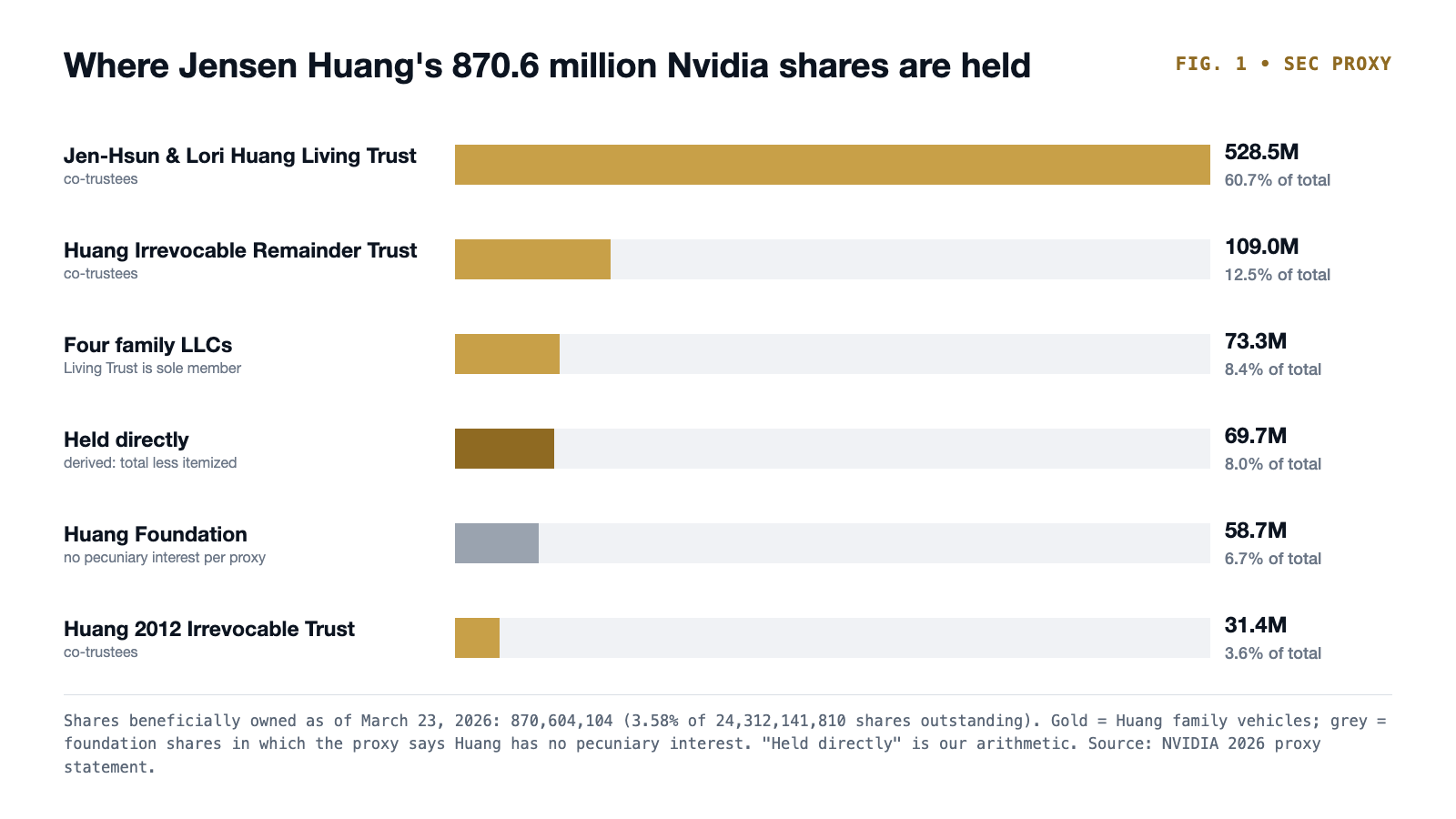
FIG. 1 · SEC proxy (DEF 14A). Huang's 870.6 million beneficially owned shares by holding vehicle, as of March 23, 2026. The "held directly" figure is our arithmetic: the total less the itemized vehicles.
One block is not his in an economic sense. The 58,683,830 shares held by The Jen-Hsun & Lori Huang Foundation count toward his reported beneficial ownership because he and his wife serve on its board, but the proxy states that they have no pecuniary interest in those shares. Take the foundation out and his economic stake is lower.
What changed since March#
Huang files a Form 4 Form 4The SEC form that officers and directors file within days of trading their company's stock, reporting what they bought, sold, received or gave away. when his holdings change. The two most recent we reviewed show no open-market sales:
- June 17, 2026: Nvidia withheld 45,723 shares at $207.41 to cover taxes on vesting stock (transaction code F, not a sale in the market).
- September 16 to 17, 2026: another tax withholding of 45,728 shares at $212.17, and a gift of 438,000 shares: 292,000 to the family foundation and 146,000 to a donor-advised fund.
The Living Trust figure fell by 60.4 million shares between the March proxy and the June Form 4, and the Form 4s list six LLCs against the proxy footnote's four. The totals still reconcile, which suggests shares moved between his own vehicles, but we have not found the filing that explains it.
What is the worth of Jensen Huang NVIDIA stock?#
| Price | Basis | Value of 811.5M shares |
|---|---|---|
| $239.24 | October 6 closing high | $194.1 billion |
| $173.73 | Wednesday close | $141.0 billion |
| $160.70 | Wednesday close less 7.5% (intraday estimate) | $130.4 billion |
The arithmetic. 811.52 million × $239.24 = $194.1 billion; × $173.73 = $141.0 billion; × $160.70 = $130.4 billion. From the high to $160.70, that is about $63.7 billion of paper value.
Three limits matter for reading these numbers:
- The shares cannot be pledged or hedged. Nvidia's insider trading policy prohibits hedging, pledging and margin accounts (proxy). That removes one way a founder's stake can create forced selling.
- Resigning does not change what he owns. The 8-K describes no change to his shares. Whether he sells is his decision.
- His pay was equity-heavy. His fiscal 2026 total compensation was $36.3 million, built on performance stock awards. The proxy sections on how those awards are treated when an executive resigns were not retrievable, and the 8-K is silent.
5. The Business He Is Leaving#↑ Contents
The operating picture is the reason this is a leadership story and not an earnings story.
| Metric | Figure | Source |
|---|---|---|
| Fiscal 2026 revenue | $215.9 billion, up 65% | 10-K |
| Q2 fiscal 2027 revenue (quarter ended July 26) | $96.2 billion, up 106% year over year and 18% from Q1 | Nvidia release, Aug. 26 |
| Q2 Data Center revenue | $89.0 billion, up 117% | Nvidia release |
| Q2 GAAP net income | $59.7 billion | Nvidia release |
| Q3 fiscal 2027 outlook | $108.0 billion, plus or minus 2%, with no China Data Center compute revenue assumed | Nvidia release |
| Purchase and supply obligations | $95.2 billion | 10-K, auditor's critical audit matter |
Two features of that revenue matter for a change at the top. It is concentrated: the 10-K says one direct customer accounted for 22% of fiscal 2026 revenue and another for 14%. That is about $47.5 billion and $30.2 billion (215.9 × 0.22; 215.9 × 0.14), together about $77.7 billion, or 36%. At that concentration, continuity in the relationships with those two customers matters to the numbers. It is mostly American in headquarters terms: customers headquartered outside the U.S. accounted for 31% of fiscal 2026 revenue, down from 41% the year before (10-K). Nvidia counts revenue by the customer's headquarters, so shipping destinations differ.
6. Nvidia's International Web: What the Filings Show#↑ Contents
Nvidia designs chips and does not make them. Its 10-K describes a fabless model that depends on a short list of suppliers, mostly in Asia.
| Layer | Who the 10-K names |
|---|---|
| Wafer manufacturing | TSMC and Samsung |
| Memory | SK Hynix, Micron and Samsung |
| Advanced packaging | CoWoS technology CoWoSChip-on-Wafer-on-Substrate, TSMC's advanced packaging process that joins a processor and high-bandwidth memory into one module. It is widely treated as a bottleneck for AI chips. |
| Assembly and test | Hon Hai Precision (Foxconn), Wistron and Fabrinet |
| Facilities | Primarily in China, India, Israel and Taiwan |
Three statements in the 10-K describe how Nvidia secures that supply:
- It says the company's business depends on consistent and reliable supply from overseas partners, "especially in Taiwan and South Korea."
- It says Nvidia has "paid premiums, provided deposits, and entered into long-term supply agreements and capacity commitments," and prepaid manufacturing and capacity agreements.
- It says lead times have exceeded 12 months.
Those are corporate contracts, with money behind them. The auditor's critical audit matter puts outstanding inventory purchase and long-term supply and capacity obligations at $95.2 billion, and provisions for excess inventory and purchase obligations were $7.2 billion in fiscal 2026 versus $3.7 billion in fiscal 2025.
The supply side is tight. On its October 15 earnings call, TSMC said demand "is still far above our capability today to supply" and that it is working to narrow the gap. It said CoWoS remains the first choice of customers, and it kept 2026 capital spending at $60 billion to $64 billion. TSMC did not name Nvidia or any customer on the call, and it has not, in anything we found, commented on Nvidia's leadership change.
How much of the capacity Nvidia holds is reported, not confirmed. Secondary outlets say Nvidia has secured more than half of TSMC's CoWoS capacity through 2026 or 2027. Neither TSMC nor Nvidia has confirmed that figure in the documents we read, and we treat it as an unverified estimate.
The U.S. side. In May 2025 Nvidia announced a partnership with Saudi Arabia's Humain: a first phase of 18,000 GB300 chips and "several hundred thousand" GPUs over five years, with projected capacity of up to 500 megawatts. Huang announced it during a state visit by President Trump, and the release carries his statement that AI is essential infrastructure for every nation.
7. How Critical Was Huang? What the Record Shows and Does Not Show#↑ Contents
This is the question that matters most to the stock, and it is the one the documents answer least directly.
What supports the idea that Huang personally mattered:
- He fronted the government-level deals. The Saudi announcement came with his name on it and a presidential state visit around it. Gulf business figures reacted to the prospect of his departure, before it happened: Damac Properties founder Hussain Sajwani called it a loss for the world and Prince Khaled bin Alwaleed called a firing a mistake (The National, Nov. 12). Neither is described as an Nvidia partner, so we read those as sentiment, not evidence of commercial effects.
- He visited the supply chain at the top. Tech Times reported that Huang flew to Taipei in May to meet TSMC Chairman C.C. Wei and lock in capacity for the Vera Rubin platform. The outlet reported the purpose of the trip, not an outcome, and it is a secondary source.
- He was the company's link to Washington. CNBC describes him as closely aligned with the Trump administration, advising the White House on AI and pushing for looser limits on chip sales to China. Per The New York Times (via CNBC), he was added to the executives on Trump's May China trip at the last minute. Patrick Moorhead of Moor Insights told CNBC he has not seen a chip CEO with this much direct influence on export policy in 35 years.
- He sat at the center of the organization. Fortune reported about 60 direct reports and no chief operating officer.
What cuts the other way:
- Nvidia's own risk factor does not name him. The 10-K says the company is "highly dependent on the services of our longstanding executive team" and warns that failure to manage succession could hurt strategic planning and execution. Huang is not mentioned in that factor, and key-person insurance is not mentioned at all.
- The contracts belong to the company. The $95.2 billion of supply commitments and the long-term agreements are corporate obligations. Nothing in the filings says they depend on Huang personally.
- His political access did not reopen China. The 10-K says Nvidia was "effectively foreclosed" from China's data center compute market by the end of fiscal 2026, and that it had generated no revenue under the H200 license program. The Nvidia 10-K also records a $4.5 billion charge on H20 inventory and purchase obligations in the first quarter of fiscal 2026.
- No supplier or customer has said anything yet. We found no statement from TSMC, SK Hynix, Samsung, Micron, Microsoft or OpenAI about the change. The market signals so far are share prices: a memory-supplier ETF fell 4% and the Philadelphia semiconductor index fell 2% at the open (NBC).
Our reading. The record supports a narrower claim than "everything ran through Huang." It supports three: he was the public face of Nvidia's deals with governments, he was the company's main voice in Washington, and Nvidia has no chair, no COO and a large span of control that now needs rebuilding. The public record does not show who inside Nvidia negotiates wafer, memory and packaging allocations day to day, and it does not show whether any counterparty has changed its terms. That is the gap to watch, and the November 17 call is the first chance to hear from the people who do.
8. China, Washington and the Policy Channel#↑ Contents
Huang's political capital was part of Nvidia's China strategy, and that is where the change is most visible.
- The commercial position is already small. CNBC reports that China including Hong Kong was about 9% of Nvidia's revenue last fiscal year and 8% in the most recent quarter, against nearly a quarter before the 2022 controls, and that Nvidia's forecasts assume zero China Data Center compute revenue. The 10-K reports about $60 million of H20 revenue under the August 2025 licenses, and no revenue under the February 2026 H200 licenses, which carry a 25% tariff on importation to the U.S.
- Congress is moving. Sen. Kevin Cramer called for Huang to resign before the announcement. The chairs of the House Foreign Affairs, China Select and Intelligence committees asked Huang to appear, with a November 18 date, and Rep. Brian Mast said yes when asked whether they would subpoena him. Three export-control bills (the AI Overwatch Act, the Chip Security Act and the MATCH Act) are candidates for the defense authorization bill, and Democrats are expected to open investigations in January (CNBC, Nov. 11). We have not seen an update on whether the briefing request changes now that Huang has resigned.
- Nvidia's voice in the debate changes. Moorhead told CNBC that Huang had been Nvidia's lead voice on China and that the voice is now weaker. Kress, whose career has been in finance, now leads a company whose lead voice on China has changed.
9. How This Affects Nvidia: A Watch List#↑ Contents
We do not forecast the share price. These are the points where the facts will arrive, and what each one would tell you.
| When | What | Why it matters |
|---|---|---|
| Nov 17, about 1:20 p.m. PT | Q3 results and the call, the first under Kress as interim CEO | Whether guidance and the $108.0 billion outlook hold, and what management says about supply commitments and supplier relationships |
| Nov 18 | House committees' requested briefing | Whether the request stands now that Huang is out, and who answers it |
| Weeks to months | CEO search | Internal or external candidate; Ives expects about a year of interim leadership |
| Ongoing | Supplier and customer commentary | A statement from TSMC, a memory maker or a large customer would be the first direct evidence about supply terms |
| Ongoing | SEC filings | Form 4s for sales under Kress's June 2026 plan and any change in Huang's holdings, plus any 8-K on governance or the search |
| January | Congressional investigations | Export-control scrutiny of Nvidia and its customers |
| Ongoing | Governance build-out | Whether the new Chair adds a COO or chief compliance officer, and whether Huang's 60 direct reports are reorganized |
Frequently Asked Questions#↑ Contents
Why did Jensen Huang resign as Nvidia CEO? Nvidia's 8-K and press release do not state a reason. News reports tied the resignation to reports of extramarital relationships and to a board investigation, and Huang acknowledged in a message to employees that he was unfaithful to his wife. Those are reports and statements by individuals, not findings in an SEC filing.
Who is running Nvidia now? CFO Colette Kress, 59, is interim CEO while she keeps her CFO role. Harvey C. Jones, 73, a director since 1993, is the board's first-ever Chair.
How much of Nvidia does Jensen Huang own? The 2026 proxy shows 870,604,104 shares, or 3.58%, as of March 23, 2026. His September 17 Form 4 accounts for 811,521,160 shares outside his family foundation, about 3.34% of the March share count. Roughly 58.7 million of the proxy total sit in a foundation in which the proxy says he has no pecuniary interest.
How much is Huang's Nvidia stake worth? About $130 billion at $160.70 a share, the Wednesday close less 7.5%, for the 811.5 million shares outside the foundation. At the October 6 closing high of $239.24 the same shares were worth about $194 billion. The figure moves with the stock.
Did Huang control Nvidia through special shares? No. Nvidia has a single class of common stock, and Fortune reported that Huang holds no super-voting shares. His stake of 3.3% to 3.6% is also roughly his share of the vote, and BlackRock and Vanguard each hold more than twice as many shares.
Does Huang's departure change Nvidia's supply contracts? Nothing in the filings says so. The supply agreements and capacity commitments are corporate obligations, totaling $95.2 billion in purchase and supply commitments, and Nvidia's release says customer commitments and the product roadmap are expected to continue without interruption. No supplier has commented publicly, so the practical effect is untested.
How important was Huang to Nvidia's relationships with TSMC and other suppliers? The public record shows him meeting TSMC's chairman and fronting government-level deals, but it does not show who negotiates allocations day to day. Nvidia's 10-K names its "executive team," not Huang, as the dependency. This is an open question until suppliers or the company say more.
What happens at Nvidia's earnings on November 17? Nvidia says it will report as scheduled, at about 1:20 p.m. PT, with the call at 2 p.m. PT. Guidance for the quarter is $108.0 billion in revenue, plus or minus 2%, with no China Data Center compute revenue assumed.
Is this financial advice? No. This article reports and analyzes public filings and news coverage. It makes no recommendation to buy, sell or hold Nvidia stock.
Conclusion and Key Takeaways#↑ Contents
- The facts of the departure are narrower than the headlines. The filing records a resignation, an interim CEO, a new Chair and a search. It does not record a reason, separation terms or a timeline.
- Huang's ownership is large in dollars and modest in percentage. Between 3.3% and 3.6% of the company, roughly $130 billion at today's price, with no special voting rights and no ability to pledge the shares.
- The company's growth does not depend on a single quarter's leadership. Revenue was up 106% last quarter and the outlook is $108.0 billion, but $95.2 billion of supply commitments and a 36% two-customer concentration make the next few quarters sensitive to execution.
- Huang's personal role in supply and diplomacy is real but unmeasured. The record shows the public face. It does not show the negotiating mechanics, and Nvidia's own risk factor points to a team.
- The next facts arrive on a schedule. November 17, November 18, the CEO search and January's congressional work will each add evidence.
Methodology and Sources#↑ Contents
How we worked. We read the primary documents directly and derived every computed figure shown above from them. Where a number is our arithmetic, the calculation is displayed. Where a source was secondary, we say so. Reuters and The Wall Street Journal were not accessible to us, and a Bloomberg page returned an access error, so we relied on SEC filings, company releases, CNBC, NBC News, Fortune and The National.
What we could not verify.
- The proxy sections on Huang's unvested awards and what happens to them on resignation (the document was truncated in retrieval).
- The reason for the resignation, which Nvidia has not stated.
- Any supplier, customer or government reaction to the resignation itself.
- Nvidia's share of TSMC CoWoS capacity, which appears only in secondary reports.
- The filing that explains the change in Huang's trust and LLC holdings between March and June.
- Share prices after the open on November 12. The $160.70 figure is the Wednesday close less 7.5% and is an estimate.
Primary sources (Tier 1)
- SEC — NVIDIA Form 8-K, Item 5.02, CEO transition (Nov. 11–12, 2026)
- SEC — NVIDIA Exhibit 99.1, "NVIDIA Announces CEO Transition" (Nov. 12, 2026)
- SEC — NVIDIA 2026 proxy statement (DEF 14A), security ownership and compensation
- SEC — NVIDIA Form 10-K for fiscal 2026 (supply chain, risk factors, Item 9B)
- SEC — Form 4, Jen-Hsun Huang, September 2026
- SEC — Form 4, Jen-Hsun Huang, June 2026
- SEC — NVIDIA Form 8-K, Colette Kress appointed CFO (Sept. 2013)
- NVIDIA — Second quarter fiscal 2027 results (Aug. 26, 2026)
- NVIDIA — Saudi Arabia and NVIDIA to build AI factories (May 2025)
- NVIDIA — HUMAIN and NVIDIA strategic partnership release (May 13, 2025)
- TSMC — 3Q26 earnings materials, including the October 15, 2026 call transcript
Established newsrooms (Tier 2)
- CNBC — Nvidia CEO Jensen Huang resigns: Live updates (Nov. 12, 2026)
- CNBC — Jensen Huang's affair with alleged Chinese spy further complicates Nvidia's China problem (Nov. 10, 2026)
- CNBC — Jensen Huang affair in DC: Resignation calls and moves to tighten Nvidia China exports (Nov. 11, 2026)
- NBC News — Nvidia stock falls after Huang resigns (Nov. 12, 2026)
- NBC News — Nvidia CEO Jensen Huang resigns after reports of affair and extramarital relationships (Nov. 12, 2026)
- Fortune — Nvidia's power is built around Jensen Huang; the scandal is testing the formula (Nov. 9, 2026)
- The National — Gulf business leaders rally behind Nvidia's Jensen Huang (Nov. 12, 2026)
Secondary (used with a caveat)
- Tech Times, "Nvidia at Computex 2026" (May 24, 2026), for the reported purpose of Huang's Taipei trip. Reports of Nvidia's share of TSMC CoWoS capacity come from aggregator sites and are not repeated here as fact.
About This Analysis#↑ Contents
Financial Gurkha is an independent markets research desk run by Kanchan Sharma from New York City. This article was drafted with AI assistance from the primary documents and news sources listed above, and every figure was checked against those sources before publication. It reports and analyzes public filings and coverage, it makes no recommendation to buy, sell or hold any security, and it takes no position on the allegations reported about any individual.
Need a full intrinsic valuation, for a public company, a private target, or your own business? Schedule a consultation with the Financial Gurkha desk.
Reported from New York City. Sources: SEC EDGAR filings by NVIDIA Corporation, NVIDIA and TSMC releases, and the news outlets linked above.