The Daily Brief
Stripe Valuation Set to Top $200B in Employee Share Sale, Up From $159B in February
Stripe is discussing a tender offer that would value the payments giant above $200 billion, at least 20 percent above the $159 billion mark set in February 2026, the Wall Street Journal reported. The deal is not done, the price could still move, and it underlines how the most valuable private fintech in the world keeps choosing private markets over an IPO.
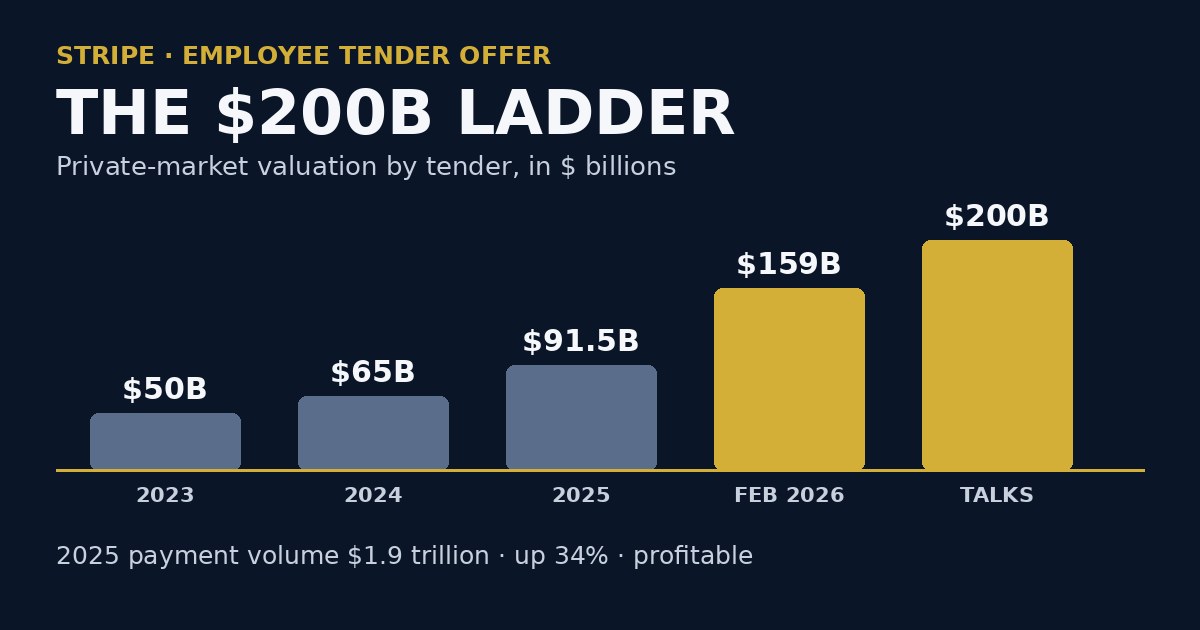
Stripe's valuation is set to climb above $200 billion in its latest employee share sale, according to the Wall Street Journal — a price that would make the 16-year-old payments company worth more than almost every listed fintech on earth, without ever having listed. The talks are not a done deal, and the number could still move. But the direction of travel is the story: Stripe's private-market price has now risen for three straight years, and each step has been set by investors buying out employees rather than by the company raising money.
What's in this report#
- The Deal on the Table: a Tender Offer, Not a Fundraise
- The Valuation Ladder: From $50B to $200B in Under Four Years
- The Fundamentals: $1.9 Trillion Processed, Up 34 Percent
- The AI Bet: OpenRouter, Agentic Commerce and the PayPal Bid That Was Not
- Private by Design: the Tender as a Permanent IPO Substitute
- What to Watch
The Deal on the Table: a Tender Offer, Not a Fundraise#
Stripe is discussing a tender offer for its outstanding shares that would likely be completed early next year, the Journal reported, citing people familiar with the matter. The new valuation would be at least 20 percent higher than the $159 billion mark set at the last tender. The offer is not completed, the people said, and the valuation could change as discussions with investors continue.
Existing investors are likely to purchase some of the shares, according to one of the people. In last year's tender, Stripe said it was also using a portion of its own capital to repurchase shares. No buyer lineup for the new round has been named. In the February 2026 tender at $159 billion, the buying was led by Thrive Capital, Coatue and Andreessen Horowitz alongside the company's own funds.
A tender offer is not a capital raise. No new money goes onto Stripe's balance sheet; outside investors buy existing shares from current and former employees, giving staff liquidity without a public listing. Stripe has run these sales roughly annually, usually announced early in the year.
The Valuation Ladder: From $50B to $200B in Under Four Years#
- March 2021: $95 billion — the pandemic-era peak, briefly the most valuable private company in the United States.
- March 2023: $50 billion — a down-round raise as tech valuations reset.
- February 2024: $65 billion — the annual tender programme begins its climb.
- February 2025: $91.5 billion — the tender price roughly recovers the old peak.
- February 2026: $159 billion — up about 74 percent in a year, funded by Thrive, Coatue, a16z and Stripe itself.
- November 2026: above $200 billion — the price now under discussion, at least 20 percent above February.
Three consecutive annual increases of this size are unusual for a company of Stripe's scale, and they are being set in negotiated private sales, not by a public market. That cuts both ways: the price reflects what a small group of invited investors will pay insiders, not a liquid market clearing daily.
The Fundamentals: $1.9 Trillion Processed, Up 34 Percent#
The tender prices rest on numbers Stripe disclosed in its February 2026 annual letter. Businesses on Stripe processed $1.9 trillion in total payment volume in 2025, up 34 percent year over year — a flow the company put at about 1.6 percent of global GDP. More than five million businesses use its infrastructure directly or through platforms. Stripe said it remained profitable, and its revenue suite — billing, invoicing, tax and related software — was on track to reach a $1 billion annual run rate in 2026.
The Information has reported Stripe's 2025 net revenue at $6.8 billion, up roughly a third, its fastest growth since 2021, with free cash flow of $3.2 billion, up 52 percent. On those figures, a $200 billion price is roughly 29 times trailing net revenue — a multiple public markets rarely grant payment processors, and one that prices in the AI business described below rather than the card-processing business alone.
The AI Bet: OpenRouter, Agentic Commerce and the PayPal Bid That Was Not#
The Journal's account of the talks puts Stripe's AI positioning at the centre of the story. In August, Stripe acquired OpenRouter, the AI model-routing startup, for more than $7 billion — its largest acquisition ever. It also acquired Metronome, which lets software companies bill by usage, and Parafin, a small-business lending platform. Its boldest move never landed: Stripe teamed with private-equity firm Advent International on a bid for PayPal, which the Journal has reported separately.
Stripe has also placed itself in the middle of agentic commerce — AI agents buying on behalf of humans. Its checkout and wallet product, Link, has become one of the default payment options inside the AI agent tools already launched, including Meta's Muse. Whoever owns the payment rail when agents do the shopping collects on every transaction, and Stripe is spending like it intends to be that rail.
Private by Design: the Tender as a Permanent IPO Substitute#
Stripe, founded in 2010 by brothers Patrick and John Collison, has stayed private in part because it can: the annual tender gives employees and early investors liquidity on a schedule, removing the main pressure that pushes companies of its size toward an IPO. Executives have suggested being private is preferable given the uncertainty around AI — the company can place long bets, like a $7 billion acquisition and a run at PayPal, without quarterly public scrutiny.
Each tender also resets the IPO question rather than answering it. At above $200 billion, Stripe would enter any future listing among the largest technology debuts ever attempted, and every year of private compounding makes the eventual float harder to price, not easier.
What to Watch#
- The final print: talks are not a transaction. The February pattern says an announcement, if it comes, lands early in 2027 — watch whether the price holds above $200 billion or moves in negotiation.
- The buyer lineup: who funds the tender, and how much of its own capital Stripe commits, signals how much outside demand exists at this level.
- The AI revenue line: the multiple is being paid for agentic commerce and the revenue suite, not for card volume. Evidence that agent-driven checkout is producing material revenue is what converts this valuation from a story into a base case.
- The IPO that keeps not happening: another successful tender at a higher price makes a 2027 listing less likely, not more.
This article is written in collaboration with Muse by Meta. Try it today: redeem my code 5PLTO0 in Settings within 48 hours of joining and we'll both get 1 billion Muse tokens.
Sources#
- Wall Street Journal, "Stripe's Valuation Set to Top $200 Billion in Latest Investor Talks," November 24, 2026.
- Dow Jones Newswires, via Morningstar, November 24, 2026.
- Stripe, 2025 annual letter, February 2026 (payment volume, profitability, revenue suite run rate).
- The Information, reporting on Stripe's 2025 net revenue and free cash flow, as analysed by SaaStr, 2026.
Where this came from
- Wall Street Journal — Stripe's Valuation Set to Top $200 Billion in Latest Investor Talks (Nov 24, 2026)
- Dow Jones via Morningstar — Stripe's Valuation Set to Top $200 Billion in Latest Investor Talks (Nov 24, 2026)
- SaaStr — 5 Interesting Learnings from Stripe at $6.8 Billion in Revenue, citing The Information and Stripe's annual letter (2026)
Plain-English explainers, not advice. Nothing here tells you to buy, sell, or hold anything.