The Daily Brief
Nvidia Reinstates Jensen Huang as CEO 11 Days After Resignation; Shares Jump 33%
The board voted unanimously to bring its co-founder back, six days after saying it did not intend to. Nvidia stock leapt about 33%, the Nasdaq surged, and the probes did not go away.
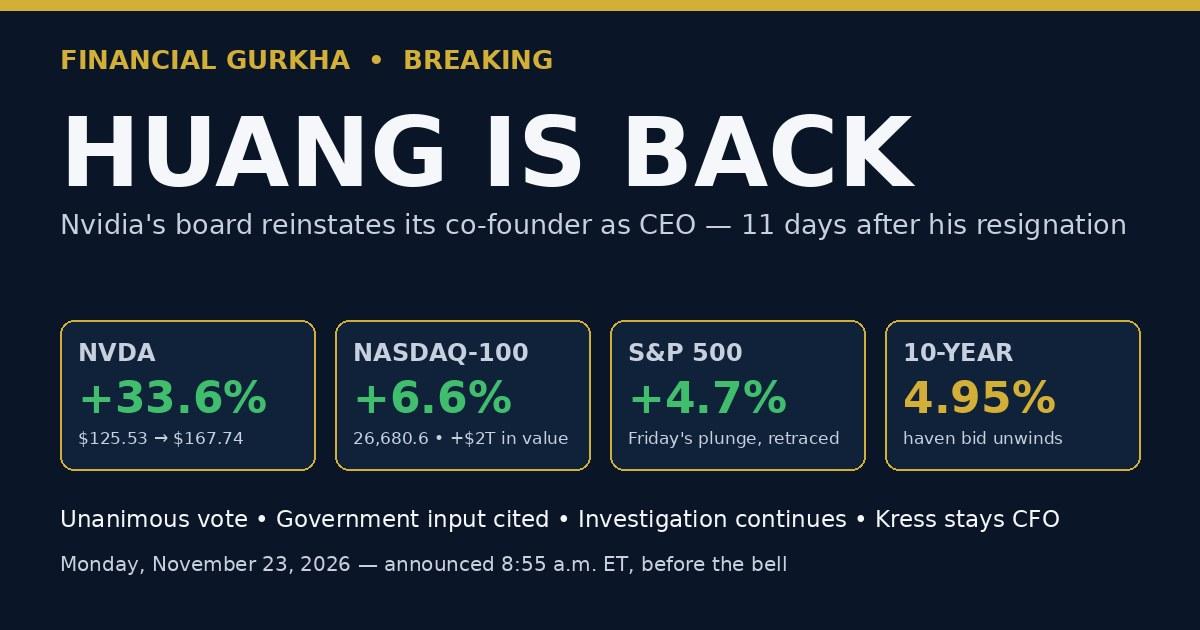
Jensen Huang is back. Nvidia announced Monday morning, in a release timed about 35 minutes before the opening bell, that its board had voted unanimously to reinstate its co-founder as President, Chief Executive Officer and board member, effective immediately — 11 days after he resigned, and six days after the board's chair said on an earnings call that the board did not intend to bring him back. Nvidia stock leapt about 33% in early trading, the Nasdaq posted one of its biggest one-day gains in years, and the AI selloff that defined last week reversed in a single session. The investigations that surrounded his exit, however, did not end with his return. The board said so itself, in the same release.
The decision, in the board's own words#
The release is short and deliberate. The board said it acted "following a series of discussions and meetings with Mr. Huang, after which the Board was satisfied with respect to Mr. Huang's candor and ability to lead NVIDIA." It then added the sentence that explains how a board reverses itself in six days: "In the process of reaching its decision, the Board received input from senior levels of the United States government, and based on that input, the Board is confident that Mr. Huang's reinstatement poses no national security risk."
Chair Harvey C. Jones, who keeps the chair, said: "The Board believes Jensen is the right person to lead NVIDIA, and that his reinstatement is in the best interests of our stockholders, employees, partners and customers." He thanked Colette Kress "for her outstanding service as interim CEO, in addition to her continuing responsibilities as NVIDIA's Chief Financial Officer."
Huang's own statement struck the note the board needed: "I am honored to return to NVIDIA and lead one of the most consequential technology companies in the world at the beginning of a new industrial revolution. I take this responsibility with the greatest humility and renewed commitment." He thanked the board, Jones, Kress and the executive staff, employees, shareholders and partners — "and above all, I am grateful for the love and support of my family. I can't wait to get back to work."
How the board got from no to unanimous#
Six days ago, on the November 17 earnings call, Jones said the board "does not intend to reinstate Jensen as CEO," and announced a permanent search run by Heidrick & Struggles. What changed was the pressure, applied in public and in sequence. A petition to bring Huang back passed 180,000 signatures, with Elon Musk among the signatories, and a large bloc of self-identified employees behind it. President Trump, who had urged Huang's return since the resignation, posted Sunday night that he hoped the board would rehire him, and on Monday called the reinstatement "the correct and proper decision." Reuters reported the return followed mounting pressure from employees, shareholders and business partners as well as the president.
Not everyone in the administration was on that side of the line. On Sunday, Treasury Secretary Scott Bessent said the export-compliance answers he demanded had still not arrived, and declined to endorse a return: "I think we have to see where the buck stops." The board moved the next morning anyway — with the release's government-input sentence doing the work of an answer. California Attorney General Rob Bonta's office served an investigative subpoena on Thursday, and Bonta has described the state's framework as covering civil and criminal prohibitions on misleading investors. None of that stopped the vote.
What changes inside Nvidia — and what does not#
The leadership question that hung over the stock is closed. Kress, who fronted the third-quarter report on November 17 — revenue of $115.8 billion, up 103%, and a $130 billion fourth-quarter guide — returns to the CFO role alone. Jones remains chair. The permanent-CEO search announced last week is overtaken by the reinstatement; the release does not mention it. The business itself never changed: the product roadmap, the $390 billion of purchase commitments and the Vera Rubin ramp all ran through the 11 days without their founder, and they now run with him again.
What does not change is the scrutiny, and the release is explicit about it. The independent directors' investigation into the reports that Huang was the target of a foreign intelligence effort "will proceed to conclusion," the board said, with Huang's stated support and cooperation. The National Security and Export Control Committee formed last week continues, and is engaging national-security counsel. One genuinely new structure appears: Nvidia is creating a Chief Compliance Officer position, to report to the board's Nominating and Corporate Governance Committee, and has begun the search. And the company "will continue to cooperate with ongoing government investigations and inquiries" — a category that, as of this morning, includes the California subpoena, the SEC's reported accounting probe, a closed-door interview with three House committees scheduled for December 1, and the public Senate Banking testimony Huang has agreed to give.
Strategists split on what the reversal says about the board itself. "There were definitely a lot of people who wanted him back," Steve Sosnick of Interactive Brokers told Reuters. "It tells us to some extent that Jensen Huang was too big to be fired." Another market commentator quoted by Reuters called the sequence "a textbook example of poor governance," while a third argued the return "removes the two big risks that NVIDIA was dealing with last week — concerns about violations of export controls and a messy CEO transition."
The stock: a third of the company's value, back in a morning#
Nvidia shares closed Friday at $125.53, down 14% on the day and down for a seventh straight week. They opened Monday at $167.04 and traded at $167.74 at 10:18 a.m. ET, up 33.6% on the session, with a market value back around $4 trillion. The move flips Nvidia's one-week return to about positive 3% — and still leaves the stock about 31% below its October 6 record close of $243.37. The shares had lost roughly a third of their value in the two weeks since the story broke; Monday recovered most of the leadership discount in the first hour, without a single new number about the business itself.
The rest of the AI complex followed. CoreWeave gained about 27% in early trading, and Arm and Micron were up in the mid-teens. Anthropic (Nasdaq: ANT), whose options began trading Monday, told a more cautious story: it opened at $93.65 against Friday's settled close of $88.91, touched $94.24, and had faded back to $88.35 by mid-morning — roughly flat on the day. The market was buying the return of a specific man, not re-rating the whole trade at Friday's closing prices.
The wider market: the rout, run backwards#
The indices retraced Friday's plunge and then some. The Nasdaq Composite surged 6.7% after the opening bell, and the Nasdaq-100 rose 6.6% to 26,680.6 — on track for its biggest one-day percentage gain since April 2025 and about $2 trillion of added market value, according to Reuters. The S&P 500 gained 4.7% and the Dow 2.5%, against Friday's closes of 6,910.39 (down 3.7%) and 48,147.33. Two weekend developments fed the same relief trade: Bessent publicly warned the Fed against overtightening, and authorities in Seoul, Taipei and Beijing rolled out market-stabilization measures after Asia's worst week since 2020.
Rates and haven assets unwound in the other direction. The 10-year Treasury yield stood at about 4.95% Monday morning, up from Friday's 4.91% close, as the safe-haven bid faded; the two-year rose about 4 basis points to 4.69%. The VIX, which closed Friday at 35.89, fell back toward 30. Gold, which had been liquidated to about $3,538 an ounce last week — a 14-month low near $3,500 at the worst of it — rebounded more than 2% to about $3,620, with silver up about 4% to $42.80. Oil stayed out of the story: Brent eased about 1.5% to near $91 and WTI held in the mid-$80s. Bitcoin climbed about 3%, back above $60,000.
Foreign markets: Europe caught it live, Asia gets its say tonight#
The announcement landed at 2:55 p.m. in Europe and 10:55 p.m. in Tokyo, so the foreign reaction is split in two. Europe traded through it: markets were largely positive, and Dutch chip-equipment maker ASML rose more than 10%. Asia's Monday session had already closed before the news — South Korea's Kospi ended 3.3% lower, dragged by Samsung Electronics and SK Hynix in the echo of Friday's rout, while TSMC rose 1.5% and lifted Taiwan's top-50 index 2.25%. Anthropic's Frankfurt listing was up about 1% at 82 euros in European hours. The full Asian verdict on Huang's return — in Taipei, Seoul and Tokyo, where Nvidia's supply chain actually sits — arrives with Tuesday's sessions.
What happens next#
Huang returns to a calendar that did not pause for him: the December 1 closed-door interview with the House committees, the public Senate testimony he has agreed to, California's subpoena, the SEC's reported accounting inquiry, and Bessent's still-unanswered compliance questions, whose roughly 10-day window runs to about November 25. The board's independent investigation runs to its conclusion with his cooperation, by the release's own terms. The stock has now priced the man back in. What it has not priced — because nobody can yet — is what any of those processes find.
This article is written in collaboration with Muse by Meta. Try it today: redeem my code 5PLTO0 in Settings within 48 hours of joining and we'll both get 1 billion Muse tokens.
Sources#
- NVIDIA Newsroom — "NVIDIA Board Reinstates Jensen Huang as President, CEO and Board Director," November 23, 2026. https://nvidianews.nvidia.com/news/nvidia-board-reinstates-jensen-huang-as-president-ceo-and-board-director
- Reuters — "Nvidia reinstates Jensen Huang as CEO," November 23, 2026. https://www.reuters.com/technology/nvidia-reinstates-jensen-huang-ceo-2026-11-23/
- Reuters — "VIEW: Nvidia reinstates Jensen Huang as CEO, igniting tech surge," November 23, 2026. https://www.reuters.com/business/view-nvidia-reinstates-jensen-huang-ceo-igniting-tech-surge-2026-11-23/
- Reuters — "AI rally set to add $2 trillion to Nasdaq-100 as Huang returns to Nvidia helm," November 23, 2026. https://www.reuters.com/business/ai-rally-set-add-2-trillion-nasdaq-100-huang-returns-nvidia-helm-2026-11-23/
- CNN — "Nvidia shares soar 30% after Huang reinstated as CEO" and markets live coverage, November 23, 2026. https://www.cnn.com/2026/11/23/markets/us-stocks-rebound-intl
- WSJ — "Nvidia Board Reinstates Jensen Huang as CEO," November 23, 2026. https://www.wsj.com/articles/nvidia-board-reinstates-jensen-huang-as-ceo-a6b49914
- Finnhub market data — NVDA and ANT session snapshots, November 23, 2026 (10:18–10:19 a.m. ET).
Where this came from
- NVIDIA Newsroom — NVIDIA Board Reinstates Jensen Huang as President, CEO and Board Director (Nov 23, 2026)
- Reuters — Nvidia reinstates Jensen Huang as CEO (Nov 23, 2026)
- Reuters — VIEW: Nvidia reinstates Jensen Huang as CEO, igniting tech surge (Nov 23, 2026)
- Reuters — AI rally set to add $2 trillion to Nasdaq-100 as Huang returns to Nvidia helm (Nov 23, 2026)
- CNN — Nvidia shares soar 30% after Huang reinstated as CEO (Nov 23, 2026)
- WSJ — Nvidia Board Reinstates Jensen Huang as CEO (Nov 23, 2026)
Plain-English explainers, not advice. Nothing here tells you to buy, sell, or hold anything.