The Daily Brief
US Export Prices Rise 1.1% in October as Terms of Trade Improve With All Five Major Partners
The Bureau of Labor Statistics reported export and import prices both up 1.1 percent in October, with the US terms of trade higher against Japan, the European Union, China, Mexico and Canada, and import capital goods prices posting their largest monthly advance since 1988.
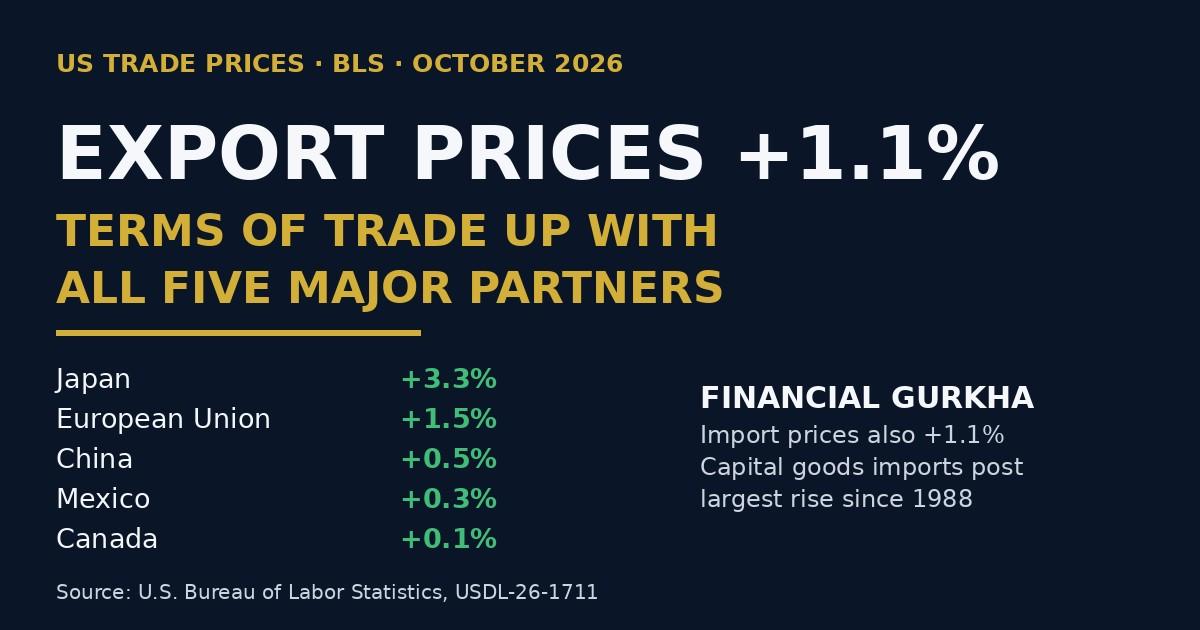
U.S. export prices rose 1.1 percent in October and import prices rose 1.1 percent, the Bureau of Labor Statistics reported Tuesday in its October import and export price release (USDL-26-1711). The headline prints match, but the bilateral detail underneath them moved in one direction: the U.S. terms of trade — the purchasing power of what America sells relative to what it buys — improved against every major partner BLS tracks.
Terms of trade: a clean sweep#
The terms of trade index rose with all five partners in October. The index with Japan advanced 3.3 percent. The index with the European Union increased 1.5 percent, extending September's 3.6 percent jump, which BLS notes was the largest one-month advance for that index since monthly percent changes were first published in January 2018. The index with China increased 0.5 percent, after a 2.4 percent rise in September, driven by higher export prices to China more than offsetting higher import prices from China. The indexes with Mexico and Canada rose 0.3 percent and 0.1 percent.
Export prices to Japan rose 3.7 percent in October, the largest monthly advance since March 2022. Export prices to China advanced 1.9 percent, and export prices to the European Union and Canada each rose 1.7 percent.
The 12-month picture, and the missing October#
One caveat runs through this release, and it matters for any year-over-year comparison: BLS did not collect survey data for October 2025 because of the lapse in appropriations, so it cannot publish 12-month percent changes for October 2026 for most indexes. The last complete 12-month comparison is through September, and it is the comparison behind the recent improvement story: export prices were up 11.6 percent over the year ended September 2026, against an 8.1 percent rise in import prices — export prices outrunning import prices by three and a half points.
Where a 12-month figure does exist for October, it points the same way. Agricultural export prices increased 9.9 percent over the year ended October 2026. Agricultural prices rose 1.2 percent in October alone and have not recorded a monthly decline since December 2025, with higher prices for nuts and animal feeds more than offsetting lower fruit prices.
What pushed import prices#
Fuel imports led the monthly increase, advancing 3.6 percent in October as petroleum and petroleum product prices rose 3.7 percent and natural gas prices rose 5.1 percent. Nonfuel import prices rose 0.8 percent.
The standout line in the release is capital goods. Import prices for capital goods increased 1.5 percent in October, the largest advance since the index was first published on a monthly basis in December 1988. BLS attributes the rise to higher prices for computers, peripherals and semiconductors, electric apparatus and parts, and industrial and service machinery — the hardware of the data-center buildout, getting more expensive at the border. Import prices for consumer goods excluding automotives rose 0.5 percent, automotive vehicles, parts and engines rose 0.4 percent, and food, feed and beverage prices fell 0.2 percent.
By origin, import prices from China increased 1.4 percent in October, the largest monthly advance since that index was first published in January 2004. Import prices from Canada rose 1.6 percent, the largest monthly rise since May 2026, while prices from Germany fell 0.3 percent.
What pushed export prices#
Nonagricultural export prices rose 1.1 percent in October. Nonagricultural industrial supplies and materials increased 2.1 percent, as higher prices for petroleum and chemicals more than offset lower prices for natural gas and nonferrous metals. Export consumer goods excluding automotives rose 0.6 percent, automotive prices rose 0.1 percent, and capital goods export prices were unchanged, with higher prices for semiconductors and telecommunications equipment offsetting lower prices for industrial and service machinery.
What comes next#
The November import and export price release is scheduled for Thursday, December 17, 2026. With the October 2025 data gap now behind the calendar, that release should also restore the full set of 12-month comparisons — the first clean year-over-year read on whether export prices are still outrunning import prices since September.
Sources#
- U.S. Bureau of Labor Statistics, "U.S. Import and Export Price Indexes — October 2026," USDL-26-1711, November 17, 2026: https://www.bls.gov/news.release/ximpim.htm
- September 2026 12-month comparisons (exports +11.6 percent, imports +8.1 percent) are from the prior release in the same BLS series (USDL-26-1577).
Where this came from
Plain-English explainers, not advice. Nothing here tells you to buy, sell, or hold anything.