The Daily Brief
IMF: the world economy just split in two — and AI picked the winners
The Fund's October outlook holds global growth at 3.1%, but warns the gains now flow to a shrinking club of AI-boom economies while energy importers get squeezed. And the entire 2027 recovery rests on one assumption: the Strait of Hormuz reopens by March.
What happened#
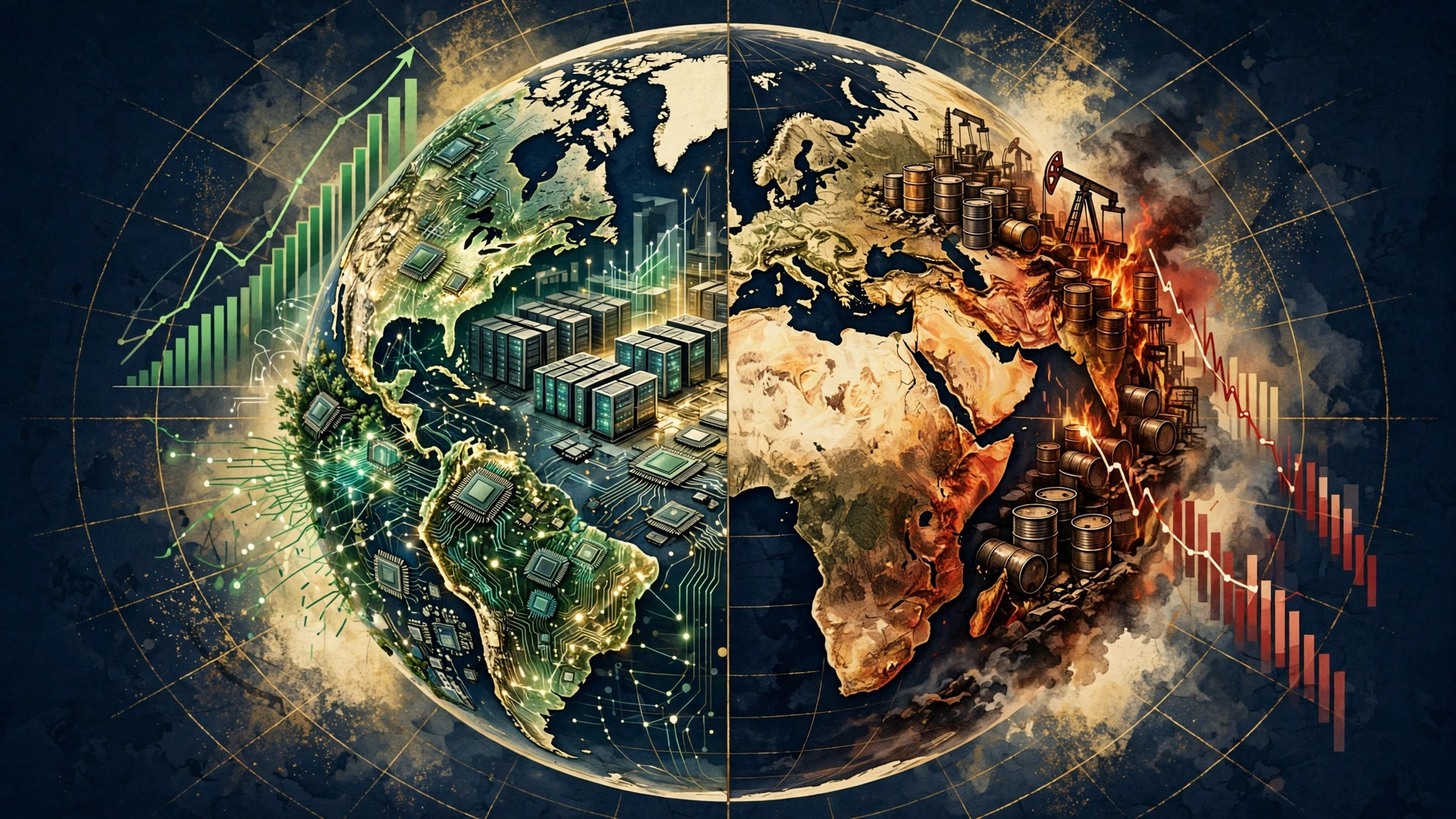
This morning in Bangkok, the International Monetary Fund released its October World Economic Outlook — titled "Resilience Under Strain, Urgent Choices" — and the headline number is almost the least interesting part. Yes, the IMF expects global growth of 3.1% this year and 3.4% next, roughly in line with earlier forecasts. But the Fund's real message is that the world economy has split in two.
On one side sit the winners: economies plugged into the AI investment boom — chipmakers, data-center hubs — and countries with diversified energy supplies. On the other: energy importers with no stake in the technology supply chain, getting squeezed simultaneously by the Middle East war and surging costs. The concentration is startling. Just 32 economies now generate 95% of all global growth — down from 54 countries in April. Nearly half of the world's economies had their growth forecasts downgraded.
The AI concentration is extreme even by tech-boom standards. Almost two-thirds of the extra global trade in computing hardware is sourced from just two countries — Taiwan and South Korea — while the US and China account for more than three-quarters of net AI-related imports. The IMF is blunt that this cuts both ways: AI investment is currently propping up global growth, but if expectations around AI prove too optimistic, the correction could hit financial markets hard. In one stress scenario, US equity prices fall 20% and American output drops nearly 2% below baseline.
On inflation, the picture is uncomfortable. Global inflation is forecast at 4.7% this year, up from 4.1% in 2025, driven by energy and food. Oil is assumed to average about $96 a barrel in 2026 — up 41% from last year. The US gets 2.3% growth in both 2026 and 2027, with American inflation at 3.6% this year easing to 2.8% next, and core inflation not returning to the Fed's 2% target until around mid-2028. The Fund puts roughly 30% odds on US growth falling below 1% in 2027.
Here is the sentence that matters most: the entire projected 2027 recovery rests on the assumption that the Strait of Hormuz — which handled about a quarter of the world's seaborne oil trade before the conflict — reopens by March 2027. If the war drags on with oil above $130 a barrel, the IMF estimates 2027 growth gets cut by half a percentage point and inflation climbs to 5.2%. Gulf economies are already in the blast radius: Saudi Arabia's GDP is now forecast to contract 3.3% this year.
The prescription is unusually direct. Public debt is at its highest since the Second World War and set to exceed 100% of global GDP before 2030, so the Fund says countries must rebuild fiscal space "without further delay," keep any help for households facing high food and energy prices temporary and targeted, and keep monetary policy data-dependent.
What it means for you#
Three things worth taking away. First, the report is basically a map: it tells you which economies are riding the AI wave and which are being crushed by energy costs — useful context whether you're thinking about where markets are exposed or just trying to understand the headlines. Second, notice how much of the optimism is conditional. A 2027 recovery that requires a shipping strait to reopen on schedule is not a forecast you should treat as a promise; it's a scenario with a single point of failure. Third, the debt warning is the quiet alarm bell. When the IMF says fiscal buffers are exhausted and borrowing costs are rising, it's telling you governments have less room to rescue the economy the next time something breaks.
The full report is free on the IMF's website — all 200-plus pages of tables, scenarios, and country forecasts, linked in the sources below. It's dense, but even skimming the executive summary will put you ahead of most people arguing about the economy online.
Where this came from
- IMF Media Center — World Economic Outlook released in Bangkok, Oct 13 (official release)
- Read the full report — IMF World Economic Outlook (official)
- Wall Street Journal — IMF warns of global economic setbacks as shocks test resilience (Oct 13)
- Bloomberg via Moneyweb — World economy holds up, nears limits of resilience, IMF says (Oct 13)
- Associated Press — IMF forecasts 3.1% global growth in 2026, sees AI propping up growth (Oct 13)
Plain-English explainers, not advice. Nothing here tells you to buy, sell, or hold anything.