MARKETS · ELECTIONS · AGRICULTURE
By Kanchan Sharma Financial Gurkha — Wednesday, November 5, 2026
Key takeaways
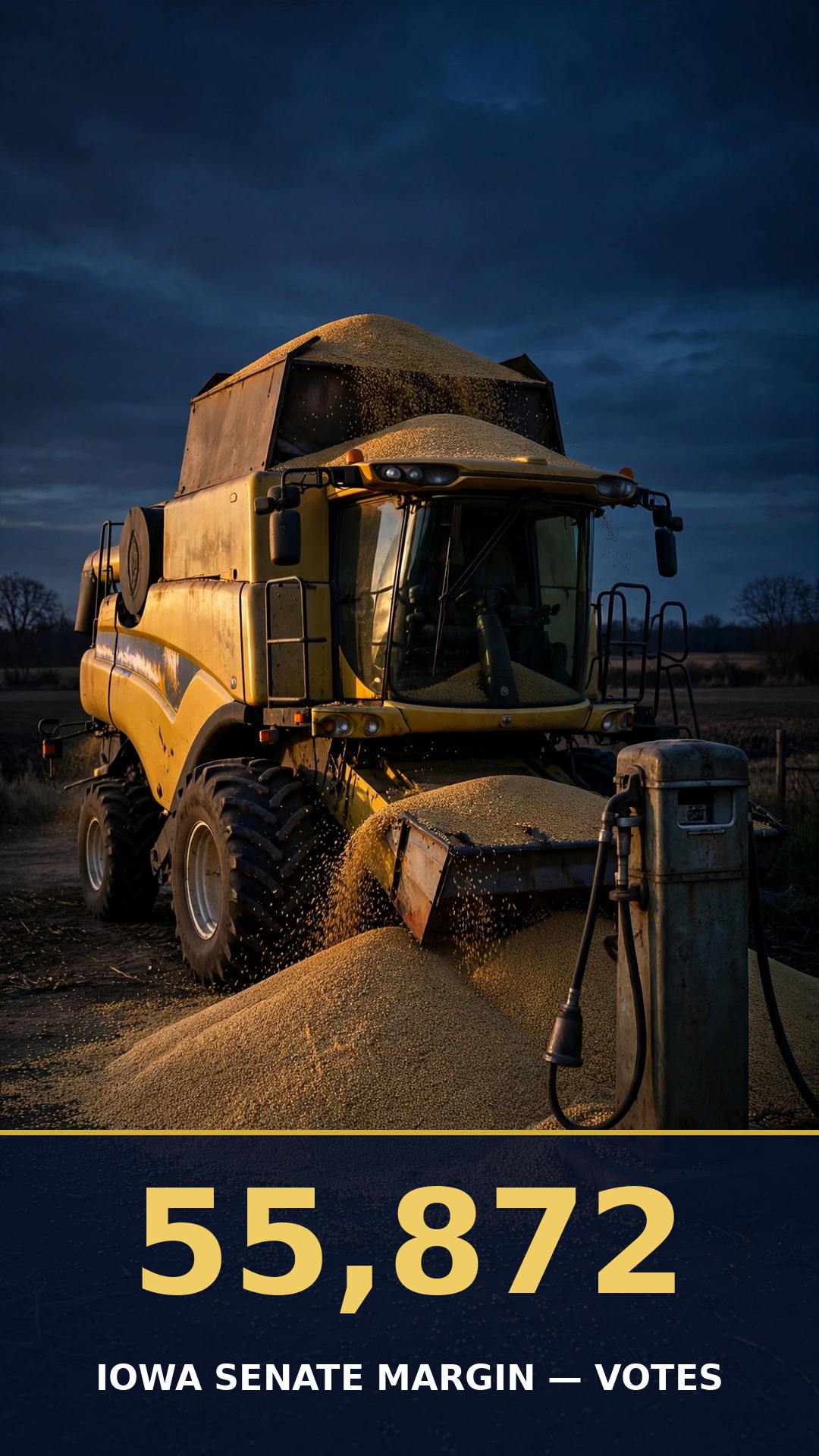
The result. Democrat Josh Turek defeated Republican Rep. Ashley Hinson for the open seat of retiring Sen. Joni Ernst. AP results: Turek 686,487 votes — Hinson 630,615, a margin of 55,872 votes. AP called the race at 11:35 p.m. ET on November 3 — the call that clinched the Senate majority for Democrats (AP; Reuters).
The first-since line that is verified. Turek is the first Democrat to win an Iowa Senate election since 2008, when Tom Harkin last won the state (AP; Reuters).
The cost side. USDA's September 2026 forecast put national farm production expenses at $492.8 billion, up 4.5% from 2025 — fertilizer, lime and soil conditioners up 15.3% to $39.6 billion, fuel and oils up 28.8% to $21.6 billion (USDA Economic Research Service, September 2026).
The revenue side. Turek campaigned on ending the tariffs, in his own words: "Our farmers don't want handouts — they want markets" (Turek, written answers to AgWeb / Farm Journal, October 15, 2026 — a candidate's claim, cited as such).
The date that matters next. The new Congress convenes January 3, 2027. From that day Democrats chair both Agriculture Committees. Committee control is agenda power — hearings, markups, oversight — not law. A Farm Bill, tariff relief and Medicaid restoration each still need 60 Senate votes and the President's signature, or a veto override Democrats do not have.
The result, in numbers#↑ Contents
This was an open seat. Sen. Joni Ernst, first elected in 2014, retired. Hinson, a sitting U.S. representative, ran as the Republican nominee with President Trump's backing. Turek ran as what Reuters described as a self-styled "prairie populist," campaigning on affordability and against corruption.
AP's results data (100% of precincts reporting, approximately 98.7% of the estimated vote) put the two-candidate count at:
- Turek (D): 686,487
- Hinson (R): 630,615
- Margin: 55,872 votes, about 4.2 points on the two-candidate count
A Libertarian candidate was also on the ballot, so full-field shares are lower than the two-candidate shares above. Results are unofficial until the Iowa canvass. The point that does not depend on the final decimal: this was a competitive race won by a clear, not a recount, margin — in a state Republicans had held in the Senate since Ernst's first win.
Reuters led its race report not with biography but with policy: Turek "campaigned on affordability and fighting corruption and criticized Hinson's support for Trump's 2025 tax law, which included Medicaid and food assistance cuts," and also campaigned on Iowa's high cancer rates and on lowering costs for farmers (Reuters, November 4, 2026).
Driver one: diesel at harvest#↑ Contents
Harvest is when a farm burns the most fuel in the shortest window, and it is not discretionary spending. A combine either runs or the crop stays in the field.
The national price on election week tells the timing story. EIA on-highway diesel averaged about $6.29 a gallon on November 3, and AAA put national average gasoline at $4.12 to $4.14 a gallon on November 3–4, against $3.05 for gasoline a year earlier (EIA; AAA). USDA's own forecast had already priced the squeeze in: fuel and oil costs for the farm sector up 28.8% in 2026, the largest percentage increase of any major expense line in the September forecast (USDA ERS).
Turek made that cost a direct charge against his opponent. In his written answers to AgWeb / Farm Journal's Ag Vote 2026 questionnaire, he said farmers were being "crushed by record-high diesel prices" at harvest, tied to the Iran war and to Hinson's votes in the House. The vote counts in that charge are the candidate's claim, and this article cites them as his claim, not as an independently verified roll-call tally. What is verified independently is the price level his voters were paying, above.
His stated remedies, from the same questionnaire: tap the Strategic Petroleum Reserve, pause diesel exports, and temporarily suspend the federal gas tax. Note the mechanics, because they matter for January: a Strategic Petroleum Reserve release is executive action — Congress cannot order it. A gas-tax suspension is a law — it needs the President's signature. Neither is delivered by a Senate seat on its own.
Driver two: tariffs and the soybean market#↑ Contents
If diesel was the cost side, tariffs were the revenue side.
Turek said ending the tariffs was a top priority because of the soybean market, and gave the campaign its most quoted farm line: "Our farmers don't want handouts — they want markets" (AgWeb, October 15, 2026). His further claim — that tariffs may have hurt Iowa more than any other state — is a comparative ranking no Tier 1 or Tier 2 state-by-state tariff-loss table in our research verified, and this article does not present it as one. It is his argument, and Iowa voters heard it as an argument.
What can be measured nationally and regionally is the scale of the market at stake. A North Dakota State University Trade Monitor study put lost U.S. agricultural export sales to China at $14.9 billion from March 2025 to February 2026, attributed to China's retaliatory tariffs — with soybeans the largest single commodity loss, at $6.8 billion, ahead of beef at $1.3 billion and cotton at $1.3 billion. Iowa is one of the states the study listed with the greatest exposure, at roughly $1.2 billion. Those are study figures, cited to the study — not a claim that tariffs alone explain a 55,872-vote margin. No exit-poll analysis in our sources isolates the farmer share of Turek's vote, and this article does not invent one.
The supporting stress data is consistent with a squeeze, not a collapse, and the distinction matters. Chapter 12 farm bankruptcies nationally reached 315 filings in 2025, up 46% from 216 in 2024, the third consecutive annual increase (American Farm Bureau Federation analysis of U.S. Courts data). USDA forecasts net farm income at $158.4 billion in 2026, down 2.6% nominally and down 5.5% after inflation — and that income figure is reached with direct government payments forecast at $47.4 billion, up 69.8% from 2025 (USDA ERS, September 2026). In the terms of Turek's own line: market income fell, government payments rose to fill part of the gap, and the candidate who said farmers wanted markets instead won.
Driver three: rural healthcare#↑ Contents
Reuters identified the third driver itself. Hinson's support for the 2025 tax law, with its Medicaid and food assistance cuts, was a central Turek attack, and he paired it with Iowa's cancer rates and rural hospital costs.
The market corroborated the salience on election night rather than the rhetoric: Medicaid-focused insurers and hospital stocks rose 3% to 8% after the results, on investor expectations that a Democratic Congress could delay provisions of the 2025 law expected to reduce Medicaid enrolment (Reuters, November 4, 2026). That is an expectation trade, not enacted policy — the same Reuters reporting noted analysts expect major healthcare change to remain unlikely under a veto threat.
This driver is also personal to the winner in a way voters could verify without a fact-checker: Turek was born with spina bifida and is a two-time Paralympic gold medallist in wheelchair basketball (Reuters). His healthcare platform — restore Medicaid funding, protect Affordable Care Act subsidies, support rural hospitals — was presented as biography as well as policy.
What Turek actually promised farmers#↑ Contents
From his AgWeb / Farm Journal answers and his campaign platform, stated as promises, not outcomes:
- A Farm Bill first. He called a new Farm Bill "three years overdue," named it his top priority, and proposed a provision barring Congress from adjourning until one passes. Inside it: nationwide year-round E15, Right to Repair, and mandatory country-of-origin labelling.
- End the tariffs, framed through the soybean market, above.
- Competition policy. Break up monopolies and vertical integration he said were squeezing family farms.
- A seat at the table. Both Turek and Hinson said during the campaign that they wanted Ernst's seat on the Senate Agriculture Committee (AgWeb, October 15, 2026).
What January 3 actually changes — and what it does not#↑ Contents
From January 3, 2027, Democrats chair both the Senate and House Agriculture Committees. That control is real and immediate: hearings, markups, oversight, subpoenas, and which farm bills reach the floor. The Senate majority also controls confirmations, including for USDA and trade leadership.
Two limits belong in the same paragraph as that power, because Iowa's voters will measure the new majority against a ledger, not a press release:
- The chair itself is not yet settled. Outgoing Senate Agriculture Ranking Member Amy Klobuchar won Minnesota's governorship and leaves the Senate. Reporting on her successor conflicts, and Democrats have not announced committee rosters. This article does not name a chair who has not been named.
- A law still needs more than a gavel. Ordinary legislation needs 60 Senate votes to break a filibuster, then the President's signature — or an override of 67 Senate votes and 290 House votes. At 53 to 55 Democratic Senate seats, an override is 12 to 14 Republican senators away. Reuters' post-election analysis makes the tariff point directly: Democratic efforts to limit presidential tariff power would be likely to face a presidential veto.
There is also a calendar trap. The 2018 Farm Bill's third one-year extension expired September 30, 2026; commodity and dairy support authority runs to December 31, 2026, with permanent 1930s–40s law as the backstop from January 1 (Congressional Research Service, updated September 23, 2026). The outgoing Congress, not Turek's, holds the pen for that December deadline. If a Farm Bill or extension is signed before January 3, the new Agriculture Committees inherit implementing it. If it is not, they inherit the cliff.
The fastest wins available without a signature are oversight of how USDA and the trade agencies execute existing programmes, confirmation leverage, and bargaining position in every must-pass bill — appropriations and the debt limit included. The test Turek set for himself on the campaign trail was narrower and harder: markets back, diesel down, a Farm Bill passed. That is the ledger this seat will be judged on in 2032, and it starts, mechanically, with a negotiation neither party can win alone.
Results are AP race calls and unofficial returns as of November 4–5, 2026; no result is certified, and final canvass figures can move margins. This article is for information and education only and is not investment advice.
Sources: Associated Press election results (Iowa, Race 17247) and race call, November 3–4, 2026; Reuters, "Democrat Josh Turek flips Republican-held US Senate seat in Iowa," November 4, 2026, and Reuters reporting on healthcare stocks, November 4, 2026; USDA Economic Research Service, Farm Sector Income Forecast, September 2026; U.S. Energy Information Administration weekly diesel data and AAA national averages, November 3–4, 2026; Congressional Research Service, Farm Bills: Major Legislative Actions, updated September 23, 2026; American Farm Bureau Federation, Chapter 12 analysis of U.S. Courts data, February 2026; North Dakota State University Trade Monitor, retrospective assessment of China's 2025/26 retaliatory tariffs; Josh Turek written answers, AgWeb / Farm Journal Ag Vote 2026, October 15, 2026 (candidate claims cited as claims).
Editorial note on a figure not used: a widely circulated figure for Iowa agricultural exports in 2024 ($13.7 billion) reached our research only through secondary reporting of USDA / USTR data and was not verified against the primary USTR state fact sheet in this pass. It is therefore not used as a fact in this article.
AI disclosure. This article was researched and drafted with the help of Muse (Meta AI). Figures are taken from the Tier 1 and Tier 2 sources cited above; candidate statements are labelled as claims, and figures that could not be verified against a primary source were left out. The analysis and conclusions are Financial Gurkha's.