Disclaimer: This article is for educational purposes only and is not investment advice. Trading and investing are subject to volatility and market risk, including partial or entire loss of capital. Please consult your financial advisor before making investment decisions. Financial Gurkha and its writers are not liable for your losses, nor do we take credit for your gains. FinancialGurkha.com and its authors assume no liability for financial outcomes. The author does not hold any position in any of the assets mentioned in the article.
AI disclosure This article was researched and drafted with the help of Muse, an AI model made by Meta. All figures were checked against the cited sources, and the analysis and conclusions are Financial Gurkha's. Financial Gurkha ensures the article is objective and factual.
Financial Gurkha | New York City | November 23, 2026
Anthropic (Nasdaq: ANT) completed the largest IPO in history on November 19, 2026: 980 million shares at $83, an $81.3 billion raise, a first trade at $111.50 and a day-one close at $97.17. Four days later the stock trades in the high $80s, and the question hanging over it is no longer the offering. It is the other 15.5 billion shares.
Only about 7 percent of Anthropic actually changed hands in the IPO. The rest — held by Amazon, Google, the seven co-founders, employees and early investors — sits behind a lockup unlike any a major IPO has used before: not one cliff at 180 days, but a calendar of 23 separate release dates running from the first trading day to November 2027, verified below against the final prospectus (Form 424B4, dated November 18, 2026). This report is the map: who owns what, who actually controls the company, and exactly when each block of supply becomes free to sell.
What's in this report#
- The short version: the five numbers that frame the next year of ANT trading
- Who owns what: Amazon, Google, the founders, the benefit fund and the public
- Ownership is not control: the Class F and Class T shares
- How the lockup works: three layers and four holder groups
- The 23-date release calendar, with running totals
- The two extra valves: hedging from day 195 and the greenshoe
- What this does to the float
- Does the stock really fall into lockup expiry?
- How Anthropic compares with a typical IPO and with SpaceX
- What we could not confirm from the filing
- Frequently asked questions
- Sources
The short version#↑ Contents
- 13.22 billion shares exist after the IPO and the concurrent private placement: 7,583,103,996 Class A and 5,636,538,278 Class N, plus one Class F share and one Class T share.
- The public bought 980 million shares (7.4 percent). A further 313,253,007 Class N shares were sold in a $26.0 billion private placement to seven strategic buyers — and those shares carry no lockup at all, only resale restrictions.
- The restricted pool behind the calendar is about 15.5 billion shares. The count is larger than the shares outstanding because it includes shares issuable from options, RSUs and convertible notes.
- Releases start immediately: up to 315 million shares were eligible to sell on the first trading day. By February 2, 2027, up to 1.63 billion restricted shares can have been released.
- The two biggest single steps come after the full-year 2026 results (up to 1.7 billion shares) and at the earlier of the Q1 2027 results or day 180 (up to 3.0 billion shares).
- Control sits in two single shares: the founders' Class F share carries 50.1 percent of the votes on general matters, and the Long-Term Benefit Trust's Class T share elects the majority of the board.
Who owns what#↑ Contents
The prospectus names the two giants directly. As of September 30, 2026, after the preferred conversion and the convertible notes conversion, Amazon and Google held the following Class N stakes:
| Holder | Shares | Stake in the company | Votes | Lockup status |
|---|---|---|---|---|
| Amazon | 1,936,452,353 Class N | 14.6% | None (Class N) | Not named by group in the filing — see the note below |
| 1,774,959,745 Class N | 13.4% | None (Class N) | 120 million placement shares carry no lockup; the rest is not named by group | |
| Seven co-founders (combined) | About 1.67 billion Class A | About 12.7% | Via Class A plus the Class F share | Longest schedule — up to 29 percent can free at the day-180 step, the rest by day 365 |
| Anthropic Public Benefit Fund | 846,840,960 Class N | 6.4% | None (Class N) | Issued at the IPO in the Initial Public Benefit Issuance |
| IPO buyers (the public) | 980 million Class A | 7.4% | 1 per share | Freely tradable |
| Private placement buyers (besides Google) | About 193 million Class N | About 1.5% | None (Class N) | No contractual lockup; restricted securities resalable only under an exemption such as Rule 144 |
| Everyone else — employees, funds, early investors | The remainder, about 5.8 billion | About 44% | Mixed | Staggered schedules below |
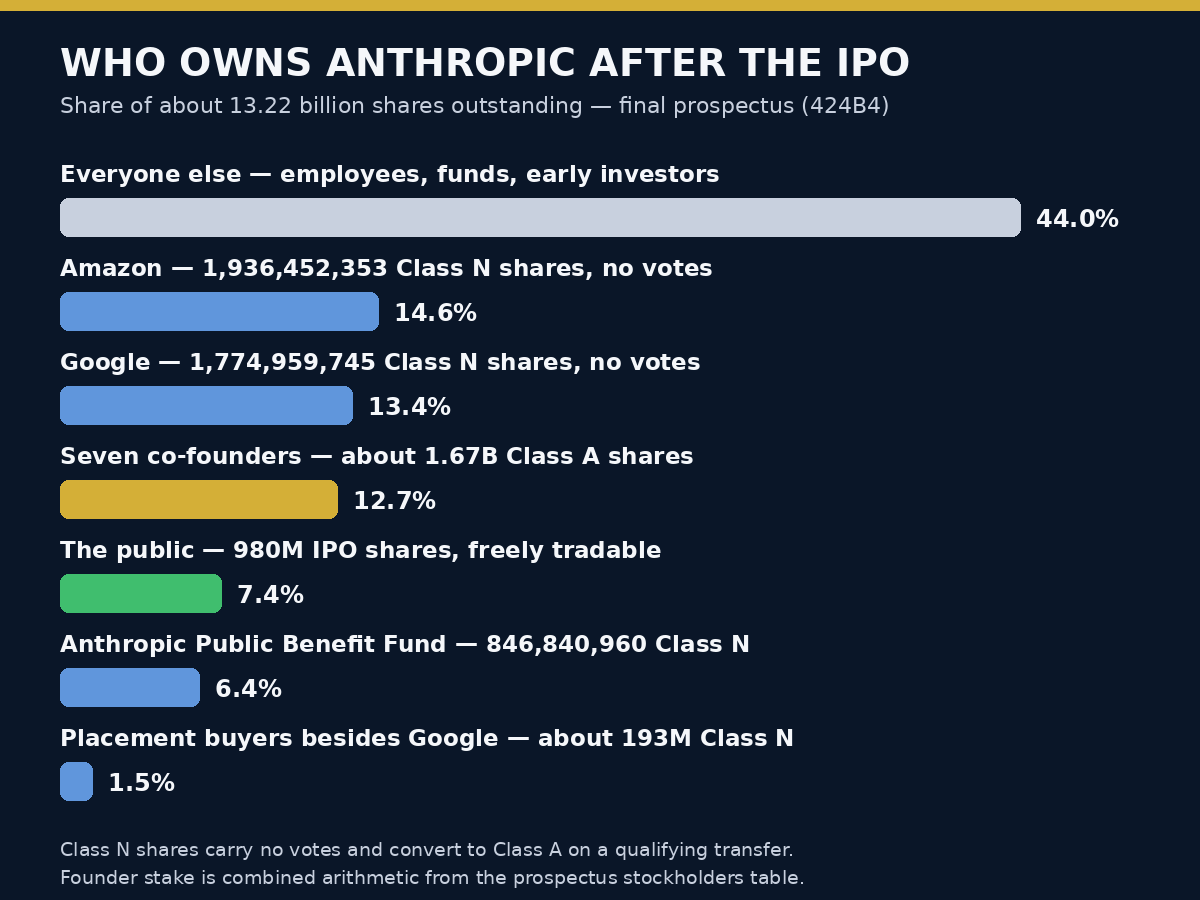
Four details from the filing matter more than the table:
The co-founders were the only sellers in the IPO. The company sold 956,351,354 new shares; the selling stockholders sold 23,648,646 — and every one of those came from the seven co-founders, exactly 3,378,378 shares each. Dario Amodei holds 241,880,722 shares after the offering and Daniela Amodei 238,030,562, per the stockholders table.
Amazon could end up with far more. Amazon's remaining convertible notes convert over time subject to an ownership cap that Amazon elected not to waive. The filing states that if the Amazon notes were converted in full without the cap, Amazon would hold 3,484,128,662 Class N shares — 48.5 percent of the entire Class N class.
The placement money was strategic, not financial. The $26.0 billion concurrent placement went to Google, NVIDIA, AMD, Broadcom, Micron, Microsoft and TSMC Partners at the same $83 price — reported commitments of $10 billion each from NVIDIA and Google, $2.5 billion from AMD, $1 billion each from Broadcom, Micron and Microsoft, and $500 million from TSMC. These are Anthropic's compute suppliers and cloud partners buying a seat inside the cap table.
The venture firms are smaller than the story suggests. Press reports before the IPO put Lightspeed at about 2 percent and Iconiq at about 1.5 to 2 percent. The strategic holders and the founders dominate; the classic Sand Hill Road syndicate does not.
One honest note on the two giants: the prospectus assigns lockup schedules by holder group, not by name, and the sections we reviewed do not state which group Amazon's and Google's pre-IPO shares sit in. Their size — both held more than 0.5 percent before the offering — points to the longest, 365-day group, but treat that as inference, not filing fact.
Ownership is not control#↑ Contents
Anthropic's share classes separate money from power almost completely:
| Class | Who holds it | Votes | Economics |
|---|---|---|---|
| Class A | The public, founders, employees | 1 per share | Full |
| Class N | Amazon, Google, placement buyers, the benefit fund | None | Full — converts to Class A on a qualifying transfer |
| Class F | Founder LLC (the seven co-founders) | 50.1% of total voting power on general matters, including electing directors other than the Class T directors | None |
| Class T | Long-Term Benefit Trust | Elects a majority of the board | None |
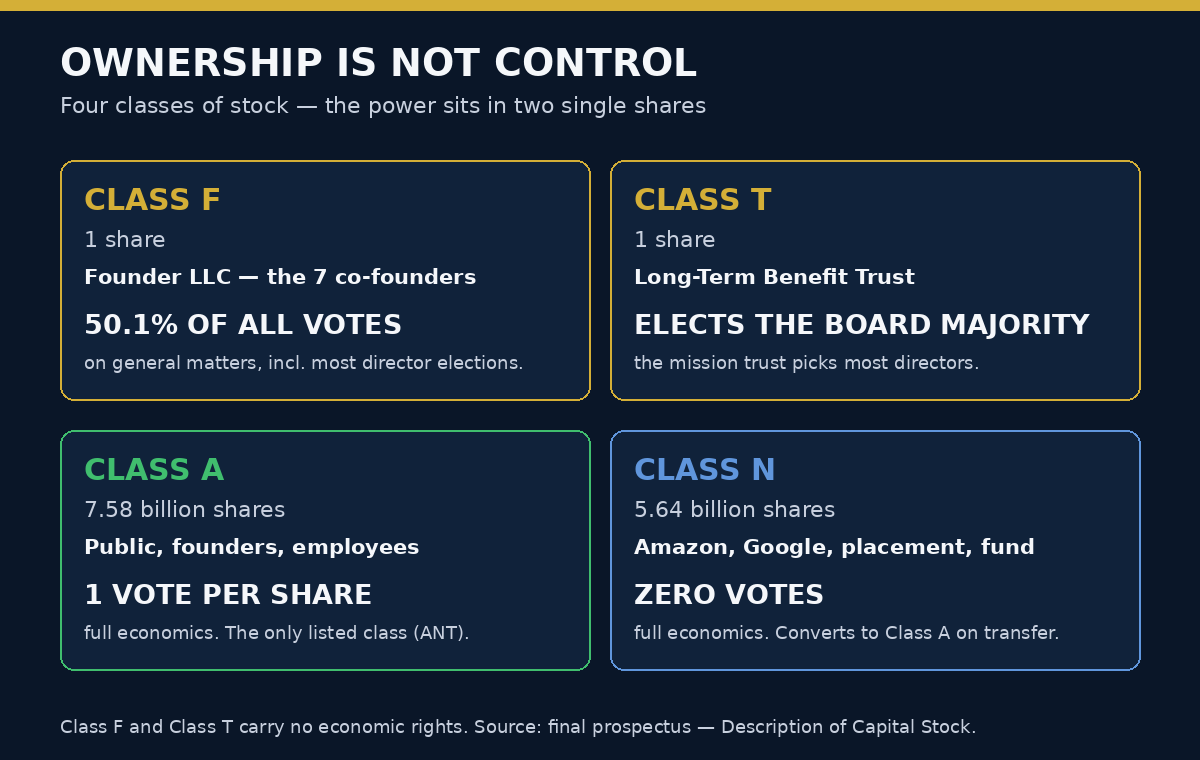
Read that table slowly. The founders can lose economic ground for a year of unlocks and still hold a voting majority on shareholder matters through a single share with no economic rights at all. The board itself answers to the Long-Term Benefit Trust, a body designed to represent the company's public-benefit mission over decades. And the two largest economic owners — Amazon at 14.6 percent and Google at 13.4 percent — hold shares with zero votes. If they ever sell to an unaffiliated buyer, the Class N shares convert into voting Class A on transfer; while they hold, they are silent partners with enormous exposure.
The founders' much-publicized pledge to dedicate 80 percent of their personal equity to philanthropy appears in the filing with its own caveat, in the prospectus's words: the commitments are "voluntary, revocable expressions of each co-founder's philanthropic intent and do not constitute legally binding obligations." Do not model it as a limit on future selling.
How the lockup works: three layers, four groups#↑ Contents
A lockup is a promise not to sell. Anthropic stacks three kinds of restraint:
- Contractual lockups with the underwriters and market standoff agreements with the company — the filing treats them as one system of "timed automatic expirations." No step depends on the share price; the releases are calendar- and earnings-driven only.
- Holder-group end dates. Non-founder directors, officers, employees and consultants are locked until the earlier of the Q1 2027 results (plus two trading days) or day 180. One group of holders of about 2.7 billion shares shares that end date. A larger group holding about 8.0 billion shares, and the seven co-founders, run to the earlier of the Q3 2027 results or day 365.
- Legal limits that outlast the lockup. Affiliates selling under Rule 144 are capped in any three-month period at the greater of 1 percent of the Class A outstanding — 75,831,040 shares on the post-IPO count — or average weekly trading volume. The placement shares, though unlocked, are restricted securities that can only be resold under an exemption or a registration statement; Google negotiated registration rights for its placement shares.
Within those end dates, shares free up in the fixed steps of the calendar below. Non-founder directors and officers — including the Chief Financial Officer and the Chief Accounting Officer — were eligible to sell from the first trading day.
The 23-date release calendar#↑ Contents
The table below is the final prospectus's own schedule (pages 318–319), with running totals we computed from its figures. Amounts are ceilings — "up to" — not predictions. Dates tied to earnings releases are estimates; Anthropic has not announced its reporting calendar.
| # | Trigger | Approx. date | Up to (shares) | Running total |
|---|---|---|---|---|
| 1 | First trading day | Nov 19, 2026 — passed | 315 million | 315 million |
| 2 | Day 27 | Dec 15, 2026 | 303 million | 618 million |
| 3 | Day 48 | Jan 5, 2027 | 303 million | 921 million |
| 4 | Day 62 | Jan 19, 2027 | 353 million | 1.27 billion |
| 5 | Day 76 | Feb 2, 2027 | 353 million | 1.63 billion |
| 6 | 2nd trading day after full-year 2026 results | Est. Feb–Mar 2027 | 1.7 billion | 3.33 billion |
| 7–11 | Days 13, 27, 41, 55, 69 after those results | Est. Mar–May 2027 | 480 million each (2.4 billion) | 5.73 billion |
| 12 | Earlier of Q1 2027 results or day 180 | By May 17, 2027 | 3.0 billion | 8.73 billion |
| 13–16 | Days 34, 48, 62, 76 after Q1 results | Est. Jun–Aug 2027 | 447 million each (1.79 billion) | 10.52 billion |
| 17 | 2nd trading day after Q2 2027 results | Est. Aug 2027 | 558 million | 11.07 billion |
| 18–22 | Days 27, 41, 55, 69, 83 after Q2 results | Est. Sep–Nov 2027 | 502 million each (2.51 billion) | 13.58 billion |
| 23 | Earlier of Q3 2027 results or day 365 | By Nov 18, 2027 | 1.9 billion | 15.48 billion |
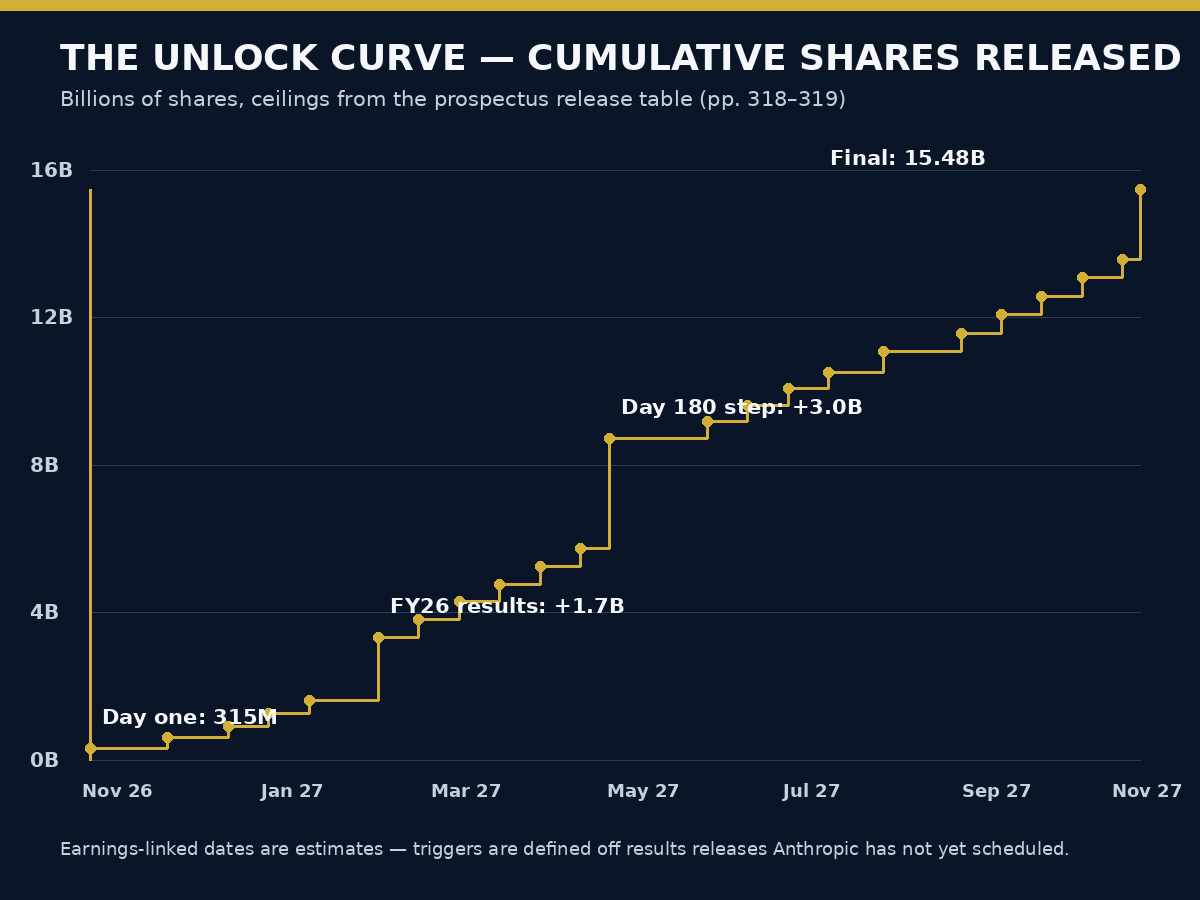
At the $83 IPO price, the day-one tranche alone represents about $26 billion of stock; the first five tranches, through February 2, about $135 billion. The shape is the story: a steady drip of 300–500 million shares every two to three weeks, punctuated by three earnings-linked steps of 1.7, 3.0 and 1.9 billion.
Who frees up when, in plain terms. Employees, officers and non-founder directors: up to 10 percent from day one, up to another 35 percent after the full-year results, and the rest at the day-180 step. Other pre-IPO holders free in the small fixed steps of days 27 through 76, then in earnings-linked steps. The largest holders and the co-founders run longest: the founders can sell up to 29 percent at the day-180 step, with the balance held to the day-365 step.
The two extra valves#↑ Contents
Hedging from day 195. The lockup agreements carve out one exception with real market weight: on or after the 195th day after the prospectus date — about June 1, 2027 — certain stockholders may enter hedging transactions on up to 20 percent of their still-locked shares, about 719 million shares in aggregate, per the filing. Hedging is not selling, and the shares do not trade. But a holder who has hedged has already laid off the economic risk, and the counterparty on the other side of that hedge typically shorts stock to stay neutral. Pressure can arrive before the shares do.
The greenshoe. The underwriters hold an option to buy up to 147 million additional shares from the company at $83 — new supply that adds directly to the tradable float if exercised.
What this does to the float#↑ Contents
Add the IPO shares to the released restricted stock and the tradable ceiling grows like this:
| Point | Shares eligible to trade (ceiling) | Multiple of the IPO shares |
|---|---|---|
| At pricing (IPO shares only) | 980 million | 1.0× |
| Day one (plus first tranche) | About 1.30 billion | 1.3× |
| Feb 2, 2027 (after five tranches) | About 2.61 billion | 2.7× |
| Day-180 step (May 2027) | About 9.71 billion | 9.9× |
| Final step (Nov 2027) | About 16.46 billion | 16.8× |
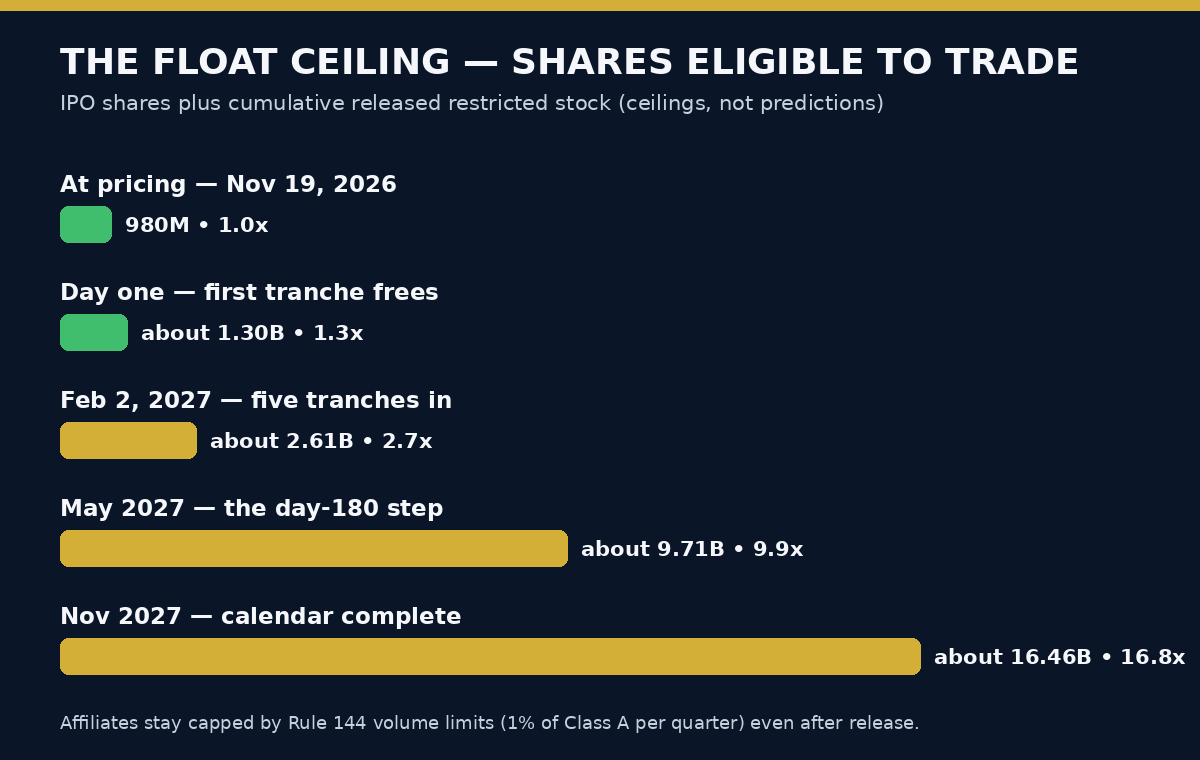
Two cautions belong with that table. First, ceilings are not flows: most holders in most IPOs do not sell the day they are allowed to, strategic holders like Amazon and Google hold for reasons beyond price, and affiliates remain bound by the Rule 144 volume caps after their lockups lapse. Second, the market knows every date on this page. Known supply tends to be priced before it arrives — which cuts both ways, as the next section covers.
Does the stock really fall into lockup expiry?#↑ Contents
The academic record on lockup expiries finds a modest average dip around expiration dates — a few percent, concentrated in the days around the event — not a mechanical crash, with wide variation by company. Three features of this calendar argue for treating each date as weather, not climate:
- There is no single cliff to front-run. Twenty-three releases spread the supply decision across a year. No one morning delivers the whole overhang.
- The big steps are earnings-linked. The 1.7 billion and 3.0 billion share tranches free two trading days after results, when the market has just repriced the company on fresh numbers anyway. Supply and information arrive together.
- The first week already showed the pattern. ANT closed day one at $97.17, then fell 8.5 percent on Friday, November 20 to a settled close of $88.91, touching $83.05 — five cents above the IPO price — intraday. That slide came with a day-one insider tranche of 315 million shares eligible and, just as plausibly, with the worst week for US stocks since March 2020 happening around it. Attribution is impossible; both forces were in the tape. On Monday, November 23, ANT options began trading — and the stock sat roughly flat near $88–89 even as Nvidia jumped about 33 percent on Jensen Huang's reinstatement. The unlock calendar is a headwind with dates attached, not a verdict.
Dates worth watching: December 15, 2026 (the first post-IPO release, 303 million shares), the full-year 2026 results (1.7 billion), and the day-180 step in May 2027 (3.0 billion, and the first founder eligibility beyond the IPO sale itself).
How Anthropic compares#↑ Contents
| Company | Lockup design | What happened / what to know |
|---|---|---|
| Typical IPO | One cliff at 180 days | The entire insider block frees on one morning |
| Uber (2019) | Standard single expiry | The stock hit an all-time low on its expiration date, about 40 percent below its IPO price |
| Snowflake, Airbnb, DoorDash, Reddit | Shortened and/or staggered | Snowflake still fell about 11 percent in the week of its final expiry — staggering softens the blow, it does not remove it |
| SpaceX (2026) | Staggered, about nine expiry periods; Musk's shares locked 366 days with no early release; first expiry let insiders sell up to 20 percent | A Morgan Stanley analyst called the expiries "largely a non-event"; a price-based bonus release (10 percent more if the stock rose 30 percent) did not trigger |
| Anthropic (2026) | 23 release dates over about a year; no price triggers; first release on day one | Founders locked to day 365, but up to 29 percent can free at about day 180 |
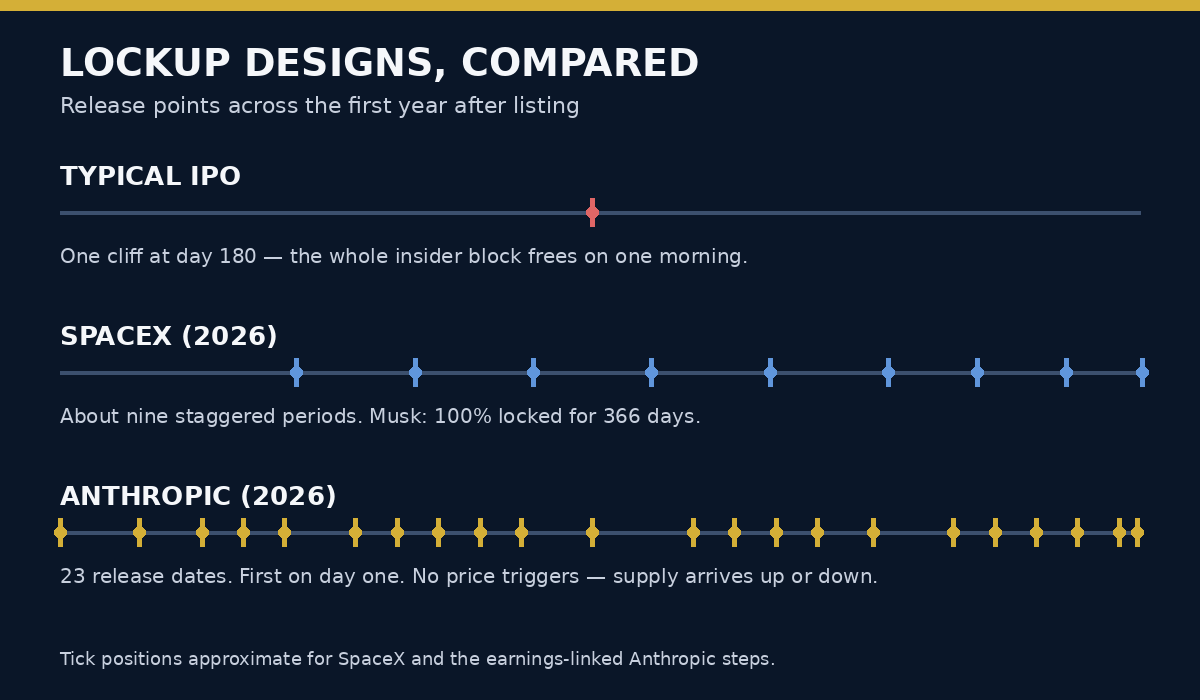
The differences that matter:
- More dates, smaller steps. Business Insider counted fewer than ten expiry dates for SpaceX, itself considered unusually granular. Anthropic has 23.
- Earlier supply. Anthropic insiders could sell from the first trading day. SpaceX's first release waited for its first earnings report.
- No price triggers. SpaceX tied a bonus release to the stock rising. Anthropic's calendar ignores price entirely — supply arrives in a rally or a rout.
- Founders are not locked as tightly as Musk. Musk held 100 percent for 366 days. Anthropic's co-founders can free up to 29 percent at about day 180 — though their Class F voting control never expires with any lockup.
- The strategic holders are the float question. Amazon and Google together hold about 28 percent of the company in non-voting shares. Their eventual decisions — hold, hedge after day 195, or sell into registration — matter more than any single calendar date.
What we could not confirm#↑ Contents
In the spirit of the filing itself, the open items: the prospectus groups holders by schedule rather than naming Amazon's and Google's pre-IPO shares into a specific group, so their exact end date is inference from their size, not a stated fact. Earnings dates for 2027 are estimates — the triggers are defined relative to results releases the company has not yet scheduled. Per-buyer placement amounts are the reported commitments; the filing confirms the buyers, the $26.0 billion total and the 313,253,007 shares. And the release figures are ceilings from the prospectus table — actual sales will be visible only as they happen, in Form 144 filings and insider reports.
Frequently Asked Questions#↑ Contents
When is the Anthropic lockup expiry? There is no single date. The final prospectus sets 23 release dates from the first trading day (November 19, 2026) to the earlier of the Q3 2027 results or day 365 (by November 18, 2027). The next release is December 15, 2026, when up to 303 million shares free up.
How many ANT shares are locked up? About 15.5 billion shares sit in the restricted pool covered by the release calendar, including shares issuable from options, RSUs and convertible notes. Shares outstanding after the IPO and placement total about 13.22 billion, of which the public bought 980 million (7.4 percent).
Who owns the most Anthropic stock? Amazon, with 1,936,452,353 Class N shares (14.6 percent of the company), followed by Google with 1,774,959,745 (13.4 percent). Both hold non-voting shares. The seven co-founders together hold about 1.67 billion Class A shares, and the Anthropic Public Benefit Fund holds 846,840,960 Class N shares.
Who controls Anthropic? Two single shares. The founders' Class F share carries 50.1 percent of the voting power on general shareholder matters, and the Long-Term Benefit Trust's Class T share elects a majority of the board. Amazon and Google, the largest economic owners, have no votes at all while they hold Class N shares.
Can insiders sell before day 180? Yes — that is the point of this calendar. Up to 315 million shares were eligible on day one, further tranches free on days 27, 48, 62 and 76, and a 1.7 billion share step follows the full-year 2026 results. Affiliates remain subject to Rule 144 volume limits (1 percent of the Class A, or 75,831,040 shares, per three months) even after their lockup ends.
What happens on day 195? From about June 1, 2027, certain stockholders may hedge up to 20 percent of their still-locked shares — about 719 million shares in aggregate, per the prospectus. Hedging does not put shares on the market directly, but it transfers economic exposure and can create short-side pressure through dealer hedging.
This article is written in collaboration with Muse by Meta. Try it today: redeem my code 5PLTO0 in Settings within 48 hours of joining and we'll both get 1 billion Muse tokens.
Sources#↑ Contents
- Anthropic, PBC — Final Prospectus (Form 424B4), dated November 18, 2026, SEC EDGAR: offering terms (cover and summary), Principal and Selling Stockholders (p. 297), Shares Eligible for Future Sale including the release table and lock-up groups (pp. 317–322), Description of Capital Stock (Class F, Class T, Class N conversion). https://www.sec.gov/Archives/edgar/data/2130357/000162828026074944/anthropicpbc-424b4.htm
- Financial Gurkha — "Anthropic Prices Tonight: The Dates, the Allotments, and the Figma Lesson," November 18, 2026 (offering structure and allotment background).
- Financial Gurkha — "Anthropic Falls Back Toward Its $83 IPO Price as AI Selloff Hits Seventh Day," November 20, 2026, and "Nvidia Reinstates Jensen Huang as CEO," November 23, 2026 (trading context).
- Finnhub — ANT session data: November 19 close $97.17; November 20 close $88.91 (low $83.05); November 23 intraday.
- Pre-IPO press reporting on venture-holder stakes (Lightspeed, Iconiq) and SpaceX lockup comparisons, as cited in the research packet: Business Insider, Fortune, Nasdaq/Motley Fool, MarketWatch/Morningstar coverage.